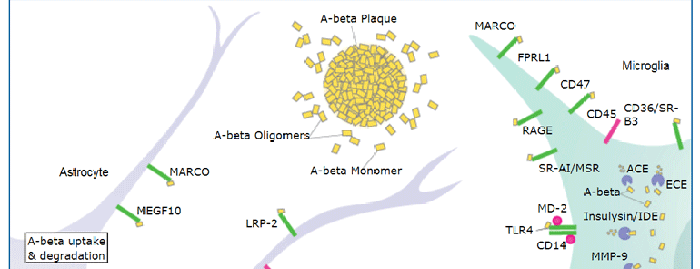
The scavenger receptor (SR) family comprises a group of functionally defined membrane receptors that share the common ability to bind and internalize modified forms of Low Density Lipoproteins (mLDL) (1‑3). Family members are classified alphabetically. The A class include four proteins: the three subtypes of SR-A (AI, AII, and AIII) that are generated by alternative splicing of the same gene, and a structurally similar protein named MARCO (4). All A class SRs are multidomain trimeric type II membrane proteins. SR-AI has an N-terminal cytoplasmic domain, a transmembrane domain, a spacer domain, an alpha -helical coiled coil, a collagen-like domain and a C-terminal cysteine-rich domain. SR-A is expressed by most tissue macrophages, dendritic cells and Kupffer cells. It is also highly expressed by microglia in neonatal as well as Alzheimer’ Disease brains. SR-AI binds a broad range of polyanionic ligands including modified proteins (e.g. Oxidized, acetylated or maleylated LDL, Advanced glycation end-product proteins), polyribonucleotides (polyguanosine and polyinosine), polysaccharides (dextran sulfate, fucoidan), phospholipids (phosphatidylserine), bacterial products (lipopolysaccharide and lipoteichoic acid) and selected chemical compounds (silica, crocidolite asbestos). The ligand-binding region has been localized to a positively charged region in the carboxyl end of the collagen-like domain. Based on its ligand binding characteristics, SR-AI is implicated in many physiological and pathophysiological functions. Studies using SR-A knockout mouse have also suggested roles of SR-A in atherogenesis, host defense and innate immunity, acquired immune responses, macrophage adhesion, and phagocytosis of apoptotic cells (1‑3).
Mouse SR-AI/MSR Antibody (268318) [PE]
R&D Systems | Catalog # FAB1797P

Key Product Details
Species Reactivity
Applications
Label
Antibody Source
Product Specifications
Immunogen
Trp79-Ser454
Accession # AAA39747
Specificity
Clonality
Host
Isotype
Scientific Data Images for Mouse SR-AI/MSR Antibody (268318) [PE]
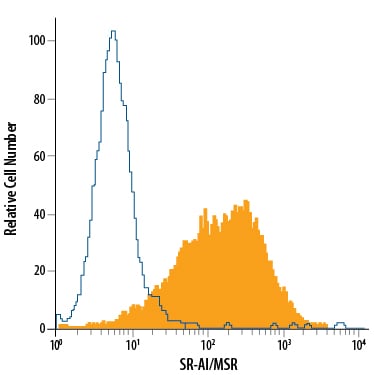
Detection of SR‑AI/MSR in RAW 264.7 Mouse Cell Line by Flow Cytometry.
RAW 264.7 mouse monocyte/macrophage cell line was stained with Rat Anti-Mouse SR-AI/MSR PE-conjugated Monoclonal Antibody (Catalog # FAB1797P, filled histogram) or isotype control antibody (Catalog # IC013P, open histogram). View our protocol for Staining Membrane-associated Proteins.Applications for Mouse SR-AI/MSR Antibody (268318) [PE]
Flow Cytometry
Sample: RAW 264.7 mouse monocyte/macrophage cell line
Spectra Viewer
Plan Your Experiments
Use our spectra viewer to interactively plan your experiments, assessing multiplexing options. View the excitation and emission spectra for our fluorescent dye range and other commonly used dyes.
Spectra Viewer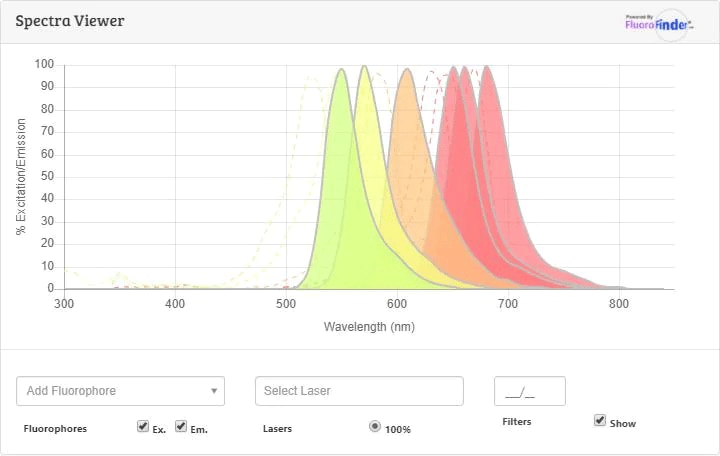
Flow Cytometry Panel Builder
Bio-Techne Knows Flow Cytometry
Save time and reduce costly mistakes by quickly finding compatible reagents using the Panel Builder Tool.
Advanced Features
- Spectra Viewer - Custom analysis of spectra from multiple fluorochromes
- Spillover Popups - Visualize the spectra of individual fluorochromes
- Antigen Density Selector - Match fluorochrome brightness with antigen density

Formulation, Preparation, and Storage
Purification
Formulation
Shipping
Stability & Storage
- 12 months from date of receipt, 2 to 8 °C as supplied.
Background: SR-AI/MSR
References
- Daugherty, A. et al. (2000) Curr. Opin. Cardiovasc. Pulm. Ren. Invest. Drugs 2:223.
- Platt, N. and S. Gordon (2001) J. Clin. Invest. 108:649.
- Platt, N. and S. Gordon (1998) Chem. Biol. 5:R193.
- Elomaa, O. et al. (1995) Cell 80:603.
Long Name
Alternate Names
Gene Symbol
UniProt
Additional SR-AI/MSR Products
Product Documents for Mouse SR-AI/MSR Antibody (268318) [PE]
Certificate of Analysis
To download a Certificate of Analysis, please enter a lot or batch number in the search box below.
Note: Certificate of Analysis not available for kit components.
Product Specific Notices for Mouse SR-AI/MSR Antibody (268318) [PE]
For research use only
Related Research Areas
Customer Reviews for Mouse SR-AI/MSR Antibody (268318) [PE]
There are currently no reviews for this product. Be the first to review Mouse SR-AI/MSR Antibody (268318) [PE] and earn rewards!
Have you used Mouse SR-AI/MSR Antibody (268318) [PE]?
Submit a review and receive an Amazon gift card!
$25/€18/£15/$25CAN/¥2500 for a review with an image
$10/€7/£6/$10CAN/¥1110 for a review without an image
Submit a review
Protocols
Find general support by application which include: protocols, troubleshooting, illustrated assays, videos and webinars.
- 7-Amino Actinomycin D (7-AAD) Cell Viability Flow Cytometry Protocol
- Extracellular Membrane Flow Cytometry Protocol
- Flow Cytometry Protocol for Cell Surface Markers
- Flow Cytometry Protocol for Staining Membrane Associated Proteins
- Flow Cytometry Staining Protocols
- Flow Cytometry Troubleshooting Guide
- Intracellular Flow Cytometry Protocol Using Alcohol (Methanol)
- Intracellular Flow Cytometry Protocol Using Detergents
- Intracellular Nuclear Staining Flow Cytometry Protocol Using Detergents
- Intracellular Staining Flow Cytometry Protocol Using Alcohol Permeabilization
- Intracellular Staining Flow Cytometry Protocol Using Detergents to Permeabilize Cells
- Propidium Iodide Cell Viability Flow Cytometry Protocol
- Protocol for Liperfluo
- Protocol for the Characterization of Human Th22 Cells
- Protocol for the Characterization of Human Th9 Cells
- Protocol: Annexin V and PI Staining by Flow Cytometry
- Protocol: Annexin V and PI Staining for Apoptosis by Flow Cytometry
- Troubleshooting Guide: Fluorokine Flow Cytometry Kits
- View all Protocols, Troubleshooting, Illustrated assays and Webinars
Associated Pathways