
NF-H Antibody (9B12) - BSA Free
Novus Biologicals | Catalog # NBP1-05210

![Western Blot: NF-H Antibody (9B12) [NBP1-05210]](https://resources.rndsystems.com/images/products/NF-H-Antibody-9B12-Western-Blot-NBP1-05210-img0006.jpg "Western Blot: NF-H Antibody (9B12) [NBP1-05210]")
Scientific images may be resized, cropped, or adjusted for brightness or contrast for presentation purposes. These updates are limited to presentation and do not affect the underlying scientific interpretation of the data. Where available, additional source data may be provided upon request.
Key Product Details
Species Reactivity
Validated:
Cited:
Applications
Validated:
Cited:
Label
Antibody Source
Format
Product Specifications
Immunogen
Marker
Clonality
Host
Isotype
Theoretical MW
Disclaimer note: The observed molecular weight of the protein may vary from the listed predicted molecular weight due to post translational modifications, post translation cleavages, relative charges, and other experimental factors.
Scientific Data Images for NF-H Antibody (9B12) - BSA Free
Western Blot: NF-H Antibody (9B12) [NBP1-05210]
Western Blot: NF-H Antibody (9B12) [NBP1-05210] - Analysis of different tissue lysates using mouse mAb to NF-H, dilution 1:10000 (Green): [1] protein standard, [2] rat spinal cord [3] mouse spinal cord, and [4] cow spinal cord. Strong band at about 200-220kDa corresponds to the major phosphorylated form of the NF-H subunit. Smaller proteolytic fragments of NF-H are also detected in some preparations.![Immunocytochemistry/ Immunofluorescence: NF-H Antibody (9B12) [NBP1-05210]](https://resources.rndsystems.com/images/products/NF-H-Antibody-9B12-Immunocytochemistry-Immunofluorescence-NBP1-05210-img0003.jpg "Immunocytochemistry/ Immunofluorescence: NF-H Antibody (9B12) [NBP1-05210]")
Immunocytochemistry/ Immunofluorescence: NF-H Antibody (9B12) [NBP1-05210]
Immunocytochemistry/Immunofluorescence: NF-H Antibody (9B12) [NBP1-05210] - Mixed neuron/glial cultures stained with NBP1-05210 (red) and rabbit GFAP antibody NB300-141 (green). Axonal profiles are stained in red, while astrocytic cells are revealed in green. Nuclei are revealed with a fluorescent DNA stain (blue).![Immunohistochemistry Free-Floating: NF-H Antibody (9B12) [NBP1-05210]](https://resources.rndsystems.com/images/products/NF-H-Antibody-9B12-Immunohistochemistry-Free-Floating-NBP1-05210-img0005.jpg "Immunohistochemistry Free-Floating: NF-H Antibody (9B12) [NBP1-05210]")
Immunohistochemistry Free-Floating: NF-H Antibody (9B12) [NBP1-05210]
Immunohistochemistry Free-Floating: NF-H Antibody (9B12) [NBP1-05210] - Analysis of a rat brain coronal section of the third ventricle stained with mouse monoclonal antibody to phosphorylated NF-H, dilution 1:5,000 (Green). Hoechst staining of nuclear DNA (Blue). Following transcardial perfusion with 4% paraformaldehyde, brain was post fixed for 24hrs, cut to 45uM, and free-floating sections were stained with above antibody. The antibody is a robust marker of the axons of neuronal cells.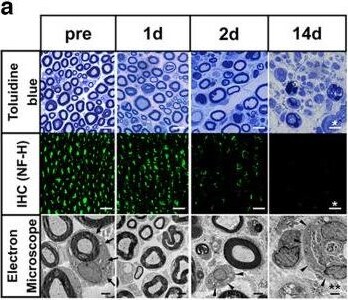
Immunocytochemistry/ Immunofluorescence: NF-H Antibody (9B12) - BSA Free [NBP1-05210] -
Wallerian degeneration and mitochondrial degeneration in axon for rat’s distal nerve stump. a, Representative images of toluidine blue staining, immunohistochemistry (NF-H), electron microscopy, before (pre) and 1, 2, and 14 d after axotomy. Immunohistochemistry was obtained the same results for three individuals. Scale bar, * 10 μm, ** 2 μm. Arrows, myelinated axon; arrowheads, demyelinated Schwann cell. b, Quantification of the myelinated axon. c, d, Quantification of the G-ratio [c: cumulative G-ratio per individual, d: scatter plot, Spearman’s rank correlation coefficient and p values showing G-ratio of individual myelinated axons against axon diameter (n = 400)]. The histologic WD was observed significantly from 2 d after axotomy. In axons, before (pre) and 1 and 2 d after axotomy were evaluated, except for after 14 d with completely collapsed axon morphology (n = 4 rat per group). e, Representative images of mitochondrial findings, before (pre) and 1, 2, and 14 d after axotomy. Evaluation was performed in axons and Schwann cells separately. Scale bar, * 200 nm. f, Violin plot of mitochondrial diameter (nm; n = 200). Cumulative mitochondria diameter per individual are also shown (n = 4 rat per group). g, Quantitative analysis of atypical mitochondria (%; n = 4 rat per group). In axons, mitochondria were significantly degenerated from 1 d after axotomy, whereas in Schwann cells, mitochondria were not significantly degenerated until 14 d after axotomy. All histologic evaluations were performed 3 mm distal to the sectional end and corresponding uninjured nerve. Error bars indicate SD; *p < 0.05, ***p < 0.001, one-way ANOVA followed by the Tukey’s post hoc test (for comparison of axons and Schwann cells, respectively). Image collected and cropped by CiteAb from the following open publication (https://pubmed.ncbi.nlm.nih.gov/36894321), licensed under a CC-BY license. Not internally tested by Novus Biologicals.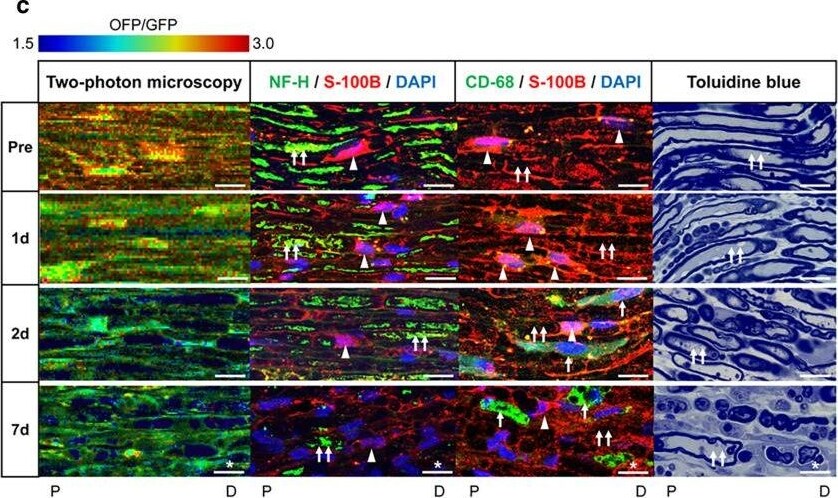
Immunocytochemistry/ Immunofluorescence: NF-H Antibody (9B12) - BSA Free [NBP1-05210] -
The gradual decrease of mice longitudinal nerve cross section ATP levels in the distal nerve stump, corresponds to histology. a, Representative ATP images in the longitudinal section before (pre) and 1, 2, and 7 d after axotomy. Scale bar, * 1 mm. P, proximal. D, distal. b, The change of ATP levels with measured ROIs (n = 6 mice per group). Distal nerve stump ATP levels were significantly decreased from 1 d after axotomy. Error bars indicate SD; **p < 0.01, ***p < 0.001, one-way ANOVA followed by the Tukey’s post hoc test. c, Representative enlarged images of two-photon microscopy, immunohistochemistry (left, NF-H/S-100B/DAPI; right, CD68/S-100B/DAPI), and toluidine blue staining, before (pre) and 1, 2, and 7 d after axotomy. Scale bar, * 10 μm. Arrows, macrophage; arrowheads, Schwann cell; double arrows, axonal soma. The ROI for measuring ATP levels was set at 3 mm distal from the sectional end, the center of the longitudinal cross-section, with a 300 × 300-μm square (Extended Data Fig. 3-1). The OFP/GFP ratios ranged from 1.5 to 3.0. All histologic evaluations were performed with the same results for three individuals, 3 mm distal from the sectional end, and the corresponding uninjured nerve. ROI, region of interest. Image collected and cropped by CiteAb from the following open publication (https://pubmed.ncbi.nlm.nih.gov/36894321), licensed under a CC-BY license. Not internally tested by Novus Biologicals.Applications for NF-H Antibody (9B12) - BSA Free
Immunocytochemistry/ Immunofluorescence
Immunohistochemistry
Immunohistochemistry Free-Floating
Western Blot
Formulation, Preparation, and Storage
Purification
Formulation
Format
Preservative
Concentration
Shipping
Stability & Storage
Background: NF-H
Long Name
Alternate Names
Entrez Gene IDs
Gene Symbol
Additional NF-H Products
Product Documents for NF-H Antibody (9B12) - BSA Free
Certificate of Analysis
To download a Certificate of Analysis, please enter a lot or batch number in the search box below.
Product Specific Notices for NF-H Antibody (9B12) - BSA Free
This product is for research use only and is not approved for use in humans or in clinical diagnosis. Primary Antibodies are guaranteed for 1 year from date of receipt.
Related Research Areas
Citations for NF-H Antibody (9B12) - BSA Free
 Powered by Bioz
Customer Reviews for NF-H Antibody (9B12) - BSA Free
There are currently no reviews for this product. Be the first to review NF-H Antibody (9B12) - BSA Free and earn rewards!
Have you used NF-H Antibody (9B12) - BSA Free?
Submit a review and receive an Amazon gift card!
$25/€18/£15/$25CAN/¥2500 for a review with an image
$10/€7/£6/$10CAN/¥1110 for a review without an image
Submit a review
Protocols
Find general support by application which include: protocols, troubleshooting, illustrated assays, videos and webinars.
- Antigen Retrieval Protocol (PIER)
- Antigen Retrieval for Frozen Sections Protocol
- Appropriate Fixation of IHC/ICC Samples
- Cellular Response to Hypoxia Protocols
- Chromogenic IHC Staining of Formalin-Fixed Paraffin-Embedded (FFPE) Tissue Protocol
- Chromogenic Immunohistochemistry Staining of Frozen Tissue
- ClariTSA™ Fluorophore Kits
- Detection & Visualization of Antibody Binding
- Fluorescent IHC Staining of Frozen Tissue Protocol
- Graphic Protocol for Heat-induced Epitope Retrieval
- Graphic Protocol for the Preparation and Fluorescent IHC Staining of Frozen Tissue Sections
- Graphic Protocol for the Preparation and Fluorescent IHC Staining of Paraffin-embedded Tissue Sections
- Graphic Protocol for the Preparation of Gelatin-coated Slides for Histological Tissue Sections
- ICC Cell Smear Protocol for Suspension Cells
- ICC Immunocytochemistry Protocol Videos
- ICC for Adherent Cells
- IHC Sample Preparation (Frozen sections vs Paraffin)
- Immunocytochemistry (ICC) Protocol
- Immunocytochemistry Troubleshooting
- Immunofluorescence of Organoids Embedded in Cultrex Basement Membrane Extract
- Immunofluorescent IHC Staining of Formalin-Fixed Paraffin-Embedded (FFPE) Tissue Protocol
- Immunohistochemistry (IHC) and Immunocytochemistry (ICC) Protocols
- Immunohistochemistry Frozen Troubleshooting
- Immunohistochemistry Paraffin Troubleshooting
- Preparing Samples for IHC/ICC Experiments
- Preventing Non-Specific Staining (Non-Specific Binding)
- Primary Antibody Selection & Optimization
- Protocol for Heat-Induced Epitope Retrieval (HIER)
- Protocol for Making a 4% Formaldehyde Solution in PBS
- Protocol for VisUCyte™ HRP Polymer Detection Reagent
- Protocol for the Fluorescent ICC Staining of Cell Smears - Graphic
- Protocol for the Fluorescent ICC Staining of Cultured Cells on Coverslips - Graphic
- Protocol for the Preparation & Fixation of Cells on Coverslips
- Protocol for the Preparation and Chromogenic IHC Staining of Frozen Tissue Sections
- Protocol for the Preparation and Chromogenic IHC Staining of Frozen Tissue Sections - Graphic
- Protocol for the Preparation and Chromogenic IHC Staining of Paraffin-embedded Tissue Sections
- Protocol for the Preparation and Chromogenic IHC Staining of Paraffin-embedded Tissue Sections - Graphic
- Protocol for the Preparation and Fluorescent ICC Staining of Cells on Coverslips
- Protocol for the Preparation and Fluorescent ICC Staining of Non-adherent Cells
- Protocol for the Preparation and Fluorescent ICC Staining of Stem Cells on Coverslips
- Protocol for the Preparation and Fluorescent IHC Staining of Frozen Tissue Sections
- Protocol for the Preparation and Fluorescent IHC Staining of Paraffin-embedded Tissue Sections
- Protocol for the Preparation of Gelatin-coated Slides for Histological Tissue Sections
- Protocol for the Preparation of a Cell Smear for Non-adherent Cell ICC - Graphic
- R&D Systems Quality Control Western Blot Protocol
- TUNEL and Active Caspase-3 Detection by IHC/ICC Protocol
- The Importance of IHC/ICC Controls
- Troubleshooting Guide: Immunohistochemistry
- Troubleshooting Guide: Western Blot Figures
- Western Blot Conditions
- Western Blot Protocol
- Western Blot Protocol for Cell Lysates
- Western Blot Troubleshooting
- Western Blot Troubleshooting Guide
- View all Protocols, Troubleshooting, Illustrated assays and Webinars