
PABPC4 Antibody
Novus Biologicals | Catalog # NB100-74594

![Western Blot: PABPC4 Antibody [NB100-74594]](https://resources.rndsystems.com/images/products/PABPC4-Antibody-Western-Blot-NB100-74594-img0006.jpg "Western Blot: PABPC4 Antibody [NB100-74594]")
Scientific images may be resized, cropped, or adjusted for brightness or contrast for presentation purposes. These updates are limited to presentation and do not affect the underlying scientific interpretation of the data. Where available, additional source data may be provided upon request.
Key Product Details
Validated by
Species Reactivity
Validated:
Cited:
Applications
Validated:
Cited:
Label
Antibody Source
Product Specifications
Immunogen
Localization
Clonality
Host
Isotype
Scientific Data Images for PABPC4 Antibody
![Immunohistochemistry-Paraffin: PABPC4 Antibody [NB100-74594]](https://resources.rndsystems.com/images/products/PABPC4-Antibody-Immunohistochemistry-Paraffin-NB100-74594-img0007.jpg "Immunohistochemistry-Paraffin: PABPC4 Antibody [NB100-74594]")
Immunohistochemistry-Paraffin: PABPC4 Antibody [NB100-74594]
Immunohistochemistry-Paraffin: PABPC4 Antibody [NB100-74594] - Sample: FFPE section of human colon carcinoma. Antibody: Affinity purified rabbit anti- PABP4 used at a dilution of 1:200 (1ug/ml). Detection: DAB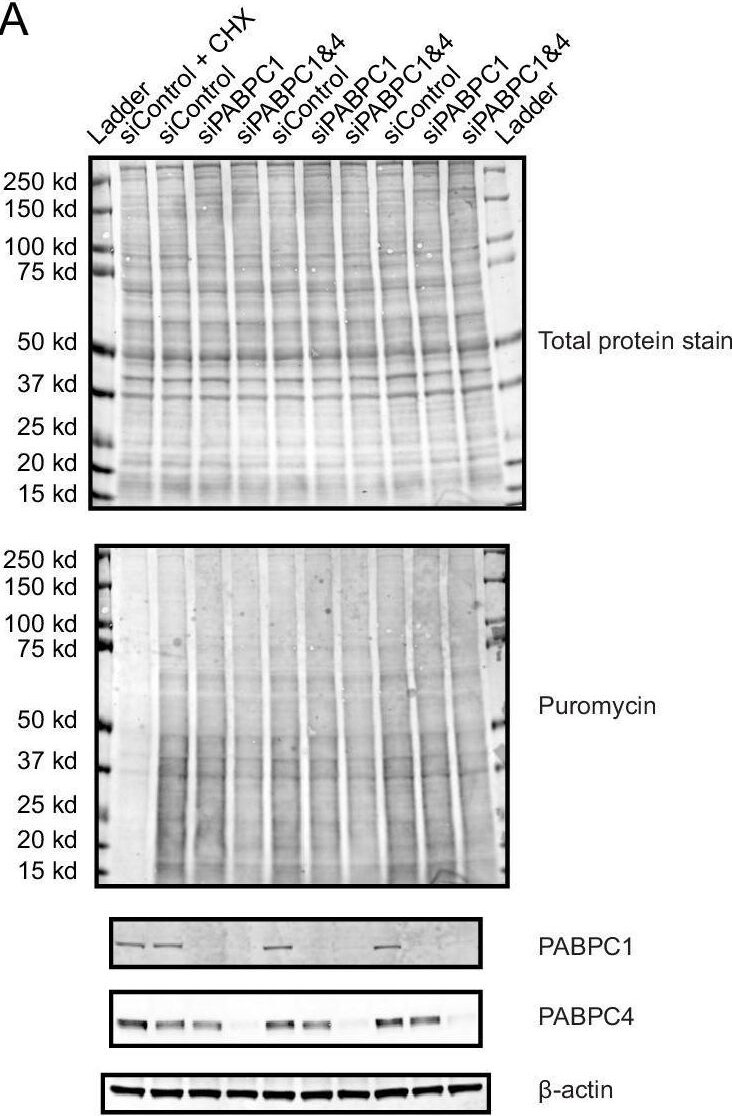
Western Blot: PABPC4 Antibody [NB100-74594] -
Depletion of PABPC in mammalian cell lines has minimal effect on TE.(A) The effect of PABPC knockdown on protein synthesis in HeLa cells. Cells transfected with the indicated siRNAs were cultured for 48 hr, then treated with puromycin before harvesting for western-blot analysis. In a control sample, cycloheximide (CHX) was added prior to puromycin treatment. At the top is the membrane showing total protein levels. In the middle is the same membrane probed for puromycin to detect nascent protein synthesis. At the bottom are the results of the same membrane probed for the indicated proteins. (B) The effect of PABPC knockdown on polysomes in HeLa cells. At the top are polysome-gradient profiles from HeLa cells transfected with either control siRNAs or siRNAs targeting PABPC1 and PABPC4. At the bottom are northern blots analyzing RNA collected from gradient fractions shown at the top, probing for four cytoplasmic mRNAs and one mitochondrial mRNA (MT-CYB). (C) The early effects of rapid PABPC1 degradation on mRNA abundance (left), ribosome-footprint abundance (middle) and TE (right) in HCT116 PABPC1-AID cells. At the top, values from cells treated with IAA for 0.5 hr are compared to those from cells not treated with IAA. In the middle, values from cells treated with IAA for 1 hr are compared to those from cells not treated with IAA. At the bottom, values from cells treated with IAA for 3 hr are compared to those from cells not treated with IAA. For each gene, values for mRNA and ribosome-footprint reads per kilobase are plotted after normalizing to values for mitochondrial mRNAs. These results are summarized Figure 6F. Image collected and cropped by CiteAb from the following open publication (https://pubmed.ncbi.nlm.nih.gov/34213414), licensed under a CC-BY license. Not internally tested by Novus Biologicals.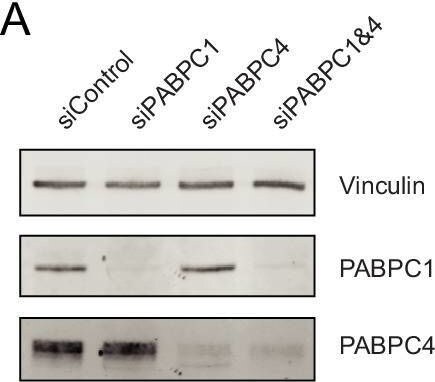
Western Blot: PABPC4 Antibody [NB100-74594] -
PABPC depletion is not sufficient to establish strong coupling between poly(A)-tail length and TE in HeLa cells.(A) Western blot showing siRNA-mediated depletion of PABPC1 and PABPC4 in HeLa cells. (B) The effect of depleting PABPC on coupling between tail length and TE in HeLa cells. Shown is the relationship between TE and median poly(A)-tail length after transfecting HeLa cells with the indicated siRNAs. A point representing the mRNA from one gene (SPECC1) fell outside the plot area in the PABPC1 and PABPC4 double-knockdown sample. Otherwise, this panel is as in Figure 2A. Tail-length measurements were obtained using TAIL-seq. Image collected and cropped by CiteAb from the following open publication (https://pubmed.ncbi.nlm.nih.gov/34213414), licensed under a CC-BY license. Not internally tested by Novus Biologicals.Applications for PABPC4 Antibody
Immunohistochemistry
Immunohistochemistry-Paraffin
Immunoprecipitation
Western Blot
Formulation, Preparation, and Storage
Purification
Formulation
Preservative
Concentration
Shipping
Stability & Storage
Background: PABPC4
Alternate Names
Gene Symbol
UniProt
Additional PABPC4 Products
Product Documents for PABPC4 Antibody
Certificate of Analysis
To download a Certificate of Analysis, please enter a lot or batch number in the search box below.
Product Specific Notices for PABPC4 Antibody
This product is for research use only and is not approved for use in humans or in clinical diagnosis. Primary Antibodies are guaranteed for 1 year from date of receipt.
Citations for PABPC4 Antibody
 Powered by Bioz
Customer Reviews for PABPC4 Antibody
There are currently no reviews for this product. Be the first to review PABPC4 Antibody and earn rewards!
Have you used PABPC4 Antibody?
Submit a review and receive an Amazon gift card!
$25/€18/£15/$25CAN/¥2500 for a review with an image
$10/€7/£6/$10CAN/¥1110 for a review without an image
Submit a review
Protocols
Find general support by application which include: protocols, troubleshooting, illustrated assays, videos and webinars.
- Antigen Retrieval Protocol (PIER)
- Antigen Retrieval for Frozen Sections Protocol
- Appropriate Fixation of IHC/ICC Samples
- Cellular Response to Hypoxia Protocols
- Chromogenic IHC Staining of Formalin-Fixed Paraffin-Embedded (FFPE) Tissue Protocol
- Chromogenic Immunohistochemistry Staining of Frozen Tissue
- ClariTSA™ Fluorophore Kits
- Detection & Visualization of Antibody Binding
- Fluorescent IHC Staining of Frozen Tissue Protocol
- Graphic Protocol for Heat-induced Epitope Retrieval
- Graphic Protocol for the Preparation and Fluorescent IHC Staining of Frozen Tissue Sections
- Graphic Protocol for the Preparation and Fluorescent IHC Staining of Paraffin-embedded Tissue Sections
- Graphic Protocol for the Preparation of Gelatin-coated Slides for Histological Tissue Sections
- IHC Sample Preparation (Frozen sections vs Paraffin)
- Immunofluorescent IHC Staining of Formalin-Fixed Paraffin-Embedded (FFPE) Tissue Protocol
- Immunohistochemistry (IHC) and Immunocytochemistry (ICC) Protocols
- Immunohistochemistry Frozen Troubleshooting
- Immunohistochemistry Paraffin Troubleshooting
- Immunoprecipitation Protocol
- Preparing Samples for IHC/ICC Experiments
- Preventing Non-Specific Staining (Non-Specific Binding)
- Primary Antibody Selection & Optimization
- Protocol for Heat-Induced Epitope Retrieval (HIER)
- Protocol for Making a 4% Formaldehyde Solution in PBS
- Protocol for VisUCyte™ HRP Polymer Detection Reagent
- Protocol for the Preparation & Fixation of Cells on Coverslips
- Protocol for the Preparation and Chromogenic IHC Staining of Frozen Tissue Sections
- Protocol for the Preparation and Chromogenic IHC Staining of Frozen Tissue Sections - Graphic
- Protocol for the Preparation and Chromogenic IHC Staining of Paraffin-embedded Tissue Sections
- Protocol for the Preparation and Chromogenic IHC Staining of Paraffin-embedded Tissue Sections - Graphic
- Protocol for the Preparation and Fluorescent IHC Staining of Frozen Tissue Sections
- Protocol for the Preparation and Fluorescent IHC Staining of Paraffin-embedded Tissue Sections
- Protocol for the Preparation of Gelatin-coated Slides for Histological Tissue Sections
- R&D Systems Quality Control Western Blot Protocol
- TUNEL and Active Caspase-3 Detection by IHC/ICC Protocol
- The Importance of IHC/ICC Controls
- Troubleshooting Guide: Immunohistochemistry
- Troubleshooting Guide: Western Blot Figures
- Western Blot Conditions
- Western Blot Protocol
- Western Blot Protocol for Cell Lysates
- Western Blot Troubleshooting
- Western Blot Troubleshooting Guide
- View all Protocols, Troubleshooting, Illustrated assays and Webinars