
Recombinant Human PGC1 alpha GST (N-Term) Protein
Novus Biologicals | Catalog # H00010891-Q01

Loading...
Key Product Details
Source
Wheat germ
Tag
GST (N-Term)
Applications
Western Blot, ELISA, Affinity Purification, Endotoxin Detection
Loading...
Product Specifications
Description
A recombinant protein with a N-terminal GST tag corresponding to the amino acid sequence 689-798 of Human PGC1 alpha
Source: Wheat Germ (in vitro)
Amino Acid Sequence: TRTELRDRFEVFGEIEECTVNLRDDGDSYGFITYRYTCDAFAALENGYTLRRSNETDFELYFCGRKQFFKSNYADLDSNSDDFDPASTKSKYDSLDFDSLLKEAQRSLRR
Purity
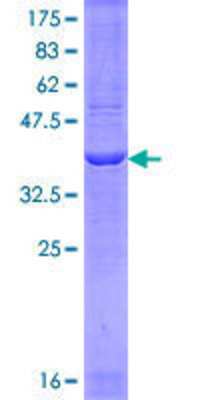
>80% by SDS-PAGE and Coomassie blue staining
Predicted Molecular Mass
91 kDa.
Disclaimer note: The observed molecular weight of the protein may vary from the listed predicted molecular weight due to post translational modifications, post translation cleavages, relative charges, and other experimental factors.
Disclaimer note: The observed molecular weight of the protein may vary from the listed predicted molecular weight due to post translational modifications, post translation cleavages, relative charges, and other experimental factors.
Activity
This protein was produced in an in vitro wheat germ expression system that should preserve correct conformational folding that is necessary for biological function. While it is possible that this protein could display some level of activity, the functionality of this protein has not been explicitly measured or validated.
Protein / Peptide Type
Recombinant Protein
Scientific Data Images for Recombinant Human PGC1 alpha GST (N-Term) Protein
Recombinant Human, PGC1 alpha Protein [H00010891-Q01] - 12.5% SDS-PAGE using Recombinant Human PGC1 alpha Protein stained with Coomassie Blue.
Formulation, Preparation, and Storage
H00010891-Q01
| Preparation Method | in vitro wheat germ expression system |
| Formulation | 50 mM Tris-HCI, 10 mM reduced Glutathione, pH 8.0 in the elution buffer. |
| Preservative | No Preservative |
| Concentration | Please see the vial label for concentration. If unlisted please contact technical services. |
| Shipping | The product is shipped with dry ice or equivalent. Upon receipt, store it immediately at the temperature recommended below. |
| Stability & Storage | Store at -80C. Avoid freeze-thaw cycles. |
Background: PGC1 alpha
PGC1 alpha is highly expressed in skeletal muscle, cardiac muscle, and brown adipose tissue, all tissues with high oxidative capacity (1, 2). PGC1 alpha is also induced by energy taxing physiological states, for example increased physical activity, reduced body temperature, and reduced food intake (3). Because of its role in pathways controlling cellular energy expenditure, PGC1 alpha dysfunction has been associated with pathophysiological conditions such as type 2 diabetes and the metabolic syndrome (3).
References
1.Liang, H., & Ward, W. F. (2006). PGC-1alpha: A key regulator of energy metabolism. American Journal of Physiology - Advances in Physiology Education. https://doi.org/10.1152/advan.00052.2006
2.Arany, Z., He, H., Lin, J., Hoyer, K., Handschin, C., Toka, O.,... Spiegelman, B. M. (2005). Transcriptional coactivator PGC-1alpha controls the energy state and contractile function of cardiac muscle. Cell Metabolism. https://doi.org/10.1016/j.cmet.2005.03.002
3.Canto, C., & Auwerx, J. (2009). PGC-1alpha, SIRT1 and AMPK, an energy sensing network that controls energy expenditure. Current Opinion in Lipidology. https://doi.org/10.1097/MOL.0b013e328328d0a4
Long Name
Peroxisome Proliferator-activated Receptor gamma, Coactivator 1 alpha
Alternate Names
LEM6, PPARGC1A
Gene Symbol
PPARGC1A
Additional PGC1 alpha Products
Product Documents for Recombinant Human PGC1 alpha GST (N-Term) Protein
Certificate of Analysis
To download a Certificate of Analysis, please enter a lot or batch number in the search box below.
Product Specific Notices for Recombinant Human PGC1 alpha GST (N-Term) Protein
This product is produced by and distributed for Abnova, a company based in Taiwan.
This product is for research use only and is not approved for use in humans or in clinical diagnosis. This product is guaranteed for 1 year from date of receipt.
Citations for Recombinant Human PGC1 alpha GST (N-Term) Protein
 Powered by Bioz
Customer Reviews for Recombinant Human PGC1 alpha GST (N-Term) Protein
There are currently no reviews for this product. Be the first to review Recombinant Human PGC1 alpha GST (N-Term) Protein and earn rewards!
Have you used Recombinant Human PGC1 alpha GST (N-Term) Protein?
Submit a review and receive an Amazon gift card!
$25/€18/£15/$25CAN/¥2500 for a review with an image
$10/€7/£6/$10CAN/¥1110 for a review without an image
Submit a review
Protocols
Find general support by application which include: protocols, troubleshooting, illustrated assays, videos and webinars.
- Cellular Response to Hypoxia Protocols
- ELISA Sample Preparation & Collection Guide
- ELISA Troubleshooting Guide
- How to Run an R&D Systems DuoSet ELISA
- How to Run an R&D Systems Quantikine ELISA
- How to Run an R&D Systems Quantikine™ QuicKit™ ELISA
- Quantikine HS ELISA Kit Assay Principle, Alkaline Phosphatase
- Quantikine HS ELISA Kit Principle, Streptavidin-HRP Polymer
- R&D Systems Quality Control Western Blot Protocol
- Sandwich ELISA (Colorimetric) – Biotin/Streptavidin Detection Protocol
- Sandwich ELISA (Colorimetric) – Direct Detection Protocol
- Troubleshooting Guide: ELISA
- Troubleshooting Guide: Western Blot Figures
- Western Blot Conditions
- Western Blot Protocol
- Western Blot Protocol for Cell Lysates
- Western Blot Troubleshooting
- Western Blot Troubleshooting Guide
- View all Protocols, Troubleshooting, Illustrated assays and Webinars
FAQs for Recombinant Human PGC1 alpha GST (N-Term) Protein
Showing
1
-
1 of
1 FAQ
Showing All
-
Q: Please differentiate to me between PPAR and PGC clearly. I am confused with the difference between these two
A:
Thank you very much for contacting Novus Biologicals technical support team and sharing your query on the differences between PGC-1 alpha and PPAR. These are two different proteins encoded by their respective genes and serves different functions. PGC-1 alpha (PGC1A or PPAR gamma coactivator 1-alpha) is a transcriptional co-activator for steroid receptors and nuclear receptors, and it regulates diverse aspects of cellular physiology. It up-regulates the transcriptional activity of PPAR-gamma /thyroid hormone receptor on the uncoupling protein promoter; regulates the key mitochondrial genes involved in adaptive thermogenesis; implicates in the metabolic reprogramming in response to nutrients availability through the coordination of the expression of a wide array of genes involved in the regulation of glucose and fatty acid metabolism. Among our PGC-1 alpha antibodies, NBP1-04676 is our best selling product with nice customer feedback and citations in at least 13 research publications. PPAR (PPAR alpha) on the other hand is a ligand-activated transcription factor which gets activated by the endogenous ligand 1-palmitoyl-2-oleoyl-sn-glycerol-3-phosphocholine, and oleylethanolamide (a naturally occurring lipid that regulates satiety), and acts as a key regulator of lipid metabolism. It also acts as a receptor for peroxisome proliferators such as hypolipidemic drugs and fatty acids. It regulates the peroxisomal beta-oxidation pathway of fatty acids, and also functions as transcription activator for the ACOX1 and P450 genes. We have a variety of PPAR alpha antibodies. I hope you will find this information helpful but please let me know if I can support you with anything else from my end. Thank you very much for choosing Novus Biologicals as your quality reagent supplier and we wish you the best with your research projects.
Loading...
Associated Pathways
