
Recombinant Human EGFR Kinase Domain His-tag Protein, CF
R&D Systems | Catalog # 11142-ER
Analyzed by SEC-MALS

Loading...
Key Product Details
- Recombinant Human EGFR Protein enables development of EGFR-targeted therapeutics, including tyrosine kinase inhibitors. It supports ligand binding, receptor activation studies, and assay development for oncology drug discovery.
- R&D Systems Sf 21 (baculovirus)-derived Recombinant Human EGFR Kinase Domain His-tag Protein (11142-ER)
- Quality control testing to verify active proteins with lot specific assays by in-house scientists
- All R&D Systems proteins are covered with a 100% guarantee
Source
Sf 21 (baculovirus)
Accession Number
Applications
Enzyme Activity
Loading...
Product Specifications
Source
Spodoptera frugiperda, Sf 21 (baculovirus)-derived human EGFR protein
Gly696-Gly1022, with an N-terminal Met and 6-His tag
Gly696-Gly1022, with an N-terminal Met and 6-His tag
Purity
>95%, by SDS-PAGE visualized with Silver Staining and quantitative densitometry by Coomassie® Blue Staining.
Endotoxin Level
<0.10 EU per 1 μg of the protein by the LAL method.
N-terminal Sequence Analysis
Met
Predicted Molecular Mass
38 kDa
SDS-PAGE
39 kDa, under reducing conditions
Activity
Measured by its ability to transfer phosphate from adenosine triphosphate (ATP) to a synthetic peptide substrate.
The specific activity is >35 pmol/min/μg, as measured under the described conditions.
Scientific Data Images for Recombinant Human EGFR Kinase Domain His-tag Protein, CF
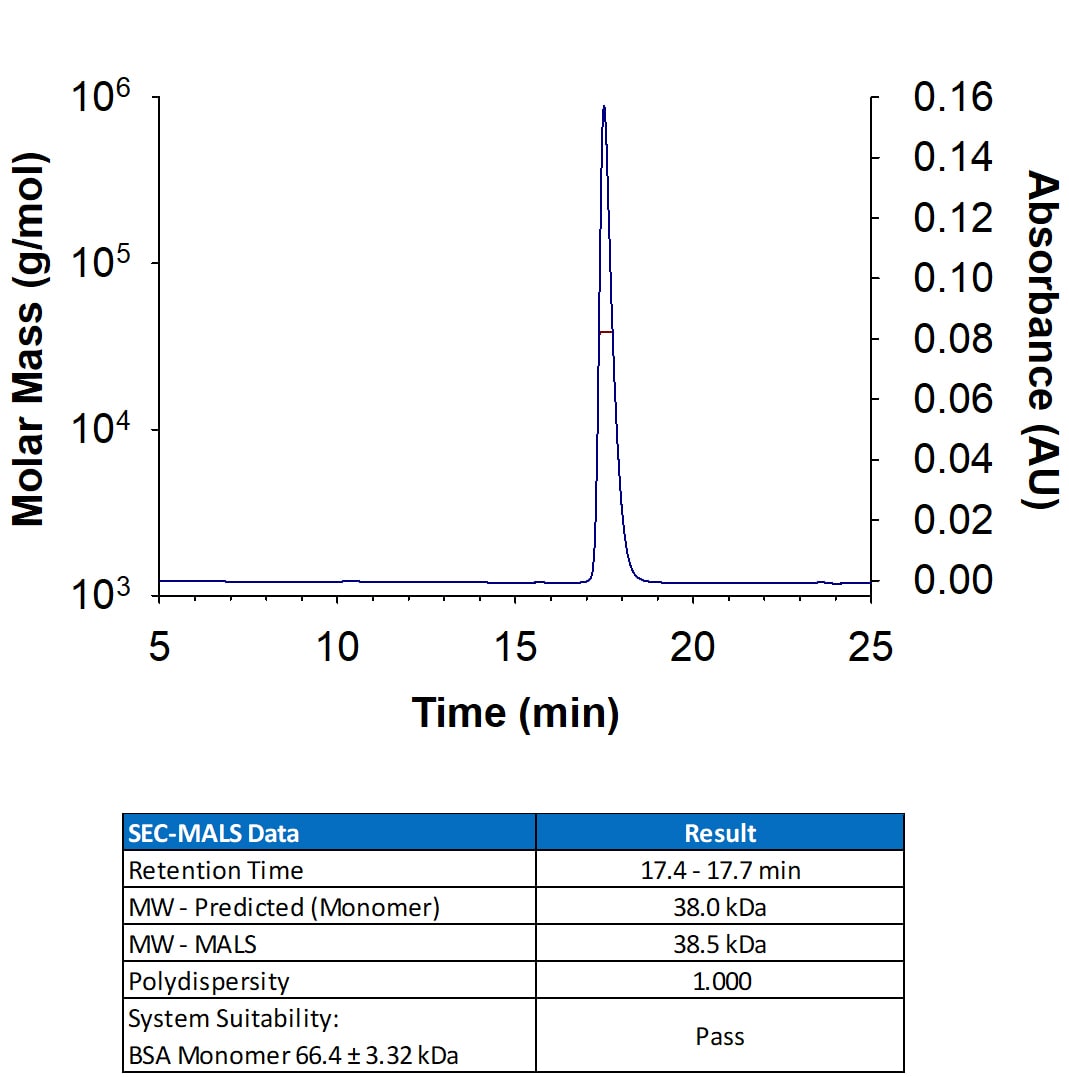
Recombinant Human EGFR Kinase Domain His-tag Protein SEC-MALS.
Recombinant Human EGFR Kinase Domain His-tag Protein (Catalog # 11142-ER) has a molecular weight (MW) of 37-40 kDa as analyzed by SEC-MALS, suggesting that this protein is a monomer. MW may differ from predicted MW due to post-translational modifications (PTMs) present (i.e. Glycosylation).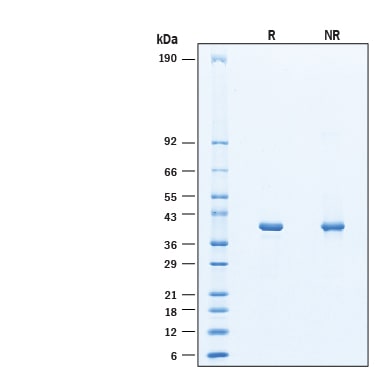
Recombinant Human EGFR Kinase Domain His-tag Protein SDS-PAGE.
2 μg/lane of Recombinant Human EGFR Kinase Domain His-tag Protein (Catalog # 11142-ER) was resolved with SDS-PAGE under reducing (R) and non-reducing (NR) conditions and visualized by Coomassie® Blue staining, showing bands at 39 kDa.Formulation, Preparation, and Storage
11142-ER
| Formulation | Supplied as a 0.2 μm filtered solution in Tris, NaCl and DTT. |
| Shipping | The product is shipped with dry ice or equivalent. Upon receipt, store it immediately at the temperature recommended below. |
| Stability & Storage | Use a manual defrost freezer and avoid repeated freeze-thaw cycles.
|
Background: EGFR
References
- Singh, A.B. and R.C. Harris (2005) Cell. Signal. 17:1183.
- Shilo, B.Z. (2005) Development 132:4017.
- Lin, C. et al. (1984) Science 224:843.
- Ullrich, A. et al. (1984) Nature 309:418.
- Stamos, J. et. al. (2002) J. Biol. Chem. 277:46265.
- Liu, Q. et al. (2013) Chem. Biol. 20:146.
- Amelia, T. et al. (2022) Molecules 27:819.
- Graus-Porta, D. et al. (1997) EMBO J. 16:1647.
- Yarden, Y. et al. (2001) Nat. Rev. Mol. Cell Biol. 2:127.
- Lemmon, M.A. (2009) Exp. Cell Res. 315:638.
- Sibilia, M. and E.F. Wagner (1995) Science 269:234.
- Miettinen, P.J. et al. (1995) Nature 376:337.
- Janne, P.A. et al. (2005) J. Clin. Oncol. 23:3227.
- Yun, C.-H. et al. (2008) Proc. Nat. Acad. Sci. USA 105:2070.
- Yu, J. et al. (2022) Front. Mol. Biosci. 9:847825.
Long Name
Epidermal Growth Factor Receptor
Alternate Names
EGF R, ErbB, ErbB1, HER-1
Gene Symbol
EGFR
UniProt
Additional EGFR Products
Product Documents for Recombinant Human EGFR Kinase Domain His-tag Protein, CF
Certificate of Analysis
To download a Certificate of Analysis, please enter a lot or batch number in the search box below.
Note: Certificate of Analysis not available for kit components.
Product Specific Notices for Recombinant Human EGFR Kinase Domain His-tag Protein, CF
For research use only
Related Research Areas
Customer Reviews for Recombinant Human EGFR Kinase Domain His-tag Protein, CF
There are currently no reviews for this product. Be the first to review Recombinant Human EGFR Kinase Domain His-tag Protein, CF and earn rewards!
Have you used Recombinant Human EGFR Kinase Domain His-tag Protein, CF?
Submit a review and receive an Amazon gift card!
$25/€18/£15/$25CAN/¥2500 for a review with an image
$10/€7/£6/$10CAN/¥1110 for a review without an image
Submit a review
Protocols
View specific protocols for Recombinant Human EGFR Kinase Domain His-tag Protein, CF (11142-ER):
Materials
- Assay Buffer: 50 mM Tris, 20 mM MgCl2, 5 mM MnCl2, 0.1 mg/mL BSA, pH 7.5
- Recombinant Human EGFR (rhEGFR) (Catalog # 11142-ER)
- Poly (4:1 Glu, Tyr), 1 mg/mL stock in 25 mM Tris, pH 7.5
- Adenosine triphosphate (ATP), 10 mM stock in deionized water
- ADP-GloTM Kinase Assay (Promega)
- White 96-well Plate
- Luminescent Plate Reader
- Dilute rhEGFR to 10 µg/mL in Assay Buffer.
- Prepare Substrate Mixture containing 65 µM ATP and 0.4 mg/mL Poly (4:1 Glu, Tyr) in Assay Buffer.
- Combine equal volumes of 10 µg/mL rhEGFR and Substrate Mixture. Replace enzyme with Assay Buffer for Substrate Control.
- Incubate at room temperature for 40 minutes.
- After incubation, transfer 10 µL of each reaction to a plate.
- Terminate the reaction and deplete the remaining ATP by adding 10 µL of ADP-GloTM Reagent to all wells.
- Incubate for 40 minutes at room temperature.
- Add 20 µL of Kinase Detection Reagent to all wells.
- Incubate at room temperature for 30 minutes.
- Read plate in Luminescence endpoint mode.
- Calculate specific activity:
Specific Activity (pmol/min/µg) = | Adjusted Luminescence* (RLU) x Conversion Factor** (pmol/RLU) |
| Incubation time (min) x amount of enzyme (µg) |
*Adjusted for Substrate Control
**Derived using ADP-GloTM Kinase Assay Kit protocol (Promega)
Per Well:- rhEGFR: 0.05 µg
- ATP: 8.125 µM
- Poly (4:1 Glu, Tyr): 2 µg
Loading...
Associated Pathways


