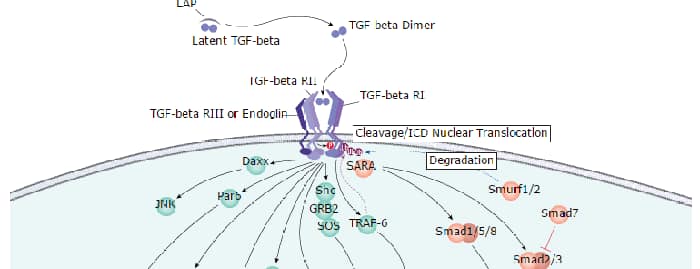
Endoglin (CD105) is a 90 kDa type I transmembrane glycoprotein of the zona pellucida (ZP) family of proteins (1‑3). Endoglin and betaglycan/T beta RIII are type III receptors for TGF beta superfamily ligands, sharing 71% aa identity with within the transmembrane (TM) and cytoplasmic domains. Endoglin is highly expressed on proliferating vascular endothelial cells, chondrocytes, and syncytiotrophoblasts of term placenta, with lower amounts on hematopoietic, mesenchymal and neural crest stem cells, activated monocytes, and lymphoid and myeloid leukemic cells (2‑5). Human Endoglin cDNA encodes 658 amino acids (aa) including a 25 aa signal sequence, a 561 aa extracellular domain (ECD) with an orphan domain and a two-part ZP domain, a TM domain and a 47 aa cytoplasmic domain (1‑3). An isoform with a 14 aa cytoplasmic domain (S-endoglin) can oppose effects of long (L) Endoglin (6, 7). The human Endoglin ECD shares 65‑72% aa identity with mouse, rat, bovine, porcine and canine Endoglin. Endoglin homodimers interact with TGF-beta 1 and TGF-beta 3 (but not TGF-beta 2), but only after binding T beta RII (8). Similarly, they interact with activin-A and BMP-7 via activin type IIA or B receptors, and with BMP‑2 via BMPR-1A/ALK-3 or BMPR-1B/ALK-6 (9). BMP-9, however, is reported to bind Endoglin directly (10). Endoglin modifies ligand‑induced signaling in multiple ways. For example, expression of Endoglin can inhibit TGF-beta 1 signals but enhance BMP7 signals in the same myoblast cell line (11). In endothelial cells, Endoglin inhibits T beta RI/ALK5, but enhances ALK1-mediated activation (12). Deletion of mouse Endoglin causes lethal vascular and cardiovascular defects, and human Endoglin haploinsufficiency can cause the vascular disorder, hereditary hemorrhagic telangiectasia type I (13, 14). These abnormalities confirm the essential function of Endoglin in differentiation of smooth muscle, angiogenesis, and neovascularization (2‑4, 12‑14). In preeclampsia of pregnancy, high levels of proteolytically generated soluble Endoglin and VEGF R1 (sFLT1), along with low placental growth factor (PlGF), are pathogenic due to antiangiogenic activity (15).
Recombinant Human Endoglin/CD105 Fc Chimera Protein, CF
R&D Systems | Catalog # 6578-EN


Loading...
Key Product Details
- R&D Systems CHO-derived Recombinant Human Endoglin/CD105 Fc Chimera Protein (6578-EN)
- Quality control testing to verify active proteins with lot specific assays by in-house scientists
- All R&D Systems proteins are covered with a 100% guarantee
Source
CHO
Accession Number
Applications
Bioactivity
Loading...
Product Specifications
Source
Chinese Hamster Ovary cell line, CHO-derived human Endoglin/CD105 protein
| Human Endoglin (Met1-Gly586) Accession # P17813 |
IEGRMD | Human IgG1 (Pro100-Lys330) |
| N-terminus | C-terminus |
Purity
>90%, by SDS-PAGE under reducing conditions and visualized by silver stain.
Endotoxin Level
<0.10 EU per 1 μg of the protein by the LAL method.
N-terminal Sequence Analysis
Glu26
Predicted Molecular Mass
87.3 kDa (monomer)
SDS-PAGE
100-115 kDa, reducing conditions
Activity
Measured by its ability to inhibit BMP-10-induced alkaline phosphatase production by MC3T3‑E1 mouse preosteoblast cells.
The ED50 for this effect is 0.3-1.2 μg/mL.
The ED50 for this effect is 0.3-1.2 μg/mL.
Formulation, Preparation, and Storage
6578-EN
| Formulation | Lyophilized from a 0.2 μm filtered solution in PBS. |
| Reconstitution | Reconstitute at 250 μg/mL in PBS.
Loading...
|
| Shipping | The product is shipped at ambient temperature. Upon receipt, store it immediately at the temperature recommended below. |
| Stability & Storage | Use a manual defrost freezer and avoid repeated freeze-thaw cycles.
|
Calculators
Background: Endoglin/CD105
References
- Gougos, A. and Letarte, M. (1990) J. Biol. Chem. 265:8361.
- ten Dijke, P. et al. (2008) Angiogenesis 11:79.
- Bernabeu, C. et al. (2007) J. Cell. Biochem. 102:1375.
- Mancini, M.L. et al. (2007) Dev. Biol. 308:520.
- Moody, J.L. et al. (2007) Stem Cells 25:2809.
- Velasco, S. et al. (2008) J. Cell Sci. 121:913.
- Perez-Gomez, E. et al. (2005) Oncogene 24:4450.
- Cheifetz, S, et al. (1992) J. Biol. Chem. 267:19027.
- Barbara, N.P. et al. (1999) J. Biol. Chem. 274:584.
- Scharpfenecker, M. et al. (2007) J. Cell Sci. 120:964.
- Scherner, O. et al. (2007) J. Biol. Chem. 282:13934.
- Pece-Barbara, N. et al. (2005) J. Biol. Chem. 280:27800.
- Arthur, H.M. et al. (2000) Dev. Biol. 217:42.
- Lebrin, F. and C.L. Mummery (2008) Trends Cardiovasc. Med. 18:25.
- Venkatesha, S. et al. (2006) Nat. Med. 12:642.
Alternate Names
CD105, ENG
Gene Symbol
ENG
UniProt
Additional Endoglin/CD105 Products
Product Documents for Recombinant Human Endoglin/CD105 Fc Chimera Protein, CF
Certificate of Analysis
To download a Certificate of Analysis, please enter a lot or batch number in the search box below.
Note: Certificate of Analysis not available for kit components.
Product Specific Notices for Recombinant Human Endoglin/CD105 Fc Chimera Protein, CF
For research use only
Citations for Recombinant Human Endoglin/CD105 Fc Chimera Protein, CF
 Powered by Bioz
Customer Reviews for Recombinant Human Endoglin/CD105 Fc Chimera Protein, CF
There are currently no reviews for this product. Be the first to review Recombinant Human Endoglin/CD105 Fc Chimera Protein, CF and earn rewards!
Have you used Recombinant Human Endoglin/CD105 Fc Chimera Protein, CF?
Submit a review and receive an Amazon gift card!
$25/€18/£15/$25CAN/¥2500 for a review with an image
$10/€7/£6/$10CAN/¥1110 for a review without an image
Submit a review