
Human tissue kallikreins refer to a group of secreted serine proteases that are encoded by homologous genes clustering on chromosome 19q13.3-4. As a member of this family, human tissue Kallikrein 14 (hKLK14) is present in many tissues, with high levels in breast, skin, prostate, and brain. The 251 amino acid hKLK14 precursor consists of a signal peptide (residues 1 to 18), a pro peptide (residues 19 to 24) and an active protein (residues 25 to 251) (1). Its enzymatic activity has been shown to be mainly trypsin-like (2). However, its physiological substrates and functions are still unclear. Several studies have suggested that hKLK14 may have clinical utility as a biomarker for cancer of the breast, ovary, and prostate (3, 4). In addition, it may be the initiator of a kallikrein proteolytic cascade responsible for the degradation of the adhesion structures in the stratum corneum (2). The purified, secreted rhKLK14 corresponds to the pro form (residues 19 to 248) with a replacement of the last three residues with a His tag at the C-terminus. When activated by thermolysin, it displays enzymatic activity towards a fluorogenic peptide described above. This activity can be inhibited by recombinant human Serpin A4, E1, and F2 (Catalog # http://www.rndsystems.com/product_results.aspx?k=1669-PI">1669-PI, http://www.rndsystems.com/product_results.aspx?k=1786-PI">1786-PI, and http://www.rndsystems.com/product_results.aspx?k=1470-PI">1470-PI, respectively).
Recombinant Human Kallikrein 14 Protein, CF
R&D Systems | Catalog # 2626-SE

Loading...
Key Product Details
- R&D Systems NS0-derived Recombinant Human Kallikrein 14 Protein (2626-SE)
- Quality control testing to verify active proteins with lot specific assays by in-house scientists
- All R&D Systems proteins are covered with a 100% guarantee
Source
NS0
Accession Number
Structure / Form
Pro form
Applications
Enzyme Activity
Loading...
Product Specifications
Source
Mouse myeloma cell line, NS0-derived human Kallikrein 14 protein
Gln19-Met248, with a C-terminal 10-His tag
Gln19-Met248, with a C-terminal 10-His tag
Purity
>95%, by SDS-PAGE under reducing conditions and visualized by silver stain.
Endotoxin Level
<1.0 EU per 1 μg of the protein by the LAL method.
N-terminal Sequence Analysis
No results obtained: Gln19 predicted
Predicted Molecular Mass
26 kDa
SDS-PAGE
28 kDa, reducing conditions
Activity
Measured by its ability to cleave the fluorogenic peptide substrate Boc-VPR-AMC (Catalog # ES011).
The specific activity is >3,000 pmol/min/µg, as measured under the described conditions.
The specific activity is >3,000 pmol/min/µg, as measured under the described conditions.
Reviewed Applications
Read 1 review rated 5 using 2626-SE in the following applications:
Scientific Data Images for Recombinant Human Kallikrein 14 Protein, CF
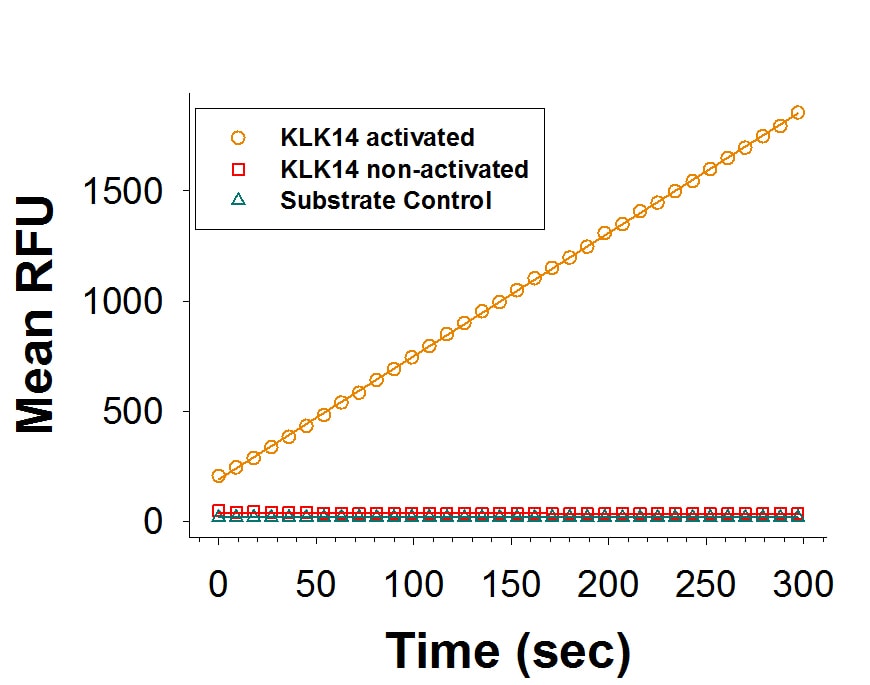
Recombinant Human Kallikrein 14 Protein Enzyme Activity
Recombinant Human Kallikrein 14 (Catalog # 2626-SE) is measured by its ability to cleave the fluorogenic peptide substrate Boc-VPR-AMC (Catalog # ES011).Formulation, Preparation, and Storage
2626-SE
| Formulation | Supplied as a 0.2 μm filtered solution in Tris, NaCl and Glycerol. |
| Shipping | The product is shipped with polar packs. Upon receipt, store it immediately at the temperature recommended below. |
| Stability & Storage | Use a manual defrost freezer and avoid repeated freeze-thaw cycles.
|
Background: Kallikrein 14
References
- Yousef, G. M. et al. (2001) Cancer Res. 61:3425.
- Brattsand, M. et al. (2004) J. Invest. Dermatol. 124:198.
- Borgono, C. et al. (2003) Cancer Res. 63:9032.
- Yousef, G. M. et al. (2003) Prostate. 56:287.
Alternate Names
KLK14
Entrez Gene IDs
43847 (Human)
Gene Symbol
KLK14
UniProt
Additional Kallikrein 14 Products
Product Documents for Recombinant Human Kallikrein 14 Protein, CF
Certificate of Analysis
To download a Certificate of Analysis, please enter a lot or batch number in the search box below.
Note: Certificate of Analysis not available for kit components.
Product Specific Notices for Recombinant Human Kallikrein 14 Protein, CF
For research use only
Citations for Recombinant Human Kallikrein 14 Protein, CF
 Powered by Bioz
Customer Reviews for Recombinant Human Kallikrein 14 Protein, CF (1)
5 out of 5
1 Customer Rating
Have you used Recombinant Human Kallikrein 14 Protein, CF?
Submit a review and receive an Amazon gift card!
$25/€18/£15/$25CAN/¥2500 for a review with an image
$10/€7/£6/$10CAN/¥1110 for a review without an image
Submit a review
Showing
1
-
1 of
1 review
Showing All
Filter By:
-
Application: Enzymatic activity in vitroVerified Customer | Posted 04/11/2018
There are no reviews that match your criteria.
Protocols
View specific protocols for Recombinant Human Kallikrein 14 Protein, CF (2626-SE):
Materials
- Activation Buffer: 50 mM Tris, 10 mM CaCl2, 150 mM NaCl, 0.05% (w/v) Brij-35, pH 7.5 (TCNB)
- Assay Buffer: 50 mM Tris, 150 mM NaCl, 0.05% (w/v) Brij-35, pH 8.0
- Recombinant Human Kallikrein 14 (rhKLK14) (Catalog # 2626-SE)
- Bacterial Thermolysin (Thermolysin) (Catalog # 3097-ZN)
- EDTA (Sigma, Catalog # E-4884)
- Substrate: BOC-Val-Pro-Arg-AMC (Catalog # ES011), 100 mM stock in DMSO
- F16 Black Maxisorp Plate (Nunc, Catalog # 475515)
- Fluorescent Plate reader (Model: SpectramMax Gemini EM by Molecular Devices) or equivalent
- Dilute rhKLK14 to 200 µg/mL in Activation Buffer.
- Dilute Thermolysin to 20 µg/mL in Activation Buffer.
- Combine 25 µL of diluted rhKLK14 and 25 µL of diluted Thermolysin.
- Incubate at 37 °C for 1 hour.
- Stop reaction with 50 µL of 100 mM EDTA.
Dilute incubated rhKLK14 mixture to 0.2 ng/µL in Assay Buffer. - Dilute Substrate to 200 µM in Assay Buffer.
- Load 50 µL of the 0.2 ng/µL rhKLK14 mixture in a plate, and start the reaction by adding 50 µL of 200 µM Substrate. Include a Substrate Blank containing 50 µL of Assay Buffer and 50 µL of 200 µM Substrate.
- Read at excitation and emission wavelengths of 380 nm and 460 nm (top read), respectively in kinetic mode for 5 minutes.
- Calculate specific activity:
|
Specific Activity (pmol/min/µg) = |
Adjusted Vmax* (RFU/min) x Conversion Factor** (pmol/RFU) |
| amount of enzyme (µg) |
*Adjusted for Substrate Blank
**Derived using calibration standard 7-Amino, 4-Methyl Coumarin (AMC) (Sigma, Catalog # A-9891).
Per Well:
- rhKLK14: 0.01 µg
- Substrate: 100 µM
Loading...