
OSM is a cytokine originally isolated from medium conditioned by PMA-treated U-937 human histiocytic leukemia cells based on its ability to inhibit growth of A375 melanoma cells. The human OSM cDNA encodes a 252 amino acid pre-pro-OSM polypeptide with a 25 residue hydrophobic signal peptide and a hydrophilic C-terminal domain that are proteolytically processed to generate the 196 residue mature form of OSM. Although both mature and pro-OSM are equally active in radio-receptor assays, the mature OSM is 5- to 60-fold more active in growth inhibition assays. Thus, proteolytic processing of the pro-OSM peptide may be important in regulating the in vivo activities of OSM.
OSM is a pleiotropic cytokine that initiates its biological activities by binding to specific cell surface receptors. The gp130, a signal transducing component ( beta subunit) of the IL-6, LIF and CNTF receptor complexes, was identified as a low-affinity OSM receptor that does not transduce OSM signals. The low affinity LIF receptor (LIF R, a gp130-related protein) has now been identified to be a component of a high-affinity OSM receptor that will transduce OSM signals. Since OSM is also active on cells that do not express LIF R, a specific OSM receptor that does not involve LIF R must also exist. Besides its growth inhibitory activities on human A375 melanoma and mouse M1 myeloid leukemic cells, as well as on other solid tumor cells, OSM also has growth stimulatory activities on normal fibroblasts, AIDS-Kaposi’s sarcoma cells, and a human erythroleukemia cell line, TF-1. Other OSM-mediated activities reported to date include: stimulation of plasminogen activator activity in cultured bovine aortic endothelial cells; regulation of IL-6 expression in human endothelial cells; and stimulation of LDL uptake and up-regulation of cell surface LDL receptors in HepG2 cells.
Best Seller
Recombinant Human Oncostatin M (OSM) Protein
R&D Systems | Catalog # 295-OM

Loading...
Key Product Details
- R&D Systems E. coli-derived Recombinant Human Oncostatin M (OSM) Protein (295-OM)
- Quality control testing to verify active proteins with lot specific assays by in-house scientists
- All R&D Systems proteins are covered with a 100% guarantee
Source
E. coli
Accession Number
Applications
Bioactivity
Loading...
Product Specifications
Source
E. coli-derived human Oncostatin M/OSM protein
Ala26-Arg221
Ala26-Arg221
Purity
>97%, by SDS-PAGE under reducing conditions and visualized by silver stain.
Endotoxin Level
<0.01 EU per 1 μg of the protein by the LAL method.
Predicted Molecular Mass
22 kDa
Activity
Measured in a cell proliferation assay using TF‑1 human erythroleukemic cells. Kitamura, T. et al. (1989) J. Cell Physiol. 140:323.
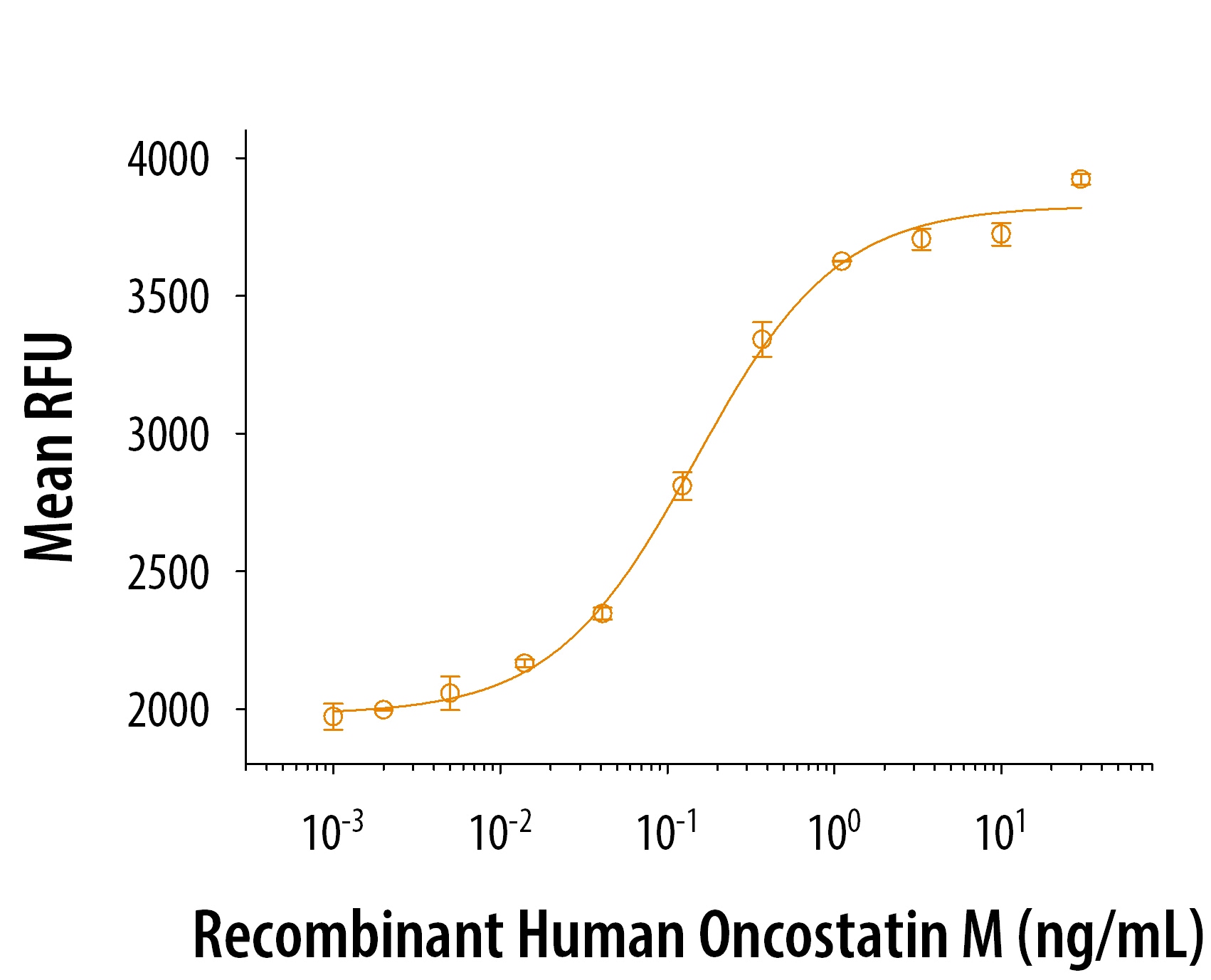
The ED50 for this effect is 0.05-0.3 ng/mL.
The ED50 for this effect is 0.05-0.3 ng/mL.
Reviewed Applications
Read 3 reviews rated 4 using 295-OM in the following applications:
Scientific Data Images for Recombinant Human Oncostatin M (OSM) Protein
Bioactivity of Human Oncostatin M / OSM
Recombinant human Oncostatin M / OSM (295-OM) induces proliferation in the TF-1 human erythroleukemic cell line. The ED50 for this effect is 0.05-0.3 ng/mL.Formulation, Preparation, and Storage
Carrier Free
What does CF mean?CF stands for Carrier Free (CF). We typically add Bovine Serum Albumin (BSA) as a carrier protein to our recombinant proteins. Adding a carrier protein enhances protein stability, increases shelf-life, and allows the recombinant protein to be stored at a more dilute concentration. The carrier free version does not contain BSA.
What formulation is right for me?In general, we advise purchasing the recombinant protein with BSA for use in cell or tissue culture, or as an ELISA standard. In contrast, the carrier free protein is recommended for applications, in which the presence of BSA could interfere.
Carrier: 295-OM
| Formulation | Lyophilized from a 0.2 μm filtered solution in Acetonitrile and TFA with BSA as a carrier protein. |
| Reconstitution | Reconstitute at 100 μg/mL in sterile PBS containing at least 0.1% human or bovine serum albumin. |
| Shipping | The product is shipped at ambient temperature. Upon receipt, store it immediately at the temperature recommended below. |
| Stability & Storage | Use a manual defrost freezer and avoid repeated freeze-thaw cycles.
|
Carrier Free: 295-OM/CF
| Formulation | Lyophilized from a 0.2 μm filtered solution in Acetonitrile and TFA. |
| Reconstitution | Reconstitute at 100 μg/mL in sterile PBS. |
| Shipping | The product is shipped at ambient temperature. Upon receipt, store it immediately at the temperature recommended below. |
| Stability & Storage | Use a manual defrost freezer and avoid repeated freeze-thaw cycles.
|
Calculators
Background: Oncostatin M/OSM
Alternate Names
MGC20461, oncostatin M, oncostatin-M
Gene Symbol
OSM
UniProt
Additional Oncostatin M/OSM Products
Product Documents for Recombinant Human Oncostatin M (OSM) Protein
Certificate of Analysis
To download a Certificate of Analysis, please enter a lot or batch number in the search box below.
Note: Certificate of Analysis not available for kit components.
Product Specific Notices for Recombinant Human Oncostatin M (OSM) Protein
For research use only
Citations for Recombinant Human Oncostatin M (OSM) Protein
 Powered by Bioz
Customer Reviews for Recombinant Human Oncostatin M (OSM) Protein (3)
4 out of 5
3 Customer Ratings
Have you used Recombinant Human Oncostatin M (OSM) Protein?
Submit a review and receive an Amazon gift card!
$25/€18/£15/$25CAN/¥2500 for a review with an image
$10/€7/£6/$10CAN/¥1110 for a review without an image
Submit a review
Showing
1
-
3 of
3 reviews
Showing All
Filter By:
-
Application: Stem/Immune cell maintenance or differentiationVerified Customer | Posted 05/20/2022
-
Application: Media additive for protein or antibody productionVerified Customer | Posted 08/20/2018
-
Application: In vitro bioactivity in cell cultureVerified Customer | Posted 12/21/2017
There are no reviews that match your criteria.
FAQs for Recombinant Human Oncostatin M (OSM) Protein
Showing
1
-
2 of
2 FAQs
Showing All
-
Q: Is Recombinant Human Oncostatin M Protein (Catalog # 295-OM) considered the the pre-OSM peptide or mature protein?
A: Recombinant Human Oncostatin M Protein (Catalog # 295-OM) is comprised of amino acids Ala26-Arg221 of accession # P13725. This region is the 196 residue mature form of OSM.
-
Q: What are the differences between Recombinant Human Oncostatin M Protein (Catalog # 295-OM) and Recombinant Human Oncostatin M (HEK293-expressed) Protein (Catalog # 8475-OM)?
A: Recombinant Human Oncostatin M Protein (Catalog # 295-OM) and Recombinant Human Oncostatin M (HEK293-expressed) Protein (Catalog # 8475-OM) share the same protein sequence, Ala26-Arg221 of Accession # P13725, but Catalog # 295-OM was expressed in E. coli and Catalog # 8475-OM was expressed in HEK293 cells. They are offered in formulations with or without BSA as a carrier protein. Both proteins are routinely tested and have the same activity range in our established QC bioassay: "Measured in a cell proliferation assay using TF‑1 human erythroleukemic cells." The ED50 for this effect is 0.05-0.3 ng/mL. Catalog # 8475-OM is produced in a mammalian expression system so we would expect it to be glycosylated. Catalog # 295-OM is produced in E coli and is not glycosylated. If endotoxin levels are of concern for your application, we would recommend selecting the Catalog # 295-OM as it has an endotoxin threshold of <0.01 EU per 1 μg of protein. Catalog # 8475-OM has a higher endotoxin threshold of <0.10 EU per 1 μg of the protein. That said, if it is important to use a mammalian expressed protein like Catalog # 8475-OM in your assay system, and you require endortoxin lower than <0.10 EU/1 μg of the protein please consult technical service to see if custom testing is an option. We also recommend reviewing the references under the Citations tab on the respective product pages to check the types of applications in which these two proteins have been evaluated.
-
Q: Is Recombinant Human Oncostatin M Protein (Catalog # 295-OM) considered the the pre-OSM peptide or mature protein?
A: Recombinant Human Oncostatin M Protein (Catalog # 295-OM) is comprised of amino acids Ala26-Arg221 of accession # P13725. This region is the 196 residue mature form of OSM.
-
Q: What are the differences between Recombinant Human Oncostatin M Protein (Catalog # 295-OM) and Recombinant Human Oncostatin M (HEK293-expressed) Protein (Catalog # 8475-OM)?
A: Recombinant Human Oncostatin M Protein (Catalog # 295-OM) and Recombinant Human Oncostatin M (HEK293-expressed) Protein (Catalog # 8475-OM) share the same protein sequence, Ala26-Arg221 of Accession # P13725, but Catalog # 295-OM was expressed in E. coli and Catalog # 8475-OM was expressed in HEK293 cells. They are offered in formulations with or without BSA as a carrier protein. Both proteins are routinely tested and have the same activity range in our established QC bioassay: "Measured in a cell proliferation assay using TF‑1 human erythroleukemic cells." The ED50 for this effect is 0.05-0.3 ng/mL. Catalog # 8475-OM is produced in a mammalian expression system so we would expect it to be glycosylated. Catalog # 295-OM is produced in E coli and is not glycosylated. If endotoxin levels are of concern for your application, we would recommend selecting the Catalog # 295-OM as it has an endotoxin threshold of <0.01 EU per 1 μg of protein. Catalog # 8475-OM has a higher endotoxin threshold of <0.10 EU per 1 μg of the protein. That said, if it is important to use a mammalian expressed protein like Catalog # 8475-OM in your assay system, and you require endortoxin lower than <0.10 EU/1 μg of the protein please consult technical service to see if custom testing is an option. We also recommend reviewing the references under the Citations tab on the respective product pages to check the types of applications in which these two proteins have been evaluated.
Loading...