
The Transferrin Receptor (TfR or TfR-1, designated CD71) is a type 2 transmembrane glycoprotein expressed on erythroid progenitors, muscle cells and proliferating cells as a 188 kDa disulfide-linked homodimer of 95 kDa monomers (1 - 4). As the major mediator of cellular iron uptake, it binds and internalizes diferric transferrin, allowing iron release at the low pH of the endosome (2, 5). The human TfR cDNA encodes 760 amino acids (aa) including a 67 aa N-terminal intracellular domain, a 21 aa transmembrane domain, and a 672 aa extracellular domain (ECD) with helical, peptidase (nonfunctional), and ligand binding domains, including an RGD potential integrin binding site (5). Human TfR ECD shares 75 - 80% aa identity with mouse, rat, feline, canine, equine, porcine and bovine TfR. A 679 aa alternately spliced form begins at aa 82 and is presumably secreted, while in an 804 aa form, 44 aa are inserted at aa 518 within the peptidase region (6). Most soluble TfR (sTfR) arises from trypsin proteolysis at aa 100, producing the circulating form of TfR (3). sTfR concentration in plasma or serum is proportional to total TfR and can be increased by iron deficiency (3). Erythroid progenitors, which use iron for hemoglobin synthesis, normally account for the bulk of total body TfR production (3). Since rapidly growing cells require iron to replicate DNA, cancer cells can express up to 5-fold more TfR than quiescent cells in the surrounding tissue (2, 4). Antibody targeting of TfR can inhibit tumor cell proliferation and induce apoptosis (2, 4). The hereditary hemochromatosis protein HFE competes with diferric transferrin for binding to TfR, and targets TfR for degradation rather than recycling (2, 5). TfR has been reported to have ferritin-independent functions in T cell development, immunological synapse formation and galectin-3-mediated cell death, and to be a cell entry receptor for New World hemorrhagic fever arenaviruses (2, 4, 7).
Best Seller
Recombinant Human TfR Protein, CF
R&D Systems | Catalog # 2474-TR
Analyzed by SEC-MALS

Loading...
Key Product Details
- Recombinant Human TfR Protein supports targeted delivery and blood brain barrier shuttle in therapeutic development.
- R&D Systems NS0-derived Recombinant Human TfR Protein (2474-TR)
- Quality control testing to verify active proteins with lot specific assays by in-house scientists
- All R&D Systems proteins are covered with a 100% guarantee
Source
NS0
Accession Number
Applications
Bioactivity
Loading...
Product Specifications
Source
Mouse myeloma cell line, NS0-derived human TfR (Transferrin R) protein
Cys89-Phe760, with an N-terminal 6-His tag
Cys89-Phe760, with an N-terminal 6-His tag
Purity
>90%, by SDS-PAGE under reducing conditions and visualized by silver stain.
Endotoxin Level
<0.10 EU per 1 μg of the protein by the LAL method.
N-terminal Sequence Analysis
His
Predicted Molecular Mass
76 kDa
SDS-PAGE
76-85 kDa, reducing conditions
Activity
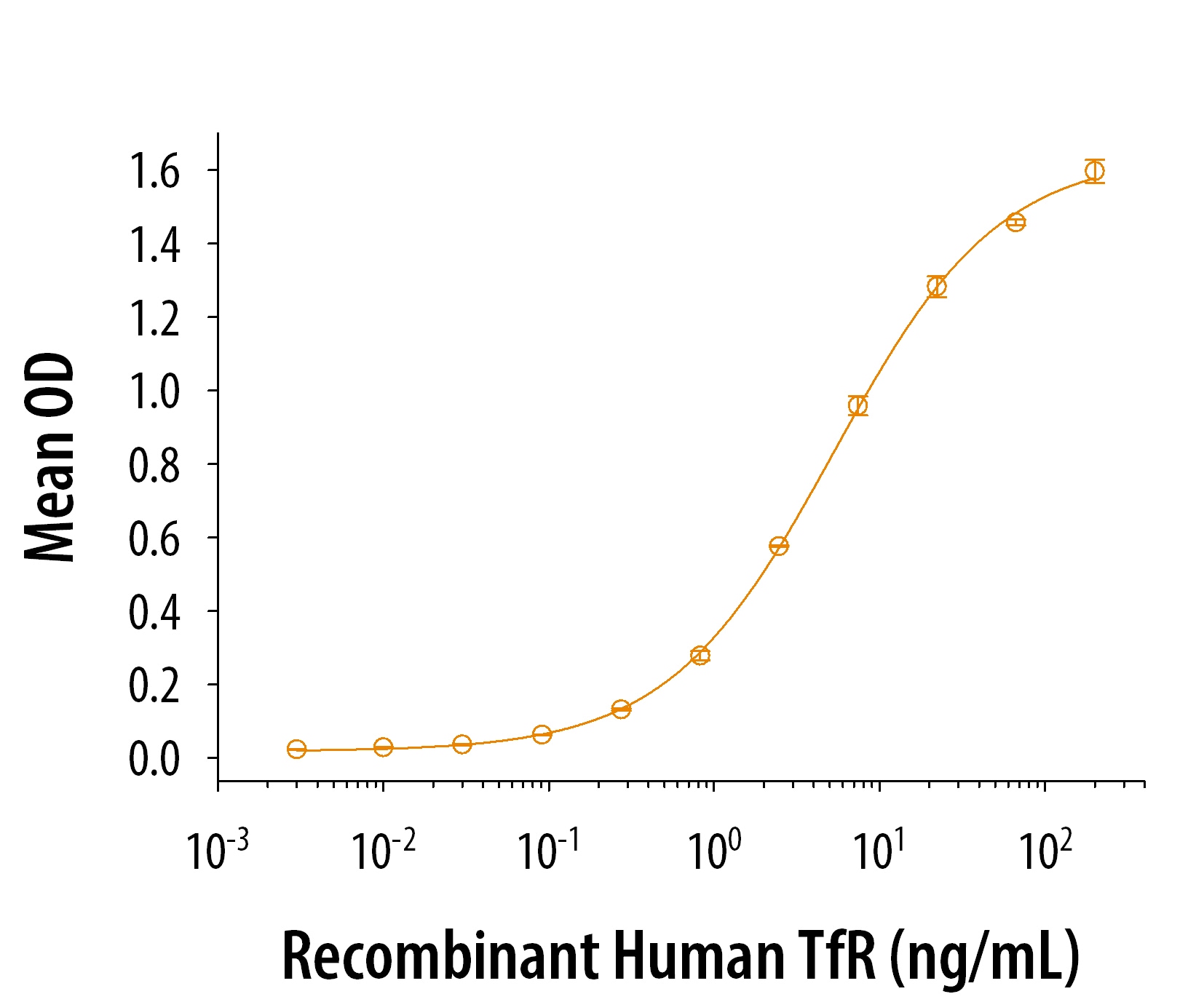
Measured by its binding ability in a functional ELISA.
When human Holo-Transferrin (Catalog # 2914-HT) is coated at 0.5 μg/mL (100 μL/well), the concentration of rhTfR that produces 50% of the optimal binding response is found to be approximately 3-12 ng/mL.
When human Holo-Transferrin (Catalog # 2914-HT) is coated at 0.5 μg/mL (100 μL/well), the concentration of rhTfR that produces 50% of the optimal binding response is found to be approximately 3-12 ng/mL.
Reviewed Applications
Read 2 reviews rated 4.5 using 2474-TR in the following applications:
Scientific Data Images for Recombinant Human TfR Protein, CF
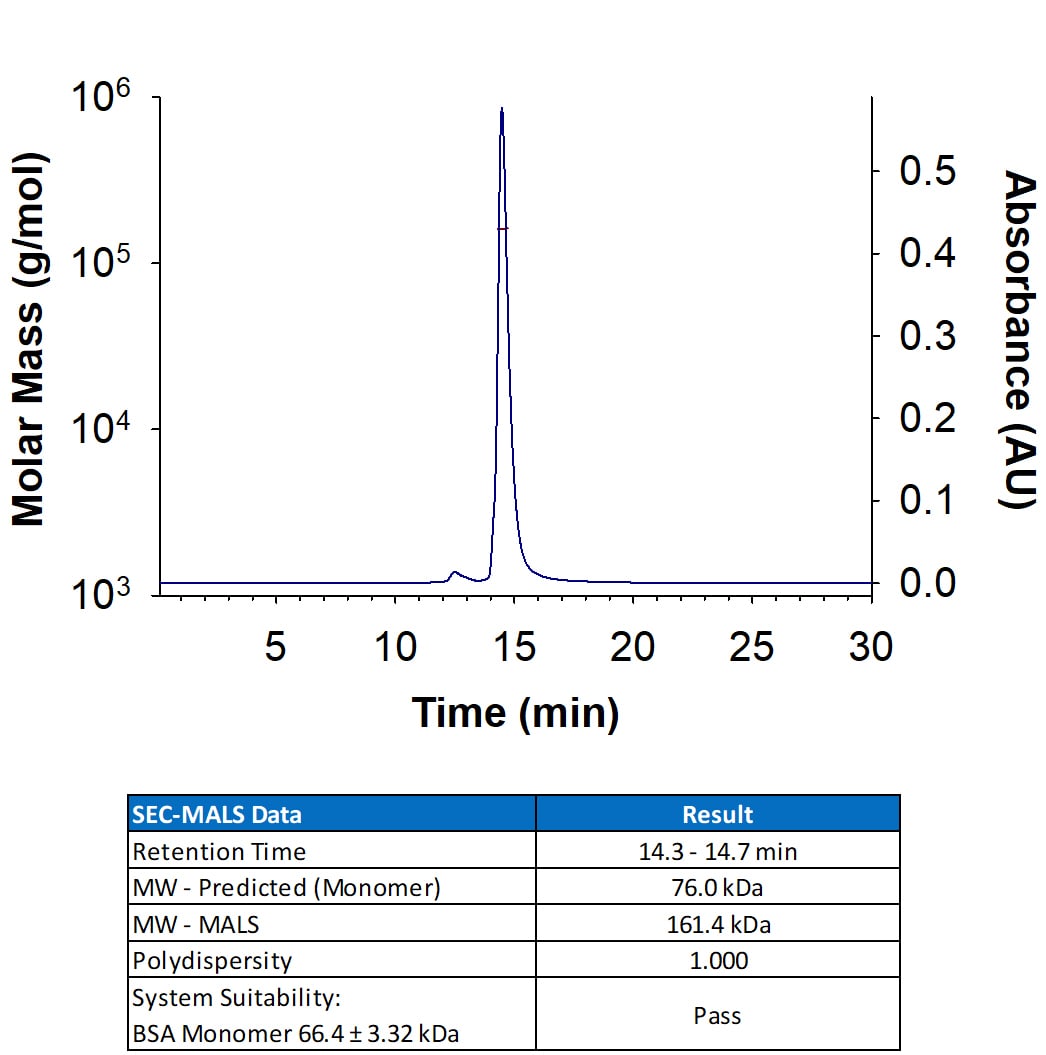
Recombinant Human TfR (Transferrin R) Protein SEC-MALS.
Recombinant Human TfR (Transferrin R) Protein (Catalog # 2474-TR) has a molecular weight (MW) of 153-169 kDa as analyzed by SEC-MALS, suggesting that this protein is a homodimer. MW may differ from predicted MW due to post-translational modifications (PTMs) present (i.e. Glycosylation).Formulation, Preparation, and Storage
2474-TR
| Formulation | Lyophilized from a 0.2 μm filtered solution in Tris and NaCl with Trehalose. |
| Reconstitution | Reconstitute at 200 μg/mL in PBS.
Loading...
|
| Shipping | The product is shipped at ambient temperature. Upon receipt, store it immediately at the temperature recommended below. |
| Stability & Storage | Use a manual defrost freezer and avoid repeated freeze-thaw cycles.
|
Calculators
Background: TfR (Transferrin R)
References
- Schneider, C. et al. (1984) Nature 311:675.
- Daniels, T.R. et al. (2006) Clin. Immunol. 121:144.
- Skikne, B.S. (2008) Am. J. Hematol. 83:872.
- Macedo, M.F. and M. deSousa (2008) Inflamm. Allergy Drug Targets 7:41.
- Aisen, P. (2004) Int. J. Biochem. Cell Biol. 36:2137.
- Entrez protein Accession # EAW53671, EAW53672.
- Radoshitzky, S.R. et al. (2007) Nature 446:92.
Long Name
Transferrin Receptor
Alternate Names
CD71, TfR (TransferrinR), TFR1, TFRC, TRFR
Gene Symbol
TFRC
UniProt
Additional TfR (Transferrin R) Products
Product Documents for Recombinant Human TfR Protein, CF
Certificate of Analysis
To download a Certificate of Analysis, please enter a lot or batch number in the search box below.
Note: Certificate of Analysis not available for kit components.
Product Specific Notices for Recombinant Human TfR Protein, CF
For research use only
Citations for Recombinant Human TfR Protein, CF
 Powered by Bioz
Customer Reviews for Recombinant Human TfR Protein, CF (2)
4.5 out of 5
2 Customer Ratings
Have you used Recombinant Human TfR Protein, CF?
Submit a review and receive an Amazon gift card!
$25/€18/£15/$25CAN/¥2500 for a review with an image
$10/€7/£6/$10CAN/¥1110 for a review without an image
Submit a review
Customer Images
Showing
1
-
2 of
2 reviews
Showing All
Filter By:
-
Application: Enzymatic activity in vitroVerified Customer | Posted 10/11/2020
-
Verified Customer | Posted 01/27/2016

There are no reviews that match your criteria.
Loading...