
Human Transferrin (Tf) is a single chain, 80 kDa member of the anion-binding superfamily of proteins (1 - 5). It is a bilobed molecule that is the product of an ancient gene duplication event (1, 6). Transferrin is synthesized as a 698 amino acid (aa) precursor that is divided into a 19 aa signal sequence plus a 679 aa mature segment that contains 19 intrachain disulfide bonds. The crystal structure of Tf reveals a protein with two flanking 340 aa globular domains. Each are composed of a beta -sheet surrounded by series of alpha -helices (1, 7). The N- and C-terminal flanking regions (or domains) will bind ferric iron through the interaction of an obligate anion (usually bicarbonate) and four amino acids (His, Asp, and two Tyr) (7, 8). Apotransferrin (or iron‑free) will initially bind one atom of iron at the C-terminus, and this is followed by subsequent iron binding by the N‑terminus to form holotransferrin (diferric Tf) (8, 9). Through its C-terminal iron‑binding domain, holotransferrin will interact with the type I Tf receptor (TfR) on the surface of cells where it is internalized into acidified endosomes. Iron dissociates from the Tf molecule within these endosomes, and is transported into the cytosol as ferrous iron. At physiological pH, iron‑free apotransferrin is not bound by TfR. But at acidic pH, such as exists in the endosome, apotransferrin has considerable affinity for TfR. Thus, it remains bound to TfR and is recycled back to the cell surface where a neutral pH environment dissociates ligand from receptor. Each Tf molecule recycles 100 - 150 times during its lifetime (8 - 11). In addition to TfR, transferrin is reported to bind to cubulin, IGFBP3, microbial iron‑binding proteins and liver-specific TfR2 (7, 12, 13, 14). Transferrin is variably glycosylated and the degree of sialylation is suggestive of certain clinical conditions (15). Finally, Tf is highly allelic and the gene codominant, with many single aa changes noted. Three general forms are known, based on standard electrophoretic mobility. Fast Tf is known as transferrin B, slow transferrin is transferrin D, and the middle migrating transferrin is type/variant C, thre most common (16, 17). Mature human TF is 73% aa identical to both mouse and rat Tf, and 68% and 71% aa identical to bovine and equine Tf, respectively.
Human Holo-Transferrin Protein, CF
R&D Systems | Catalog # 2914-HT


Key Product Details
- R&D Systems Human Plasma-derived Human Holo-Transferrin Protein (2914-HT)
- Quality control testing to verify active proteins with lot specific assays by in-house scientists
- All R&D Systems proteins are covered with a 100% guarantee
Source
Applications
Product Specifications
Source
The human plasma used for the isolation of this product were certified by the supplier to be HIV-1 and HBsAg negative at the time of shipment. Human blood products should always be treated in accordance with universal handling precautions.
Purity
Endotoxin Level
SDS-PAGE
Activity
The ED50 for this effect is 0.075-0.375 μg/mL.
Optimal concentration depends on cell type as well as the application or research objectives.
Reviewed Applications
Read 5 reviews rated 4.6 using 2914-HT in the following applications:
Formulation, Preparation, and Storage
2914-HT
| Formulation | Lyophilized from a 0.2 μm filtered solution in sterile water. |
| Reconstitution | Reconstitute at 50 mg/mL in sterile, deionized water.
Loading...
|
| Shipping | The product is shipped with dry ice or equivalent. Upon receipt, store it immediately at the temperature recommended below. |
| Stability & Storage | Use a manual defrost freezer and avoid repeated freeze-thaw cycles.
|
Calculators
Background: Holo-Transferrin
References
- Brus, C.M. et al. (2001) Nat. Struct. Biol. 4:919.
- Schaeffer, E. et al. (1987) Gene 56:109.
- MacGillivray, R.T.A. et al. (1983) J. Biol. Chem. 258:3543.
- Yang, F. et al. (1984) Proc. Natl. Acad. Sci. USA 81:2752.
- Uzan, G. et al. (1984) Biochem. Biophys. Res. Commun. 119:273.
- Zak, O. et al. (2002) Biochemistry 41:7416.
- Gomme, P.T. and K. B. McCann (2005) Drug Discov. Today 10:267.
- Liu, R. et al. (2003) Biochemistry 42:12447.
- Pakdaman, R. et al. (1999) J. Mol. Biol. 293:1273.
- Hemadi, M. et al. (2004) Biochemistry 43:1736.
- Aisen, P. et al. (2001) Int. J. Biochem. Cell Biol. 33:940.
- Kozyraki, R. et al. (2001) Proc. Natl. Acad. Sci. USA 98:12941.
- Boulton, I.C. et al. (1998) Biochem. J. 334:269.
- Robb, A. and M. Wessling-Resnick (2004) Blood 104:4294.
- Landberg, E. et al. (1995) Biochem. Biophys. Res. Commun. 210:267.
- Gorg, A. et al. (1983) Hum. Genet. 64:222.
- Bean, P. and J.B. Peter (1994) Clin. Chem. 40:2078.
Alternate Names
Entrez Gene IDs
Gene Symbol
Additional Holo-Transferrin Products
Product Documents for Human Holo-Transferrin Protein, CF
Certificate of Analysis
To download a Certificate of Analysis, please enter a lot or batch number in the search box below.
Note: Certificate of Analysis not available for kit components.
Product Specific Notices for Human Holo-Transferrin Protein, CF
For research use only
Citations for Human Holo-Transferrin Protein, CF
 Powered by Bioz
Customer Reviews for Human Holo-Transferrin Protein, CF (5)
Have you used Human Holo-Transferrin Protein, CF?
Submit a review and receive an Amazon gift card!
$25/€18/£15/$25CAN/¥2500 for a review with an image
$10/€7/£6/$10CAN/¥1110 for a review without an image
Submit a review
Customer Images
-
Application: Cell ProliferationVerified Customer | Posted 03/21/2025

-
Application: Media additive for protein or antibody productionVerified Customer | Posted 06/03/2022
-
Application: Stem/Immune cell maintenance or differentiationVerified Customer | Posted 03/01/2022
-
Application: Stem/Immune cell maintenance or differentiationVerified Customer | Posted 12/15/2016We use human Transferrin to supplement media for murine embryonic stem cells (ESC) differentiation in embryoid bodies (EBs) and further to hemogenic endothelium from which hematopoietic stem and progenitor cells emerge.
-
Verified Customer | Posted 01/28/2016
There are no reviews that match your criteria.
FAQs for Human Holo-Transferrin Protein, CF
-
Q: What are the differences between Human Holo-Transferrin Protein, CF (Catalog # 2914-HT) and Human Apo-Transferrin Protein, CF (Catalog # 3188-AT)?
A: Human Transferrin has two different iron binding domains, one at the N-terminus and one at the C-terminus. Apo-transferrin (3188-AT) is not bound to any iron atoms and Holo-Transferrin (2914-HT) has an iron atom bound at both the N- and C-terminal domains.
-
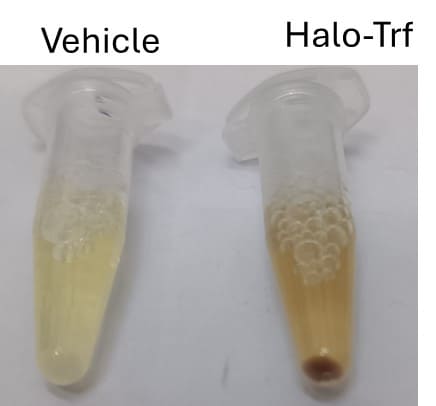
Q: When I opened the vial of Human Holo-Transferrin Protein, CF (catalog # 2914-HT), the white powder turned red in color - is that normal?
A: The holo-transferrin proteinis saturated with iron and the appearance of pink to dark orange/red color is consistent with our manufacturing observations.
-
Q: What are the differences between Human Holo-Transferrin Protein, CF (Catalog # 2914-HT) and Human Apo-Transferrin Protein, CF (Catalog # 3188-AT)?
A: Human Transferrin has two different iron binding domains, one at the N-terminus and one at the C-terminus. Apo-transferrin (3188-AT) is not bound to any iron atoms and Holo-Transferrin (2914-HT) has an iron atom bound at both the N- and C-terminal domains.
-
Q: When I opened the vial of Human Holo-Transferrin Protein, CF (catalog # 2914-HT), the white powder turned red in color - is that normal?
A: The holo-transferrin proteinis saturated with iron and the appearance of pink to dark orange/red color is consistent with our manufacturing observations.