
Recombinant Mouse Angiopoietin-like 3 (aa 17-220), CF
R&D Systems | Catalog # 8344-AN

Key Product Details
- R&D Systems CHO-derived Recombinant Mouse Angiopoietin-like 3 (aa 17-220) (8344-AN)
- Quality control testing to verify active proteins with lot specific assays by in-house scientists
- All R&D Systems proteins are covered with a 100% guarantee
Source
Accession Number
Applications
Product Specifications
Source
Ser17-Thr206, with a C-terminal 6-His tag
Purity
Endotoxin Level
N-terminal Sequence Analysis
Predicted Molecular Mass
SDS-PAGE
Activity
Scientific Data Images for Recombinant Mouse Angiopoietin-like 3 (aa 17-220), CF
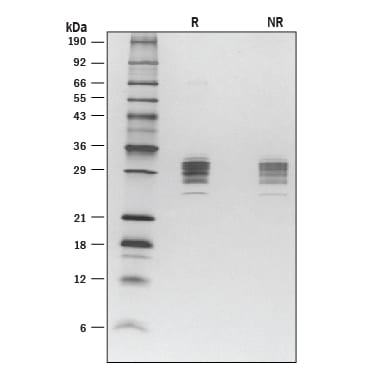
Recombinant Mouse Angiopoietin-like 3 (aa 17-220) SDS-PAGE
1 μg/lane of Recombinant Mouse Angiopoietin-like 3 (Catalog # 8344-AN) was resolved with SDS-PAGE under reducing (R) and non-reducing (NR) conditions and visualized by silver staining, showing both R and NR bands at 23-37 kDa.Formulation, Preparation, and Storage
8344-AN
| Formulation | Lyophilized from a 0.2 μm filtered solution in MOPS,NaCl and CHAPS. |
| Reconstitution | Reconstitute at 100 μg/mL in PBS.
Loading...
|
| Shipping | The product is shipped at ambient temperature. Upon receipt, store it immediately at the temperature recommended below. |
| Stability & Storage | Use a manual defrost freezer and avoid repeated freeze-thaw cycles.
|
Calculators
Background: Angiopoietin-like Protein 3/ANGPTL3
References
- Santulli, G. (2014) Front. Endocrinol. (Lausanne) 5:4.
- Conklin, D. et al. (1999) Genomics 62:477.
- Ge, H. et al. (2005) J. Lipid Res. 46:1484.
- Ono, M. et al. (2003) J. Biol. Chem. 278:41804.
- Koishi, R. et al. (2002) Nat. Genet. 30:151.
- Essalmani, R. et al. (2013) J. Biol. Chem. 288:26410.
- Quagliarini, F. et al. (2012) Proc. Natl. Acad. Sci. USA 109:19751.
- Shimizugawa, T. et al. (2002) J. Biol. Chem. 277:33742.
- Shimamura, M. et al. (2007) Arterioscler. Thromb. Vasc. Biol. 27:366.
- Koster, A. et al. (2005) Endocrinology 146:4943.
- Inaba, T. et al. (2003) J. Biol. Chem. 278:21344.
- Shimamura, M. et al. (2004) Biochem. Biophys. Res. Commun. 322:1080.
- Fugier, C. et al. (2006) J. Biol. Chem. 281:11553.
- Matsusue, K. et al. (2006) Mol. Cell Endocrinol. 256:23.
- Camenisch, G. et al. (2002) J. Biol. Chem. 277:17281.
- Zhang, C.C. et al. (2006) Nat. Med. 12:240.
Alternate Names
Gene Symbol
UniProt
Additional Angiopoietin-like Protein 3/ANGPTL3 Products
- All Products for Angiopoietin-like Protein 3/ANGPTL3
- Angiopoietin-like Protein 3/ANGPTL3 cDNA Clones
- Angiopoietin-like Protein 3/ANGPTL3 ELISA Kits
- Angiopoietin-like Protein 3/ANGPTL3 Lysates
- Angiopoietin-like Protein 3/ANGPTL3 Primary Antibodies
- Angiopoietin-like Protein 3/ANGPTL3 Proteins and Enzymes
- Angiopoietin-like Protein 3/ANGPTL3 Simple Plex
Product Documents for Recombinant Mouse Angiopoietin-like 3 (aa 17-220), CF
Certificate of Analysis
To download a Certificate of Analysis, please enter a lot or batch number in the search box below.
Note: Certificate of Analysis not available for kit components.
Product Specific Notices for Recombinant Mouse Angiopoietin-like 3 (aa 17-220), CF
For research use only
Related Research Areas
Customer Reviews for Recombinant Mouse Angiopoietin-like 3 (aa 17-220), CF
There are currently no reviews for this product. Be the first to review Recombinant Mouse Angiopoietin-like 3 (aa 17-220), CF and earn rewards!
Have you used Recombinant Mouse Angiopoietin-like 3 (aa 17-220), CF?
Submit a review and receive an Amazon gift card!
$25/€18/£15/$25CAN/¥2500 for a review with an image
$10/€7/£6/$10CAN/¥1110 for a review without an image
Submit a review
FAQs for Recombinant Mouse Angiopoietin-like 3 (aa 17-220), CF
-
Q:
This protein datasheet indicates I need to use a cross-linking antibody, Catalog # MAB050, for biological activity. What is this antibody and is it really necessary?
A: The antibody is directed against a 6x histidine repeat and is recommended for use as a cross-linker of proteins with 6x his-tag. Crosslinking is often used for proteins that require receptor trimerization and can result greater biological activity. R&D Systems Quality Control tests the performance of these proteins in the presence of the cross-linking antibody. Therefore, it is necessary to use this antibody when trying to achieve the same level of specific activity described in the datasheet.