
FGF basic (FGF-2, HBGF-2) is one of at least 22 mitogenic proteins of the FGF family, which show 35-60% amino acid conservation (1-3). Unlike other FGFs, FGF acidic and basic lack signal peptides and are secreted by an alternate pathway. Storage pools within the cell or on cell surface heparan sulfate proteoglycans (HSPG) are likely. The predicted 17 kDa FGF basic isoform can be located in both the cytoplasm and the nucleus and is presumed to be the form secreted (4). Transcription from alternate start sites produces 21-24 kDa forms found only in the nucleus. High and low molecular weight human FGF basic targets the expression of different genes when expressed in NIH-3T3 cells (5). The 17 kDa mouse sequence has 98% aa identity with rat, and 95% identity with human, bovine and sheep FGF basic (6, 7). Autocrine, intracrine and paracrine actions of FGF basic have been identified. Binding of FGF to heparin or cell surface HSPG is necessary for binding, dimerization and activation of tyrosine kinase FGF receptors. FGF basic binds other proteins, polysaccharides and lipids with lower affinity (3). Expression of FGF basic is nearly ubiquitous but disruption of the mouse FGF basic gene gives a relatively mild phenotype, suggesting compensation by other FGF family members. FGF basic modulates such normal processes as angiogenesis, wound healing and tissue repair, embryonic development and differentiation, neuronal function and neural degeneration. Transgenic overexpression of FGF basic results in excessive proliferation and angiogenesis reminiscent of a variety of pathological conditions (1-3).
Recombinant Mouse FGF basic/FGF2/bFGF Protein
R&D Systems | Catalog # 3139-FB

Key Product Details
- R&D Systems E. coli-derived Recombinant Mouse FGF basic/FGF2/bFGF Protein (3139-FB)
- Quality control testing to verify active proteins with lot specific assays by in-house scientists
- All R&D Systems proteins are covered with a 100% guarantee
Source
Accession Number
Applications
Product Specifications
Source
Ala11-Ser154
Purity
Endotoxin Level
N-terminal Sequence Analysis
Predicted Molecular Mass
Activity
The ED50 for this effect is 0.3-1.8 ng/mL.
Reviewed Applications
Read 1 review rated 5 using 3139-FB in the following applications:
Scientific Data Images for Recombinant Mouse FGF basic/FGF2/bFGF Protein
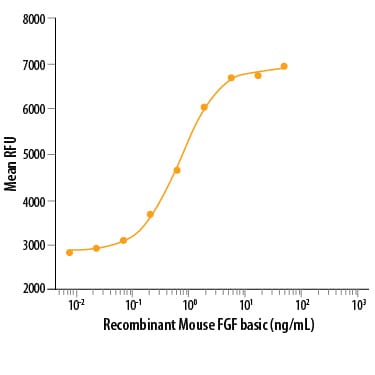
Recombinant Mouse FGF basic/FGF2/bFGF Protein Bioactivity
Recombinant Mouse FGF basic/FGF2/bFGF (Catalog # 3139-FB) stimulates cell proliferation of the NR6R‑3T3 mouse fibroblast cell line. The ED50 for this effect is 0.3-1.8 ng/mL.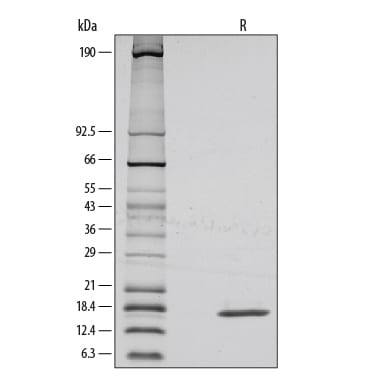
Recombinant Mouse FGF basic/FGF2/bFGF Protein SDS-PAGE
1 μg/lane of Recombinant Mouse FGF basic/FGF2/bFGF was resolved with SDS-PAGE under reducing (R) conditions and visualized by silver staining, showing a single band at 18 kDa.Formulation, Preparation, and Storage
Carrier Free
What does CF mean?CF stands for Carrier Free (CF). We typically add Bovine Serum Albumin (BSA) as a carrier protein to our recombinant proteins. Adding a carrier protein enhances protein stability, increases shelf-life, and allows the recombinant protein to be stored at a more dilute concentration. The carrier free version does not contain BSA.
What formulation is right for me?In general, we advise purchasing the recombinant protein with BSA for use in cell or tissue culture, or as an ELISA standard. In contrast, the carrier free protein is recommended for applications, in which the presence of BSA could interfere.
Carrier: 3139-FB
| Formulation | Lyophilized from a 0.2 μm filtered solution in MOPS, Na2SO4, EDTA and DTT with BSA as a carrier protein. |
| Reconstitution | Reconstitute at 100 μg/mL in sterile PBS containing at least 0.1% human or bovine serum albumin. |
| Shipping | The product is shipped at ambient temperature. Upon receipt, store it immediately at the temperature recommended below. |
| Stability & Storage | Use a manual defrost freezer and avoid repeated freeze-thaw cycles.
|
Carrier Free: 3139-FB/CF
| Formulation | Lyophilized from a 0.2 μm filtered solution in MOPS, Na2SO4, EDTA and DTT. |
| Reconstitution | Reconstitute at 100 μg/mL in sterile PBS. |
| Shipping | The product is shipped at ambient temperature. Upon receipt, store it immediately at the temperature recommended below. |
| Stability & Storage | Use a manual defrost freezer and avoid repeated freeze-thaw cycles.
|
Calculators
Background: FGF basic/FGF2/bFGF
References
- Coulier, F. et al. (1997) J. Mol. Evol. 44:43.
- Fernig, D. et al. (1994) Prog. Growth Factor Res. 5:353.
- Presta, M. et al. (2005) Cytokine. Growth Factor Rev. 16:159.
- Claus, P. et al. (2003) J. Biol. Chem. 278:479.
- Quarto, N. et al. (2005) Gene 356:49.
- Tsuneto, M. et al. (2005) Biochem. Biophys. Res. Comm. 335:1239.
- Hebert, J. M. et al. (1990) Dev. Biol. 138:454.
Long Name
Alternate Names
Gene Symbol
UniProt
Additional FGF basic/FGF2/bFGF Products
Product Documents for Recombinant Mouse FGF basic/FGF2/bFGF Protein
Certificate of Analysis
To download a Certificate of Analysis, please enter a lot or batch number in the search box below.
Note: Certificate of Analysis not available for kit components.
Product Specific Notices for Recombinant Mouse FGF basic/FGF2/bFGF Protein
For research use only
Related Research Areas
Citations for Recombinant Mouse FGF basic/FGF2/bFGF Protein
 Powered by Bioz
Customer Reviews for Recombinant Mouse FGF basic/FGF2/bFGF Protein (1)
Have you used Recombinant Mouse FGF basic/FGF2/bFGF Protein?
Submit a review and receive an Amazon gift card!
$25/€18/£15/$25CAN/¥2500 for a review with an image
$10/€7/£6/$10CAN/¥1110 for a review without an image
Submit a review
-
Application: Cell ProliferationVerified Customer | Posted 09/08/2021
There are no reviews that match your criteria.
FAQs for Recombinant Mouse FGF basic/FGF2/bFGF Protein
-
Q: What receptors does FGF basic bind?
A:
FGF receptor specificity has been reviewed in multiple citations. Please find more information at: //www.rndsystems.com/resources/articles/fibroblast-growth-factors-and-their-receptors


