
Recombinant Mouse Sonic Hedgehog/Shh, N-Terminus Protein
R&D Systems | Catalog # 461-SH

Loading...
Key Product Details
- R&D Systems E. coli-derived Recombinant Mouse Sonic Hedgehog/Shh, N-Terminus Protein (461-SH)
- Quality control testing to verify active proteins with lot specific assays by in-house scientists
- All R&D Systems proteins are covered with a 100% guarantee
Source
E. coli
Accession Number
Applications
Bioactivity
Loading...
Product Specifications
Source
E. coli-derived mouse Sonic Hedgehog/Shh protein
Cys25-Gly198, with a C-terminal 6-His tag
Cys25-Gly198, with a C-terminal 6-His tag
Purity
>97%, by SDS-PAGE under reducing conditions and visualized by silver stain.
Endotoxin Level
<0.10 EU per 1 μg of the protein by the LAL method.
N-terminal Sequence Analysis
Cys25
Predicted Molecular Mass
20 kDa
Activity
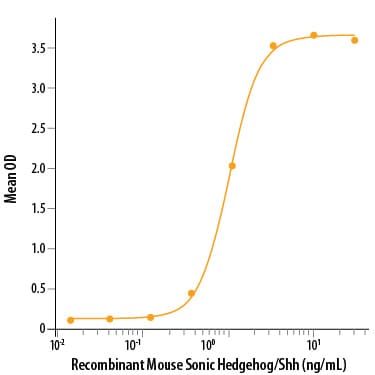
Measured by its ability to induce alkaline phosphatase production by C3H10T1/2 mouse embryonic fibroblast cells. Nakamura, T. et al. (1997) Biochem. Biophys. Res. Commun. 237:465.
The ED50 for this effect is 0.6-3 µg/mL.
The ED50 for this effect is 0.6-3 µg/mL.
Scientific Data Images for Recombinant Mouse Sonic Hedgehog/Shh, N-Terminus Protein
Recombinant Mouse Sonic Hedgehog/Shh, N-Terminus Protein Bioactivity
Recombinant Mouse Sonic Hedgehog/Shh, N-Terminus (Catalog # 461-SH) induces alkaline phosphatase production by the C3H10T1/2 mouse embryonic fibroblast cell line. The ED50 for this effect is 0.6-3 μg/mL.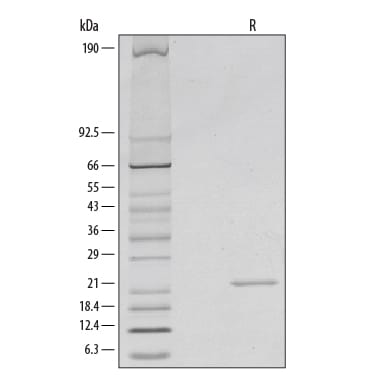
Recombinant Mouse Sonic Hedgehog/Shh, N-Terminus Protein SDS-PAGE
1 μg/lane of Recombinant Mouse Sonic Hedgehog/Shh, N-Terminus was resolved with SDS-PAGE under reducing (R) conditions and visualized by silver staining, showing a single band at 23 kDa.Formulation, Preparation, and Storage
Carrier Free
What does CF mean?CF stands for Carrier Free (CF). We typically add Bovine Serum Albumin (BSA) as a carrier protein to our recombinant proteins. Adding a carrier protein enhances protein stability, increases shelf-life, and allows the recombinant protein to be stored at a more dilute concentration. The carrier free version does not contain BSA.
What formulation is right for me?In general, we advise purchasing the recombinant protein with BSA for use in cell or tissue culture, or as an ELISA standard. In contrast, the carrier free protein is recommended for applications, in which the presence of BSA could interfere.
Carrier: 461-SH
| Formulation | Lyophilized from a 0.2 μm filtered solution in PBS, Trehalose and with BSA as a carrier protein. |
| Reconstitution | Reconstitute at 100 μg/mL in sterile PBS containing at least 0.1% human or bovine serum albumin. |
| Shipping | The product is shipped at ambient temperature. Upon receipt, store it immediately at the temperature recommended below. |
| Stability & Storage | Use a manual defrost freezer and avoid repeated freeze-thaw cycles.
|
Carrier Free: 461-SH/CF
| Formulation | Lyophilized from a 0.2 μm filtered solution in PBS with Trehalose. |
| Reconstitution | Reconstitute at 100 μg/mL in sterile PBS. |
| Shipping | The product is shipped at ambient temperature. Upon receipt, store it immediately at the temperature recommended below. |
| Stability & Storage | Use a manual defrost freezer and avoid repeated freeze-thaw cycles.
|
Calculators
Background: Sonic Hedgehog/Shh
N-terminal cysteine and modified by cholesterol addition at its C-terminus (6). These modifications contribute to the membrane tethering of Shh as well as its assembly into various sized multimers (6-9). Lipid modification and multimerization greatly increase Shh-N receptor binding affinity and signaling potency (5, 6, 8, 9). Monomeric and multimeric Shh can be released from the plasma membrane by the cooperative action of DISP1, SCUBE2, and TACE/ADAM17 (10-12). Modifications also extend the effective range of Shh functionality and are required for the development of protein gradients important in tissue morphogenesis (9, 13). Canonical signaling of Shh is mediated by a multicomponent receptor complex that includes Patched (PTCH1, PTCH2) and Smoothened (SMO) (14). The binding of Shh to PTCH releases the basal repression of SMO by PTCH. Shh activity can also be regulated through interactions with heparin, glypicans, and membrane-associated Hip (hedgehog interacting protein) (13, 15, 16).
References
- Briscoe, J. and P.P. Therond (2013) Mol. Cell. Biol. 14:416.
- Aviles, E.C. et al. (2013) Front. Cell. Neurosci. 7:86.
- Xie, J. et al. (2013) OncoTargets Ther. 6:1425.
- Echelard, Y. et al. (1993) Cell 75:1417.
- Zeng, X. et al. (2001) Nature 411:716.
- Feng, J. et al. (2004) Development 131:4357.
- Goetz, J.A. et al. (2006) J. Biol. Chem. 281:4087.
- Pepinsky, R.B. et al. (1998) J. Biol. Chem. 273:14037.
- Chen, M.-H. et al. (2004) Genes Dev. 18:641.
- Etheridge, L.A. et al. (2010) Development 137:133.
- Jakobs, P. et al. (2014) J. Cell Sci. 127:1726.
- Dierker, T. et al. (2009) J. Biol. Chem. 284:8013.
- Lewis, P.M. et al. (2001) Cell 105:599.
- Carpenter, D. et al. (1998) Proc. Natl. Acad. Sci. USA 95:13630.
- Filmus, J. and M. Capurro (2014) Matrix Biol. 35:248.
- Chuang, P.-T. and A.P. McMahon (1999) Nature 397:617.
Alternate Names
HHG1, HLP3, HPE3, MCOPCB5, Shh, ShhNC, SMMCI, TPTPS
Gene Symbol
SHH
UniProt
Additional Sonic Hedgehog/Shh Products
Product Documents for Recombinant Mouse Sonic Hedgehog/Shh, N-Terminus Protein
Certificate of Analysis
To download a Certificate of Analysis, please enter a lot or batch number in the search box below.
Note: Certificate of Analysis not available for kit components.
Product Specific Notices for Recombinant Mouse Sonic Hedgehog/Shh, N-Terminus Protein
For research use only
Citations for Recombinant Mouse Sonic Hedgehog/Shh, N-Terminus Protein
 Powered by Bioz
Customer Reviews for Recombinant Mouse Sonic Hedgehog/Shh, N-Terminus Protein
There are currently no reviews for this product. Be the first to review Recombinant Mouse Sonic Hedgehog/Shh, N-Terminus Protein and earn rewards!
Have you used Recombinant Mouse Sonic Hedgehog/Shh, N-Terminus Protein?
Submit a review and receive an Amazon gift card!
$25/€18/£15/$25CAN/¥2500 for a review with an image
$10/€7/£6/$10CAN/¥1110 for a review without an image
Submit a review
FAQs for Recombinant Mouse Sonic Hedgehog/Shh, N-Terminus Protein
Showing
1
-
1 of
1 FAQ
Showing All
-
Q: What is the difference between Recombinant Mouse Sonic Hedgehog Catalog # 464-SH and Catalog # 461-SH?
A: Recombinant Mouse Sonic Hedgehog, Catalog # 464-SH, possesses a N-terminal mutation that increases its potency in bioassay tests. The amino acid sequence is Cys25-Gly198 (Cys25Ile-Ile), accession number Q62226. The Cys25Ile-Ile mutation was created to match a publication that describes enhanced activity with these modifications: "http://www.ncbi.nlm.nih.gov/pubmed/11284692". Catalog # 461-SH does not possess this mutation.

