Recombinant Mouse Thrombomodulin/BDCA-3 Protein, CF

R&D Systems | Catalog # 3894-PA

R&D Systems
Loading...

Key Product Details

  • R&D Systems NS0-derived Recombinant Mouse Thrombomodulin/BDCA-3 Protein (3894-PA)
  • Quality control testing to verify active proteins with lot specific assays by in-house scientists
  • All R&D Systems proteins are covered with a 100% guarantee

Source

NS0

Accession Number

Applications

Enzyme Activity
Loading...

Product Specifications

Source

Mouse myeloma cell line, NS0-derived mouse Thrombomodulin/BDCA-3 protein
Leu17-Ser517, with a C-terminal 6-His tag

Purity

>90%, by SDS-PAGE under reducing conditions and visualized by silver stain.

Endotoxin Level

<1.0 EU per 1 μg of the protein by the LAL method.

N-terminal Sequence Analysis

Leu17 & Lys22

Predicted Molecular Mass

55 kDa

SDS-PAGE

90-100 kDa, reducing conditions

Activity

Measured by its ability to mediate thrombin activation of protein C.


Formulation, Preparation, and Storage

3894-PA
Formulation Supplied as a 0.2 μm filtered solution in Tris and NaCl.
Shipping The product is shipped with polar packs. Upon receipt, store it immediately at the temperature recommended below.
Stability & Storage Use a manual defrost freezer and avoid repeated freeze-thaw cycles.
  • 6 months from date of receipt, -20 to -70 °C as supplied.
  • 3 months, -20 to -70 °C under sterile conditions after opening.

Background: Thrombomodulin/BDCA-3

Encoded by the THBD gene, Thrombomodulin is also known as CD141 antigen and blood dendritic cell antigen 3 (BDCA-3). The deduced amino acid sequence of mouse THBD predicts a signal peptide (aa 1 to 16) and a mature chain (aa 17 to 577) that consists of the following domains: C-type lectin (aa 31 to 167), EGF-like (aa 240 to 280, aa 283 to 323, aa 324 to 362, aa 364 to 404, aa 405 to 439, and aa 440 to 480), transmembrane (aa 518 to 541) and cytoplasmic (aa 542 to 577) (1). The R&D Systems recombinant mouse THBD consists of aa 17 to 517, corresponding to the extracellular portion of the type I membrane protein.

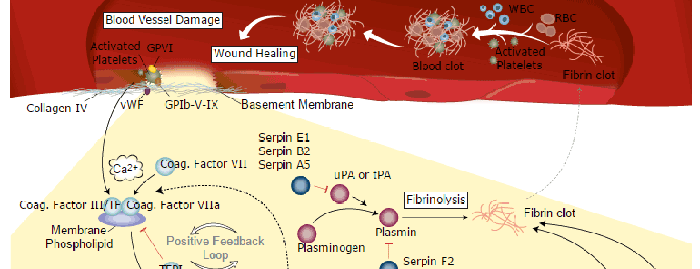
Predominantly synthesized by vascular endothelial cells, THBD inhibits coagulation and fibrinolysis (2‑4). It functions as a cell surface receptor and an essential cofactor for active thrombin, which in turn activates protein C and thrombin-activatable fibrinolysis inhibitor (TAFI), also known as carboxypeptidase B2 (CPB2). Activated protein C (APC), facilitated by protein S, degrades coagulation factors Va and VIIIa, which are required for thrombin activation. Activated CPB2 cleaves basic C-terminal amino acid residues of its substrates, including fibrin, preventing the conversion of plasminogen to plasmin. In addition, THBD gene polymorphisims are associated with human disease and THBD plays a role in thrombosis, stroke, arteriosclerosis, and cancer (5). For example, increased serum levels of THBD, due to protease cleavage, have been associated with smoking, cardiac surgery, atherosclerosis, liver cirrhosis, diabetes mellitus, cerebral and myocardial infarction, and multiple sclerosis (6).

References

  1. Dittman, W.A. and P.W. Majerus (1989) Nucleic Acids Res. 17:802.
  2. Van de Wouwer, M. et al. (2004) Arterioscler. Thromb. Vasc. 24:1374.
  3. Wu, K.K. et al. (2000) Ann Med. 32:73.
  4. Li, Y.H. et al. (2006) Cardiovasc. Hematol. Agents Med. Chem. 4:183.
  5. Weiler, H. and B.H. Isermann (2003) J. Thromb. Haemost. 1:1515.
  6. Califano, F. et al. (2000) Eur. Rev. Med. Pharmacol. Sci. 4:59.

Alternate Names

BDCA-3, BDCA3, CD141, Fetomodulin, THBD, THRM

Entrez Gene IDs

7056 (Human); 21824 (Mouse); 83580 (Rat)

Gene Symbol

THBD

UniProt

Additional Thrombomodulin/BDCA-3 Products

Product Documents for Recombinant Mouse Thrombomodulin/BDCA-3 Protein, CF

Certificate of Analysis

To download a Certificate of Analysis, please enter a lot or batch number in the search box below.

Note: Certificate of Analysis not available for kit components.

Product Specific Notices for Recombinant Mouse Thrombomodulin/BDCA-3 Protein, CF

For research use only

Citations for Recombinant Mouse Thrombomodulin/BDCA-3 Protein, CF

Customer Reviews for Recombinant Mouse Thrombomodulin/BDCA-3 Protein, CF

There are currently no reviews for this product. Be the first to review Recombinant Mouse Thrombomodulin/BDCA-3 Protein, CF and earn rewards!

Have you used Recombinant Mouse Thrombomodulin/BDCA-3 Protein, CF?

Submit a review and receive an Amazon gift card!

$25/€18/£15/$25CAN/¥2500 Yen for a review with an image

$10/€7/£6/$10CAN/¥1110 Yen for a review without an image

Submit a review
Amazon Gift Card

Protocols

View specific protocols for Recombinant Mouse Thrombomodulin/BDCA-3 Protein, CF (3894-PA):

Materials
  • Activation Buffer: 0.05 M Tris, 0.01 M CaCl2, 0.15 M NaCl, 0.05 % Brij-35, pH 7.5 (TCNB)
  • Recombinant Human Coagulation Factor II/Thrombin (rhThrombin) (Catalog # 1473-SE)
  • Recombinant Mouse Thrombomodulin/BDCA‑3 (rmTHBD) (Catalog # 3894-PA)
  • Recombinant Human Coagulation Factor XIV/Protein C (rhPROC) (Catalog # 3349-SE)
  • Recombinant Human Serpin C1 (rhSerpin C1) (Catalog # 1267-PI)
  • Heparin (Sigma-Aldrich, Catalog # H3393), 20 mg/mL in deionized water
  • Assay Buffer: 0.05 M Tris, 0.1 M NaCl, 0.01% Brij-35, pH 8.5
  • Substrate: BOC-Val-Pro-Arg-AMC (Catalog # ES011)
  • F16 Black Maxisorp Plate (Nunc, Catalog # 475515)
  • Fluorescent Plate Reader (Model: SpectraMax Gemini EM by Molecular Devices) or equivalent
  1. Dilute rhThrombin to 4 μg/mL in Activation Buffer.
  2. Dilute rmTHBD to 1.2 μg/mL in Activation Buffer.
  3. Dilute rhPROC to 40 μg/mL in Activation Buffer.
  4. Combine 25 μL of the diluted rhPROC, 12.5 μL of the diluted rhThrombin, and 12.5 μL of the diluted rmTHBD in a microfuge tube. Incubate for one hour at 37 °C to activate rhPROC. As a control combine 25 μL of the diluted rhPROC, 12.5 μL of the diluted rhThrombin, and 12.5 μL of Activation Buffer in a microfuge tube.
  5. Dilute rhSerpin C1 to 20 μg/mL with 2.7 μg/mL heparin in Activation Buffer.
  6. Add and mix 50 μL of the diluted rhSerpin C1/heparin solution to the reaction vials. Incubate at room temperature for 30 minutes to stop rhThrombin activity.
  7. Dilute the reaction mixture 1:5 in Assay Buffer.
  8. Dilute Substrate to 200 μM in Assay Buffer.
  9. Load in a black well plate (F16 Black Maxisorp Plate, Nunc Catalog # 475515) 50 μL of 2 μg/mL of rhPROC (100 ng/well), and start the reaction by adding 50 μL of 200 μM Substrate.
  10. Read (top read) immediately in kinetic mode for 5 minutes at excitation and emission wavelengths of 380 nm and 460 nm, respectively.
  11. Calculate specific activity:

     Specific Activity (pmol/min/µg) =

Adjusted Vmax* (RFU/min) x Conversion Factor** (pmol/RFU)
amount of enzyme (µg)

      *Adjusted for control containing no rmTHBD
      **Derived using calibration standard 7-Amino, 4-Methyl Coumarin (Sigma-Aldrich, Catalog # A9891).

Per Well:

  • rhPROC: 0.1 μg
  • rmTHBD: 1.5 ng
  • Substrate: 100 μM

FAQs

No product specific FAQs exist for this product.

View all FAQs for Proteins and Enzymes