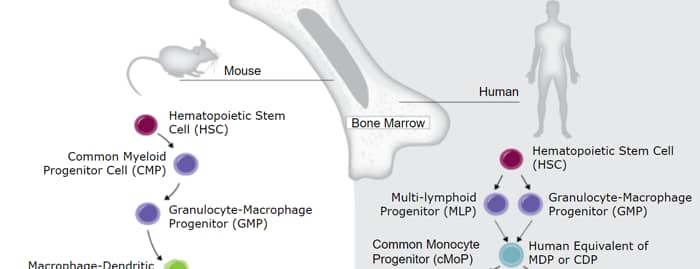
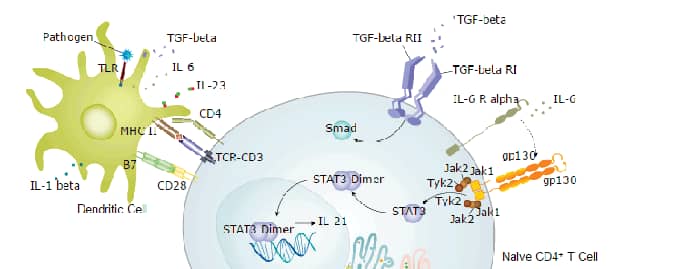
TLR9 (Toll‑like receptor 9), designated CD289, is a member of the TLR family of innate immune receptors that is mainly expressed by colonic epithelium, CD123+ plasmacytoid predendritic cells (pDC), and splenic transitional B cells (1‑9). TLR9 responds to unmethylated DNA CpG motifs that occur mainly in bacteria and viruses (1, 2). Mouse TLR9 cDNA encodes a 1032 amino acid (aa) type I transmembrane glycoprotein with a 793 aa extracellular domain (ECD) that contains 26 leucine‑rich repeats (LRRs, aa 26‑818), and a 193 aa cytoplasmic domain with a TIR sequence that dimerizes with signaling adaptors such as MyD88 (1). The mouse TLR9 ECD shares 87% aa sequence identity with rat and 71‑74% with human, feline, canine, equine, porcine, bovine and ovine TLR9. Predicted splice forms vary at the N‑terminus by initiating either upstream or downstream of the standard site. The full-length 150 kDa form, which is ligand‑binding but nonsignaling, is found in the endoplasmic reticulum. It undergoes accessory protein-mediated translocation either to the cell membrane or to lysosomes (1‑3). TLR9 is cleaved to remove LRR1‑14, producing an 80 kDa signaling fragment within acidic endolysosomes where it encounters microbial CpG DNA rather than self-DNA (2, 10, 11). However, immune complexes of self‑DNA with lupus erythematosus anti‑DNA antibodies can induce TLR9 activation and IFN‑ alpha production in pDC (4). A soluble form also found in endosomes includes all 26 LRRs and negatively regulates active TLR9 (12). Activation of TLR9 contributes to splenocyte proliferation, pDC maturation, macrophage inflammatory cytokine production, Th1 inflammatory responses, NK cell activation and recruitment, B cell surface MHC class II up‑regulation and immunoglobulin production, and generation and maintenance of memory B cells (1, 5‑9).
Recombinant Mouse TLR9 Fc Chimera Protein, CF
R&D Systems | Catalog # 7960-TR

Loading...
Key Product Details
- R&D Systems CHO-derived Recombinant Mouse TLR9 Fc Chimera Protein (7960-TR)
- Quality control testing to verify active proteins with lot specific assays by in-house scientists
- All R&D Systems proteins are covered with a 100% guarantee
Source
CHO
Accession Number
Structure / Form
Disulfide-linked homodimer
Applications
Bioactivity
Loading...
Product Specifications
Source
Chinese Hamster Ovary cell line, CHO-derived mouse TLR9 protein
| Mouse TLR9 (Leu26-Asp818) Accession # AAK29625 |
IEGRMDP | Mouse IgG2A (Glu98-Lys330) |
| N-terminus | C-terminus |
Purity
>95%, by SDS-PAGE under reducing conditions and visualized by silver stain.
Endotoxin Level
<0.10 EU per 1 μg of the protein by the LAL method.
N-terminal Sequence Analysis
Leu26
Predicted Molecular Mass
115.8 kDa (monomer)
SDS-PAGE
140-170 kDa, reducing conditions
Activity
Measured by its ability to bind biotinylated CpG oligodeoxynucleotide, type B. The 50% maximum binding is achieved at 30‑150 ng/mL of Recombinant Mouse TLR9 Fc Chimera.
Optimal dilutions should be determined by each laboratory for each application.
Optimal dilutions should be determined by each laboratory for each application.
Formulation, Preparation, and Storage
7960-TR
| Formulation | Lyophilized from a 0.2 μm filtered solution in PBS. |
| Reconstitution | Reconstitute at 100 μg/mL in PBS.
Loading...
|
| Shipping | The product is shipped at ambient temperature. Upon receipt, store it immediately at the temperature recommended below. |
| Stability & Storage | Use a manual defrost freezer and avoid repeated freeze-thaw cycles.
|
Calculators
Background: TLR9
References
- Hemmi, H. et al. (2000) Nature 408:740.
- Barton, G.M. et al. (2006) Nat. Immunol. 7:49.
- Latz, E. et al. (2004) Nat. Immunol. 5:190.
- Barrat, F.J. et al. (2005) J. Exp. Med. 202:1131.
- Krieg, A.M. et al. (1995) Nature 374:546.
- Aranburu, A. et al. (2010) J. Immunol. 185:7293.
- Guerrier, T. et al. (2012) J. Autoimmun. 39:173.
- Guillerey, C. et al. (2012) Blood 120:90.
- Cunningham-Rundles, C. et al. (2006) J. Immunol. 176:1978.
- Ewald, S.E. et al. (2008) Nature 456:658.
- Park, B. et al. (2008) Nat. Immunol. 9:1407.
- Chockalingam, A. et al. (2011) Eur. J. Immunol. 41:2176.
Long Name
Toll-like Receptor 9
Alternate Names
CD289
Gene Symbol
TLR9
UniProt
Additional TLR9 Products
Product Documents for Recombinant Mouse TLR9 Fc Chimera Protein, CF
Certificate of Analysis
To download a Certificate of Analysis, please enter a lot or batch number in the search box below.
Note: Certificate of Analysis not available for kit components.
Product Specific Notices for Recombinant Mouse TLR9 Fc Chimera Protein, CF
For research use only
Citations for Recombinant Mouse TLR9 Fc Chimera Protein, CF
 Powered by Bioz
Customer Reviews for Recombinant Mouse TLR9 Fc Chimera Protein, CF
There are currently no reviews for this product. Be the first to review Recombinant Mouse TLR9 Fc Chimera Protein, CF and earn rewards!
Have you used Recombinant Mouse TLR9 Fc Chimera Protein, CF?
Submit a review and receive an Amazon gift card!
$25/€18/£15/$25CAN/¥2500 for a review with an image
$10/€7/£6/$10CAN/¥1110 for a review without an image
Submit a review
Loading...
Associated Pathways