

Key Product Details
Species Reactivity
Human
Applications
Immunocytochemistry/ Immunofluorescence
Label
Unconjugated
Antibody Source
Polyclonal Rabbit IgG
Format
BSA Free
Loading...
Product Specifications
Immunogen
Produced in rabbits immunized with E. coli-derived Human TET1 fragment.
Clonality
Polyclonal
Host
Rabbit
Isotype
IgG
Description
This antibody can be stored at 2C to 8C for one month without detectable loss of activity. Antibody products are stable for twelve months from date of receipt when stored at -20C to -80C. Avoid repeated freeze-thaw cycles.
Scientific Data Images for TET1 Antibody - BSA Free
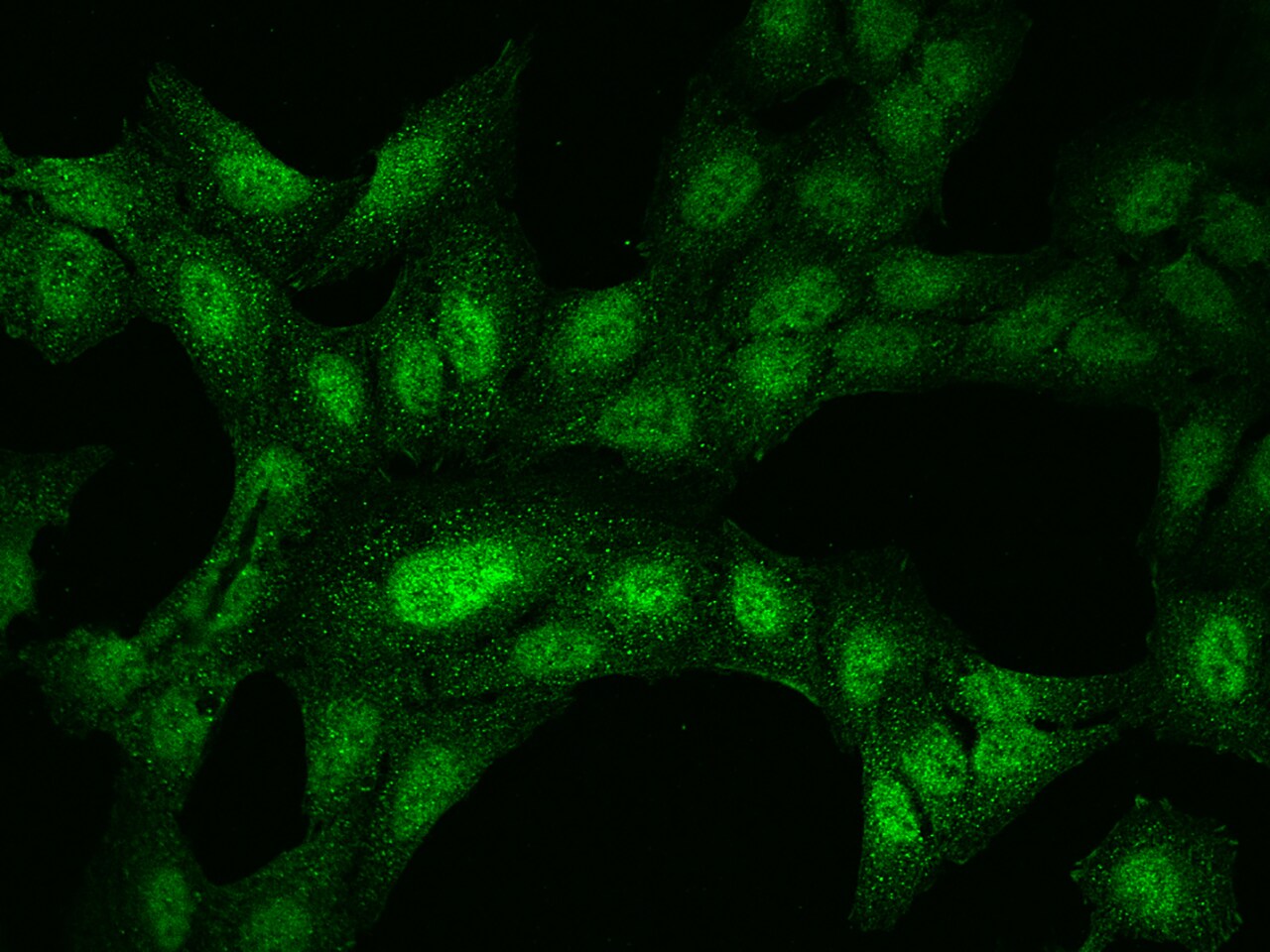
Immunocytochemistry/Immunofluorescence: TET1 Antibody [NBP2-97605] -
Immunocytochemistry/Immunofluorescence: TET1 Antibody [NBP2-97605] - Immunofluorescence staining of TET1 in U2OS cells. Cells were fixed with 4% PFA, permeabilzed with 0.1% Triton X-100 in PBS, blocked with 10% serum, and incubated with NBP2-97605 antibody (dilution ratio 1:200) at 4C overnight. Then cells were stained with the Alexa Fluor(R)488-conjugated Goat Anti-rabbit IgG secondary antibody (green). Positive staining was localized to Nucleus.Applications for TET1 Antibody - BSA Free
Application
Recommended Usage
Immunocytochemistry/ Immunofluorescence
1:100-1:500
Formulation, Preparation, and Storage
Purification
Antigen and protein A Affinity-purified
Formulation
PBS
Format
BSA Free
Preservative
0.03% Proclin 300
Concentration
Please see the vial label for concentration. If unlisted please contact technical services.
Shipping
The product is shipped with polar packs. Upon receipt, store it immediately at the temperature recommended below.
Stability & Storage
Store at 4C short term. Aliquot and store at -20C long term. Avoid freeze-thaw cycles.
Background: TET1
Recent studies have shown a role for TET1 in mediating epigenetic changes, such as DNA methylation status, in response to environmental factors such as food and nutrition, exercise, radiation, and allergens (3). The balance between DNA methylation and demethylation is crucial in health and homeostasis (3,5). In addition to response to environmental exposures, TET1 also plays a role in different diseases and cancer subtypes where it can function as either a tumor suppressor or tumor promoter (2,5). TET1 was originally identified as a fusion partner for the mixed lineage leukemia (MLL) gene in acute myeloid leukemia (AML) (1-3). While TET1 expression is low in AML, it is highly expressed in T-cell acute lymphoblastic leukemia (T-ALL) (2). Similarly, TET1 expression is suppressed in hormone receptor positive breast cancer (HRBC) but elevated in triple negative breast cancer (2). TET1 is a potential therapeutic target in certain cancers, but due to its complex role in different signaling pathways its potential needs to be more widely studied (2). While TET1 is primarily responsible for initiating DNA demethylation, it also functions alongside 5hmc in maintaining pluripotency in embryonic stem cells (ESCs) and can serve as a marker for differentiation (1,2,4,5).
References
1. Tan L, Shi YG. Tet family proteins and 5-hydroxymethylcytosine in development and disease. Development. 2012;139(11):1895-1902. https://doi.org/10.1242/dev.070771
2. Liu W, Wu G, Xiong F, Chen Y. Advances in the DNA methylation hydroxylase TET1. Biomark Res. 2021;9(1):76. https://doi.org/10.1186/s40364-021-00331-7
3. Zhu T, Brown AP, Ji H. The Emerging Role of Ten-Eleven Translocation 1 in Epigenetic Responses to Environmental Exposures. Epigenet Insights. 2020;13:2516865720910155. https://doi.org/10.1177/2516865720910155
4. Melamed P, Yosefzon Y, David C, Tsukerman A, Pnueli L. Tet Enzymes, Variants, and Differential Effects on Function. Front Cell Dev Biol. 2018;6:22. https://doi.org/10.3389/fcell.2018.00022
5. Ma C, Seong H, Liu Y, Yu X, Xu S, Li Y. Ten-eleven translocation proteins (TETs): tumor suppressors or tumor enhancers?. Front Biosci (Landmark Ed). 2021;26(10):895-915. https://doi.org/10.52586/4996
6. Uniprot (Q8NFU7)
Long Name
Methylcytosine dioxygenase TET1
Alternate Names
CXXC6, EC 1.14.11.n2, KIAA1676, LCX
Gene Symbol
TET1
Additional TET1 Products
Product Documents for TET1 Antibody - BSA Free
Certificate of Analysis
To download a Certificate of Analysis, please enter a lot or batch number in the search box below.
Product Specific Notices for TET1 Antibody - BSA Free
This product is for research use only and is not approved for use in humans or in clinical diagnosis. Primary Antibodies are guaranteed for 1 year from date of receipt.
Customer Reviews for TET1 Antibody - BSA Free
There are currently no reviews for this product. Be the first to review TET1 Antibody - BSA Free and earn rewards!
Have you used TET1 Antibody - BSA Free?
Submit a review and receive an Amazon gift card!
$25/€18/£15/$25CAN/¥2500 for a review with an image
$10/€7/£6/$10CAN/¥1110 for a review without an image
Submit a review
Protocols
Find general support by application which include: protocols, troubleshooting, illustrated assays, videos and webinars.
- Appropriate Fixation of IHC/ICC Samples
- Cellular Response to Hypoxia Protocols
- ClariTSA™ Fluorophore Kits
- Detection & Visualization of Antibody Binding
- ICC Cell Smear Protocol for Suspension Cells
- ICC Immunocytochemistry Protocol Videos
- ICC for Adherent Cells
- Immunocytochemistry (ICC) Protocol
- Immunocytochemistry Troubleshooting
- Immunofluorescence of Organoids Embedded in Cultrex Basement Membrane Extract
- Immunohistochemistry (IHC) and Immunocytochemistry (ICC) Protocols
- Preparing Samples for IHC/ICC Experiments
- Preventing Non-Specific Staining (Non-Specific Binding)
- Primary Antibody Selection & Optimization
- Protocol for VisUCyte™ HRP Polymer Detection Reagent
- Protocol for the Fluorescent ICC Staining of Cell Smears - Graphic
- Protocol for the Fluorescent ICC Staining of Cultured Cells on Coverslips - Graphic
- Protocol for the Preparation and Fluorescent ICC Staining of Cells on Coverslips
- Protocol for the Preparation and Fluorescent ICC Staining of Non-adherent Cells
- Protocol for the Preparation and Fluorescent ICC Staining of Stem Cells on Coverslips
- Protocol for the Preparation of a Cell Smear for Non-adherent Cell ICC - Graphic
- TUNEL and Active Caspase-3 Detection by IHC/ICC Protocol
- The Importance of IHC/ICC Controls
- View all Protocols, Troubleshooting, Illustrated assays and Webinars
Loading...