
TLR8 Antibody (935166) [DyLight 405]
Novus Biologicals | Catalog # FAB8999E

Key Product Details
Species Reactivity
Human
Applications
Flow Cytometry, CyTOF-ready
Label
DyLight 405 (Excitation = 400 nm, Emission = 420 nm)
Antibody Source
Recombinant Monoclonal Mouse IgG2B Clone # 935166
Loading...
Product Specifications
Immunogen
Chinese hamster ovary cell line CHO-derived recombinant human TLR8
Glu27-Thr827
Accession # Q9NR97
Glu27-Thr827
Accession # Q9NR97
Specificity
Detects human TLR8 in direct ELISAs.
Clonality
Monoclonal
Host
Mouse
Isotype
IgG2B
Description
This conjugate is made on demand and is not held in inventory. Each order represents a unique lot. All conjugates are generated using validated conjugation protocols and meet strict degree of labeling (F/P) specifications; additional information is available upon request. The antibody concentration is provided on the individual product label.
For specialized conjugation needs, like large quantities, specific concentrations, and defined F/P ratios, bulk and custom antibody conjugation services are available.
For specialized conjugation needs, like large quantities, specific concentrations, and defined F/P ratios, bulk and custom antibody conjugation services are available.
Applications for TLR8 Antibody (935166) [DyLight 405]
Application
Recommended Usage
CyTOF-ready
Optimal dilutions of this antibody should be experimentally determined.
Flow Cytometry
Optimal dilutions of this antibody should be experimentally determined.
Application Notes
Recommended applications are based on validated applications from the unconjugated base product MAB8999. This conjugated antibody is not kept in inventory and is made to order using validated conjugation protocols.
Spectra Viewer
Plan Your Experiments
Use our spectra viewer to interactively plan your experiments, assessing multiplexing options. View the excitation and emission spectra for our fluorescent dye range and other commonly used dyes.
Spectra Viewer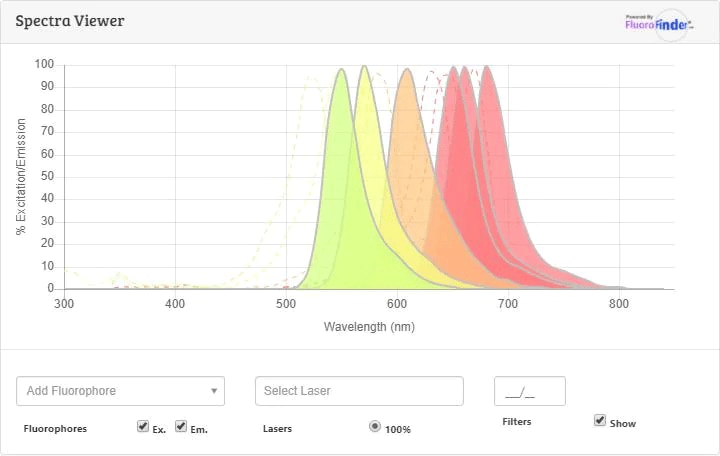
Flow Cytometry Panel Builder
Bio-Techne Knows Flow Cytometry
Save time and reduce costly mistakes by quickly finding compatible reagents using the Panel Builder Tool.
Advanced Features
- Spectra Viewer - Custom analysis of spectra from multiple fluorochromes
- Spillover Popups - Visualize the spectra of individual fluorochromes
- Antigen Density Selector - Match fluorochrome brightness with antigen density

Formulation, Preparation, and Storage
Purification
Protein A or G purified from hybridoma culture supernatant
Formulation
50mM Sodium Borate
Preservative
0.05% Sodium Azide
Concentration
Please see the vial label for concentration. If unlisted please contact technical services.
Shipping
The product is shipped with polar packs. Upon receipt, store it immediately at the temperature recommended below.
Stability & Storage
Store at 4C in the dark.
Background: TLR8
TLR8 is highly similar to TLR7 and both pathways are mediated by the adapter protein MyD88 to signal through IFN regulatory factor 7 (IRF7) and nuclear factor (NF)-kappaB (1-3,5). However, TLR7 recognizes guanosine and GU-rich ssRNA, while TLR8 recognizes uridine and AU-rich sequences (2,5). TLR7/TLR8 agonists, including derivatives of the immunostimulatory imiquimod, have been shown to be a promising cancer therapy capable of providing anticancer signals to antigen presenting cells (APCs), with many agonists being tested in both pre-clinical and clinical trials (6). Similarly, studies suggest that agonists for TLR8, in combination with other individual TLR agonists and antagonists, may also be useful for treating inflammatory allergic diseases, such as allergic rhinitis (7).
References
1. Sakaniwa, K., & Shimizu, T. (2020). Targeting the innate immune receptor TLR8 using small-molecule agents. Acta crystallographica. Section D, Structural biology, 76(Pt 7). https://doi.org/10.1107/S2059798320006518
2. Cervantes, J. L., Weinerman, B., Basole, C., & Salazar, J. C. (2012). TLR8: the forgotten relative revindicated. Cellular & molecular immunology. https://doi.org/10.1038/cmi.2012.38
3. Ohto, U., Tanji, H., & Shimizu, T. (2014). Structure and function of toll-like receptor 8. Microbes and infection. https://doi.org/10.1016/j.micinf.2014.01.007
4. Uniprot (Q9NR97)
5. Jannuzzi, G. P., de Almeida, J., Paulo, L., de Almeida, S. R., & Ferreira, K. S. (2020). Intracellular PRRs Activation in Targeting the Immune Response Against Fungal Infections. Frontiers in cellular and infection microbiology. https://doi.org/10.3389/fcimb.2020.591970
6. Frega, G., Wu, Q., Le Naour, J., Vacchelli, E., Galluzzi, L., Kroemer, G., & Kepp, O. (2020). Trial Watch: experimental TLR7/TLR8 agonists for oncological indications. Oncoimmunology. https://doi.org/10.1080/2162402X.2020.1796002
7. Golshiri-Isfahani, A., Amizadeh, M., & Arababadi, M. K. (2018). The roles of toll like receptor 3, 7 and 8 in allergic rhinitis pathogenesis. Allergologia et immunopathologia. https://doi.org/10.1016/j.aller.2017.09.026
Long Name
Toll-like Receptor 8
Alternate Names
CD288
Gene Symbol
TLR8
Additional TLR8 Products
Product Documents for TLR8 Antibody (935166) [DyLight 405]
Certificate of Analysis
To download a Certificate of Analysis, please enter a lot or batch number in the search box below.
Product Specific Notices for TLR8 Antibody (935166) [DyLight 405]
DyLight (R) is a trademark of Thermo Fisher Scientific Inc. and its subsidiaries.
This product is for research use only and is not approved for use in humans or in clinical diagnosis. Primary Antibodies are guaranteed for 1 year from date of receipt.
Customer Reviews for TLR8 Antibody (935166) [DyLight 405]
There are currently no reviews for this product. Be the first to review TLR8 Antibody (935166) [DyLight 405] and earn rewards!
Have you used TLR8 Antibody (935166) [DyLight 405]?
Submit a review and receive an Amazon gift card!
$25/€18/£15/$25CAN/¥2500 for a review with an image
$10/€7/£6/$10CAN/¥1110 for a review without an image
Submit a review
Protocols
Find general support by application which include: protocols, troubleshooting, illustrated assays, videos and webinars.
- 7-Amino Actinomycin D (7-AAD) Cell Viability Flow Cytometry Protocol
- Extracellular Membrane Flow Cytometry Protocol
- Flow Cytometry Protocol for Cell Surface Markers
- Flow Cytometry Protocol for Staining Membrane Associated Proteins
- Flow Cytometry Staining Protocols
- Flow Cytometry Troubleshooting Guide
- Intracellular Flow Cytometry Protocol Using Alcohol (Methanol)
- Intracellular Flow Cytometry Protocol Using Detergents
- Intracellular Nuclear Staining Flow Cytometry Protocol Using Detergents
- Intracellular Staining Flow Cytometry Protocol Using Alcohol Permeabilization
- Intracellular Staining Flow Cytometry Protocol Using Detergents to Permeabilize Cells
- Propidium Iodide Cell Viability Flow Cytometry Protocol
- Protocol for Liperfluo
- Protocol for the Characterization of Human Th22 Cells
- Protocol for the Characterization of Human Th9 Cells
- Protocol: Annexin V and PI Staining by Flow Cytometry
- Protocol: Annexin V and PI Staining for Apoptosis by Flow Cytometry
- Troubleshooting Guide: Fluorokine Flow Cytometry Kits
- View all Protocols, Troubleshooting, Illustrated assays and Webinars


