
VEGF Antibody - BSA Free
Novus Biologicals | Catalog # NB100-2381

![Western Blot: VEGF AntibodyBSA Free [NB100-2381]](https://resources.rndsystems.com/images/products/VEGFA-Antibody-Western-Blot-NB100-2381-img0005.jpg "Western Blot: VEGF AntibodyBSA Free [NB100-2381]")
Scientific images may be resized, cropped, or adjusted for brightness or contrast for presentation purposes. These updates are limited to presentation and do not affect the underlying scientific interpretation of the data. Where available, additional source data may be provided upon request.
Key Product Details
Species Reactivity
Validated:
Human, Mouse, Rat, Bovine, Canine, Chicken, Equine, Guinea Pig
Cited:
Human, Mouse, Rat, Avian - Chicken
Applications
Validated:
Western Blot, ELISA
Cited:
Western Blot, ELISA
Label
Unconjugated
Antibody Source
Polyclonal Rabbit IgG
Format
BSA Free
Loading...
Product Specifications
Immunogen
A synthetic peptide made to an internal region of the human VEGFA protein sequence (between residues 180-232). [Swiss-Prot: P15692]
Localization
Secreted
Clonality
Polyclonal
Host
Rabbit
Isotype
IgG
Scientific Data Images for VEGF Antibody - BSA Free
Western Blot: VEGF AntibodyBSA Free [NB100-2381]
Western Blot: VEGF Antibody [NB100-2381] - Detection of VEGFA doublet in CSF-IR/VEGFA chimera transfected lysate using.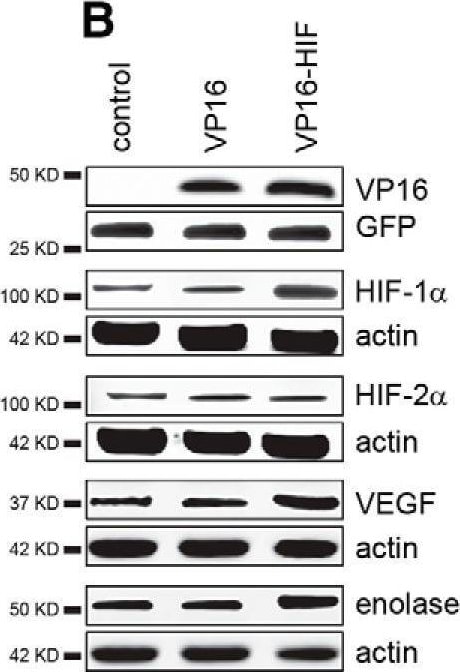
Western Blot: VEGF Antibody - BSA Free [NB100-2381] -
HIF-1 alpha protein and HIF-1 alpha target genes are elevated in SCs following retrovirus administration. Expression of mRNA for VP16, HIF-1 alpha, and beta -actin in transfected SCs was confirmed by PCR in VP16 and VP16-HIF SCs (A). Protein expression of VP16, HIF-1 alpha, HIF-2 alpha, VEGF, enolase, and protein loading controls (GFP or beta -actin) in transfected SCs was assessed by western blotting (B). Protein expression was normalized to the loading control. Relative intensity of VP16 expression is shown in C, and the fold change in protein expression relative to control SCs is shown for HIF-1 alpha (D) HIF-2 alpha (E), VEGF (F), and enolase (G). Values are as follows: VP16 (control: 0.0 +/- 0.0; VP16: 0.40 +/- 0.01; VP16-HIF: 0.41 +/- 0.00); HIF-1 alpha (control: 1.0 +/- 0.04; VP16: 1.0 +/- 0.04; VP16-HIF: 5.9 +/- 0.01); HIF-2 alpha (control: 1.0 +/- 0.01; VP16: 1.0 +/- 0.01; VP16-HIF: 1.0 +/- 0.02); VEGF (control: 1.0 +/- 0.01; VP16: 1.02 +/- 0.02; VP16-HIF: 2.2 +/- 0.01); enolase (control: 1.0 +/- 0.01; VP16: 1.0 +/- 0.04; VP16-HIF: 1.7 +/- 0.00); n = 3/group. Mean +/- SEM, *p < 0.0001. Figure Contributions: Veena Kandaswamy generated the VP16-HIF cells. Veena Kandaswamy performed the PCRs. Ying Dai performed the western blottings. Ying Dai and Caitlin Hill analyzed the data. Image collected and cropped by CiteAb from the following open publication (https://pubmed.ncbi.nlm.nih.gov/31488552), licensed under a CC-BY license. Not internally tested by Novus Biologicals.Applications for VEGF Antibody - BSA Free
Application
Recommended Usage
ELISA
1:500
Western Blot
1 ug/mL
Application Notes
In Western blot, a band is seen at ~42 kDa with a chimera transfected lysate representing the homodimer VEGFA. Another faint band is seen at ~21 kDa, representing the monomer form of VEGFA. The observed molecular weight of the protein may vary from the listed predicted molecular weight due to post translational modifications, post translation cleavages, relative charges, and other experimental factors. This antibody did not work in IHC.
Formulation, Preparation, and Storage
Purification
Immunogen affinity purified
Formulation
PBS
Format
BSA Free
Preservative
0.09% Sodium Azide
Concentration
1.0 mg/ml
Shipping
The product is shipped with polar packs. Upon receipt, store it immediately at the temperature recommended below.
Stability & Storage
Store at 4C. Do not freeze.
Background: VEGF
References
1. Melincovici CS, Bosca AB, susman S, et al. Vascular endothelial growth factor (VEGF) - key factor in normal and pathological angiogenesis. Rom J Morphol Embryol. 2018;59(2):455-467.
2. Shaik F, Cuthbert GA, Homer-Vanniasinkam S, Muench SP, Ponnambalam S, Harrison MA. Structural Basis for Vascular Endothelial Growth Factor Receptor Activation and Implications for Disease Therapy. Biomolecules. 2020;10(12):1673. https://doi.org/10.3390/biom10121673
3. Apte RS, Chen DS, Ferrara N. VEGF in Signaling and Disease: Beyond Discovery and Development. Cell. 2019;176(6):1248-1264. https://doi.org/10.1016/j.cell.2019.01.021
4. Matsumoto K, Ema M. Roles of VEGF-A signalling in development, regeneration, and tumours. J Biochem. 2014;156(1):1-10. https://doi.org/10.1093/jb/mvu031
5. Itatani Y, Kawada K, Yamamoto T, Sakai Y. Resistance to Anti-Angiogenic Therapy in Cancer-Alterations to Anti-VEGF Pathway. Int J Mol Sci. 2018;19(4):1232. Published 2018 Apr 18. doi:10.3390/ijms19041232
6. Uniprot (P15692)
7. Hamilton JL, Nagao M, Levine BR, Chen D, Olsen BR, Im HJ. Targeting VEGF and Its Receptors for the Treatment of Osteoarthritis and Associated Pain. J Bone Miner Res. 2016;31(5):911-924. https://doi.org/10.1002/jbmr.2828
Long Name
Vascular Endothelial Growth Factor
Alternate Names
MVCD1, VAS, Vasculotropin, VEGF-A, VEGFA, VPF
Gene Symbol
VEGFA
Additional VEGF Products
Product Documents for VEGF Antibody - BSA Free
Certificate of Analysis
To download a Certificate of Analysis, please enter a lot or batch number in the search box below.
Product Specific Notices for VEGF Antibody - BSA Free
This product is for research use only and is not approved for use in humans or in clinical diagnosis. Primary Antibodies are guaranteed for 1 year from date of receipt.
Citations for VEGF Antibody - BSA Free
 Powered by Bioz
Customer Reviews for VEGF Antibody - BSA Free
There are currently no reviews for this product. Be the first to review VEGF Antibody - BSA Free and earn rewards!
Have you used VEGF Antibody - BSA Free?
Submit a review and receive an Amazon gift card!
$25/€18/£15/$25CAN/¥2500 for a review with an image
$10/€7/£6/$10CAN/¥1110 for a review without an image
Submit a review
Protocols
View specific protocols for VEGF Antibody - BSA Free (NB100-2381):
VEGF Antibody:
Western Blot Protocol
1. Perform SDS-PAGE (4-12%) on samples to be analyzed.
2. Transfer proteins to Nitrocellulose according to the instructions provided by the manufacturer of the transfer apparatus.
3. Rinse membrane with dH2O and then stain the blot using ponceau S for 1-2 minutes to access the transfer of proteins onto the nitrocellulose membrane. Rinse the blot in water to remove excess stain and mark the lane locations and locations of molecular weight markers using a pencil.
4. Rinse the blot in TBS for approximately 5 minutes.
5. Block the membrane using 5% non-fat dry milk + 1% BSA in TBS for 1 hour at room temperature.
6. Rinse the membrane in dH2O and then wash the membrane in wash buffer [TBS + 0.1% Tween] 3 times for 10 minutes each.
7. Dilute the rabbit anti-VEGFA primary antibody (NB 100-2381) in blocking buffer and incubate 1 hour at room temperature.
8. Rinse the membrane in dH2O and then wash the membrane in wash buffer [TBS + 0.1% Tween] 3 times for 10 minutes each.
9. Apply the diluted rabbit-IgG HRP-conjugated secondary antibody in blocking buffer (as per manufacturer's instructions) and incubate 1 hour at room temperature.
10. Wash the blot in wash buffer [TBS + 0.1% Tween] 3 times for 10 minutes each (this step can be repeated as required to reduce background).
11. Apply the detection reagent of choice in accordance with the manufacturer's instructions (we used BioFX Super Plus ECL).
Note: Tween-20 can be added to the blocking or antibody dilution buffer at a final concentration of 0.05-0.2%, provided it does not interfere with antibody-antigen binding.
Western Blot Protocol
1. Perform SDS-PAGE (4-12%) on samples to be analyzed.
2. Transfer proteins to Nitrocellulose according to the instructions provided by the manufacturer of the transfer apparatus.
3. Rinse membrane with dH2O and then stain the blot using ponceau S for 1-2 minutes to access the transfer of proteins onto the nitrocellulose membrane. Rinse the blot in water to remove excess stain and mark the lane locations and locations of molecular weight markers using a pencil.
4. Rinse the blot in TBS for approximately 5 minutes.
5. Block the membrane using 5% non-fat dry milk + 1% BSA in TBS for 1 hour at room temperature.
6. Rinse the membrane in dH2O and then wash the membrane in wash buffer [TBS + 0.1% Tween] 3 times for 10 minutes each.
7. Dilute the rabbit anti-VEGFA primary antibody (NB 100-2381) in blocking buffer and incubate 1 hour at room temperature.
8. Rinse the membrane in dH2O and then wash the membrane in wash buffer [TBS + 0.1% Tween] 3 times for 10 minutes each.
9. Apply the diluted rabbit-IgG HRP-conjugated secondary antibody in blocking buffer (as per manufacturer's instructions) and incubate 1 hour at room temperature.
10. Wash the blot in wash buffer [TBS + 0.1% Tween] 3 times for 10 minutes each (this step can be repeated as required to reduce background).
11. Apply the detection reagent of choice in accordance with the manufacturer's instructions (we used BioFX Super Plus ECL).
Note: Tween-20 can be added to the blocking or antibody dilution buffer at a final concentration of 0.05-0.2%, provided it does not interfere with antibody-antigen binding.
Find general support by application which include: protocols, troubleshooting, illustrated assays, videos and webinars.
- Cellular Response to Hypoxia Protocols
- ELISA Sample Preparation & Collection Guide
- ELISA Troubleshooting Guide
- How to Run an R&D Systems DuoSet ELISA
- How to Run an R&D Systems Quantikine ELISA
- How to Run an R&D Systems Quantikine™ QuicKit™ ELISA
- Quantikine HS ELISA Kit Assay Principle, Alkaline Phosphatase
- Quantikine HS ELISA Kit Principle, Streptavidin-HRP Polymer
- R&D Systems Quality Control Western Blot Protocol
- Sandwich ELISA (Colorimetric) – Biotin/Streptavidin Detection Protocol
- Sandwich ELISA (Colorimetric) – Direct Detection Protocol
- Troubleshooting Guide: ELISA
- Troubleshooting Guide: Western Blot Figures
- Western Blot Conditions
- Western Blot Protocol
- Western Blot Protocol for Cell Lysates
- Western Blot Troubleshooting
- Western Blot Troubleshooting Guide
- View all Protocols, Troubleshooting, Illustrated assays and Webinars
FAQs for VEGF Antibody - BSA Free
Showing
1
-
4 of
4 FAQs
Showing All
-
Q: I am looking for an antibody for detection of VEGFA in bovine samples in an ELISA-type assay. I found NB100-2381H. Do you know if this product has been specifically tested with bovine or if cross-reactivity is merely predicted based on homology? Also, do you know if ELISA in this case refers to detection of actual endogenous protein in a sample or if the assay was peptide-based?
A: We verified ELISA as an application based on a customer review. They used the antibody to identify the recombinant protein. It has not yet been tested to detect the endogenous protein in other samples like blood or plasma. Bovine is listed as reactive species based on homology, but we will fully guarantee detection of the bovine protein with this product. We will also guarantee the ELISA application. This will go for both the HRP conjugated antibody NB100-2381H and the unconjugated antibody NB100-2381.
-
Q: We are looking for a VEGFA antibody for use with porcine. Do you know if this antibody has actually been tested with porcine samples, or if cross-reactivity is just predicted based on homology? Is there any info or data regarding use with porcine?
A: The chimera transfected lysate shows on our website that is actually a porcine aorta endothelial cell line, which has been transfected with human VEGFR2. The antibody is detecting both the human protein and the endogenous porcine protein. We have received feedback from customers that NB100-2381 works in porcine tissues.
-
Q: What is the heparin binding activity of FGF and VEGF?
A: These proteins are not assayed for their ability to bind Heparin. More information about the FGF family of growth factors is available in this review article: Basilico, C. (1992) Adv. Can. Res. 59:115.
-
Q: Why is the molecular weight of VEGF different from the similar antibody, for some companies the the molecular weight is 40KD)?
A: I can't comment on another company's antibody because I don't have any information about their products. I can tell you that VEGF is expressed in a variety of isoforms and is subject to various post-translational modifications that influence its apparent molecular weight in an SDS-PAGE gel compared to the theoretical molecular weight.
-
Q: I am looking for an antibody for detection of VEGFA in bovine samples in an ELISA-type assay. I found NB100-2381H. Do you know if this product has been specifically tested with bovine or if cross-reactivity is merely predicted based on homology? Also, do you know if ELISA in this case refers to detection of actual endogenous protein in a sample or if the assay was peptide-based?
A: We verified ELISA as an application based on a customer review. They used the antibody to identify the recombinant protein. It has not yet been tested to detect the endogenous protein in other samples like blood or plasma. Bovine is listed as reactive species based on homology, but we will fully guarantee detection of the bovine protein with this product. We will also guarantee the ELISA application. This will go for both the HRP conjugated antibody NB100-2381H and the unconjugated antibody NB100-2381.
-
Q: We are looking for a VEGFA antibody for use with porcine. Do you know if this antibody has actually been tested with porcine samples, or if cross-reactivity is just predicted based on homology? Is there any info or data regarding use with porcine?
A: The chimera transfected lysate shows on our website that is actually a porcine aorta endothelial cell line, which has been transfected with human VEGFR2. The antibody is detecting both the human protein and the endogenous porcine protein. We have received feedback from customers that NB100-2381 works in porcine tissues.
-
Q: What is the heparin binding activity of FGF and VEGF?
A: These proteins are not assayed for their ability to bind Heparin. More information about the FGF family of growth factors is available in this review article: Basilico, C. (1992) Adv. Can. Res. 59:115.
-
Q: Why is the molecular weight of VEGF different from the similar antibody, for some companies the the molecular weight is 40KD)?
A: I can't comment on another company's antibody because I don't have any information about their products. I can tell you that VEGF is expressed in a variety of isoforms and is subject to various post-translational modifications that influence its apparent molecular weight in an SDS-PAGE gel compared to the theoretical molecular weight.
-
Q: I am looking for an antibody for detection of VEGFA in bovine samples in an ELISA-type assay. I found NB100-2381H. Do you know if this product has been specifically tested with bovine or if cross-reactivity is merely predicted based on homology? Also, do you know if ELISA in this case refers to detection of actual endogenous protein in a sample or if the assay was peptide-based?
A: We verified ELISA as an application based on a customer review. They used the antibody to identify the recombinant protein. It has not yet been tested to detect the endogenous protein in other samples like blood or plasma. Bovine is listed as reactive species based on homology, but we will fully guarantee detection of the bovine protein with this product. We will also guarantee the ELISA application. This will go for both the HRP conjugated antibody NB100-2381H and the unconjugated antibody NB100-2381.
-
Q: We are looking for a VEGFA antibody for use with porcine. Do you know if this antibody has actually been tested with porcine samples, or if cross-reactivity is just predicted based on homology? Is there any info or data regarding use with porcine?
A: The chimera transfected lysate shows on our website that is actually a porcine aorta endothelial cell line, which has been transfected with human VEGFR2. The antibody is detecting both the human protein and the endogenous porcine protein. We have received feedback from customers that NB100-2381 works in porcine tissues.
-
Q: What is the heparin binding activity of FGF and VEGF?
A: These proteins are not assayed for their ability to bind Heparin. More information about the FGF family of growth factors is available in this review article: Basilico, C. (1992) Adv. Can. Res. 59:115.
-
Q: Why is the molecular weight of VEGF different from the similar antibody, for some companies the the molecular weight is 40KD)?
A: I can't comment on another company's antibody because I don't have any information about their products. I can tell you that VEGF is expressed in a variety of isoforms and is subject to various post-translational modifications that influence its apparent molecular weight in an SDS-PAGE gel compared to the theoretical molecular weight.
-
Q: I am looking for an antibody for detection of VEGFA in bovine samples in an ELISA-type assay. I found NB100-2381H. Do you know if this product has been specifically tested with bovine or if cross-reactivity is merely predicted based on homology? Also, do you know if ELISA in this case refers to detection of actual endogenous protein in a sample or if the assay was peptide-based?
A: We verified ELISA as an application based on a customer review. They used the antibody to identify the recombinant protein. It has not yet been tested to detect the endogenous protein in other samples like blood or plasma. Bovine is listed as reactive species based on homology, but we will fully guarantee detection of the bovine protein with this product. We will also guarantee the ELISA application. This will go for both the HRP conjugated antibody NB100-2381H and the unconjugated antibody NB100-2381.
-
Q: We are looking for a VEGFA antibody for use with porcine. Do you know if this antibody has actually been tested with porcine samples, or if cross-reactivity is just predicted based on homology? Is there any info or data regarding use with porcine?
A: The chimera transfected lysate shows on our website that is actually a porcine aorta endothelial cell line, which has been transfected with human VEGFR2. The antibody is detecting both the human protein and the endogenous porcine protein. We have received feedback from customers that NB100-2381 works in porcine tissues.
-
Q: What is the heparin binding activity of FGF and VEGF?
A: These proteins are not assayed for their ability to bind Heparin. More information about the FGF family of growth factors is available in this review article: Basilico, C. (1992) Adv. Can. Res. 59:115.
-
Q: Why is the molecular weight of VEGF different from the similar antibody, for some companies the the molecular weight is 40KD)?
A: I can't comment on another company's antibody because I don't have any information about their products. I can tell you that VEGF is expressed in a variety of isoforms and is subject to various post-translational modifications that influence its apparent molecular weight in an SDS-PAGE gel compared to the theoretical molecular weight.
Loading...
Associated Pathways


