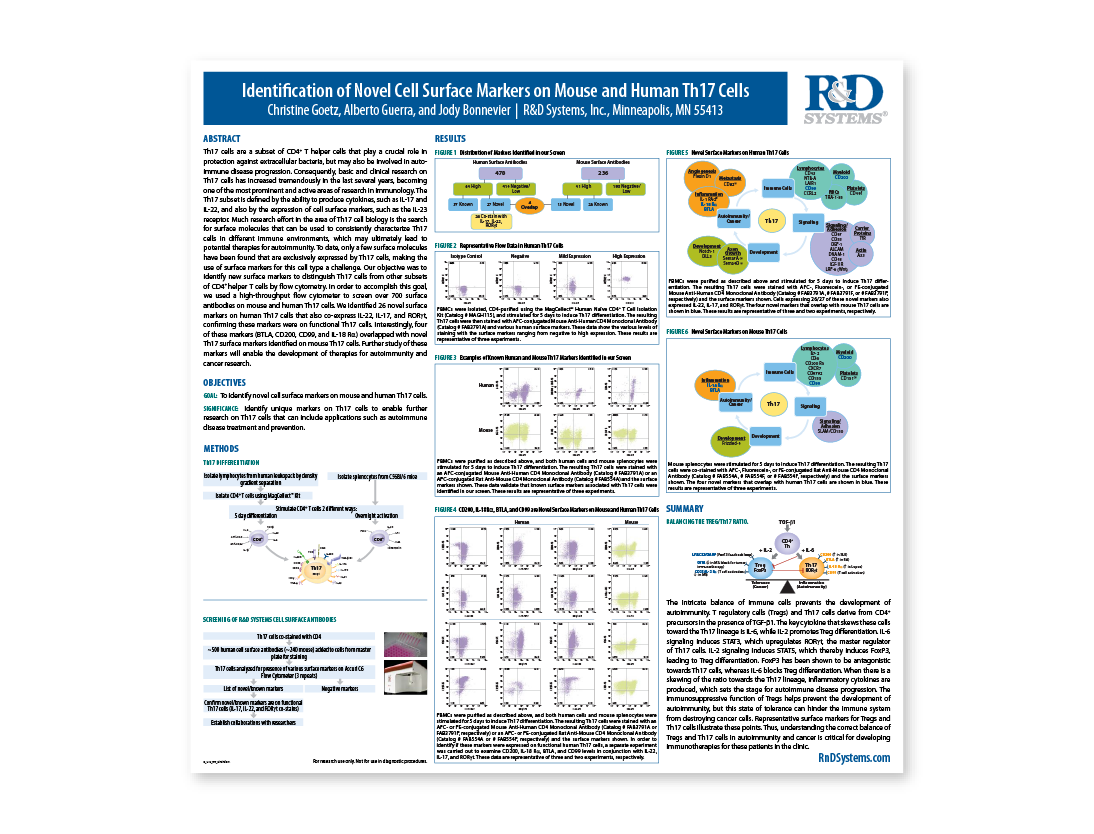
Identification of Novel Cell Surface Markers on Mouse and Human Th17 Cells
by Christine Goetz, Alberto Guerra, and Jody Bonnevier.
Scientific Meeting PostersABSTRACT
Th17 cells are a subset of CD4+ T helper cells that play a crucial role in protection against extracellular bacteria, but may also be involved in autoimmune disease progression. Consequently, basic and clinical research on Th17 cells has increased tremendously in the last several years, becoming one of the most prominent and active areas of research in immunology. The Th17 subset is defined by the ability to produce cytokines, such as IL-17 and IL-22, and also by the expression of cell surface markers, such as the IL-23 receptor. Much research effort in the area of Th17 cell biology is the search for surface molecules that can be used to consistently characterize Th17 cells in different immune environments, which may ultimately lead to potential therapies for autoimmunity. To date, only a few surface molecules have been found that are exclusively expressed by Th17 cells, making the use of surface markers for this cell type a challenge. Our objective was to identify new surface markers to distinguish Th17 cells from other subsets of CD4+ helper T cells by flow cytometry. In order to accomplish this goal, we used a high-throughput flow cytometer to screen over 700 surface antibodies on mouse and human Th17 cells. We identified 26 novel surface markers on human Th17 cells that also co-express IL-22, IL-17, and ROR gamma t, confirming these markers were on functional Th17 cells. Interestingly, four of these markers (BTLA, CD200, CD99, and IL-18 R alpha) overlapped with novel Th17 surface markers identified on mouse Th17 cells. Further study of these markers will enable the development of therapies for autoimmunity and cancer research.
Download PDF