
Organoids: Model Systems of Tissue Development and Disease Poster
Life Science PostersLife Science Posters Summary
Animal Models to Organoids: Bridging the Gap in Human Disease Research
Model organisms and animal models have played an instrumental role in our current understanding of the development and pathogenesis of a variety of diseases, but there are frequently limitations in applying the results from these models to humans. This is due to fundamental differences in human genetics, development, anatomy, physiology, immunology, and the mechanisms by which different diseases progress. As a result, organoids and 3-D cell culture systems are emerging as powerful new platforms for exploring human organ development, modeling disease, screening for drug toxicity, and investigating personalized medicine.
Miniature Organs Advancing Human Biology and Disease Modeling
Organoids are miniature, simplified versions of an organ that mimic the cellular composition and architecture of the tissue of origin and exhibit functional similarities. They are generated in vitro from pluripotent or adult stem cells, and are typically composed of multiple different cell types, which are capable of self-renewal and self-organization. While organoids are generally small in size, they are stable model systems that are amenable to long-term cultivation and manipulation. Organoid models have been developed for a wide variety of different human organs including brain, colon, heart, intestine, kidney, liver, lung, stomach, pancreas, and prostate, among others. Although methods for generating these organoids are still evolving, their potential to complement animal model systems and extend our ability to study human organ development, tissue regeneration, disease, and drug toxicity in a more physiologically relevant setting is now widely recognized in the biomedical field.
Showcase the Promise of Organoids in Scientific Discovery
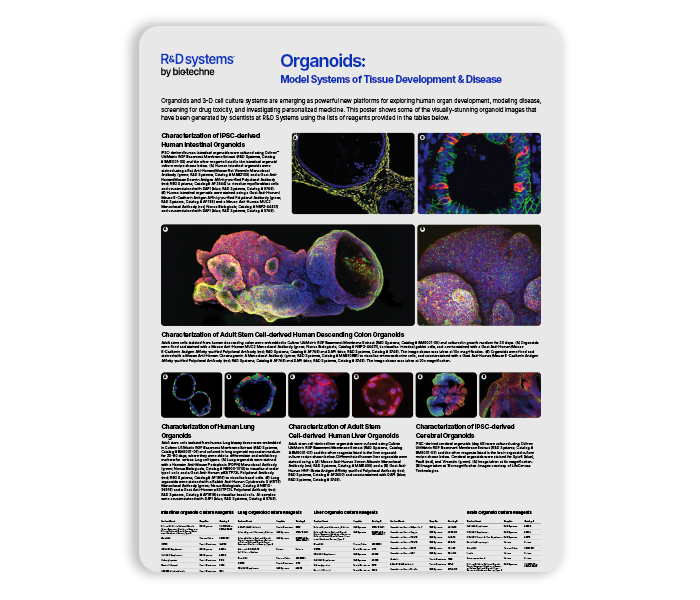
This poster shows some of the visually-stunning organoid images that have been generated by our cell culture specialists at R&D Systems using the recipes provided in the tables. We hope that the beauty of these images will not only be a colorful addition to your lab or office space, but that it will also serve as a reminder of how exciting it is to explore new scientific frontiers.
Request Literature
To access this literature content please fill out the form below.