
BAF180/PB1 Antibody - BSA Free
Novus Biologicals | Catalog # NB100-79833

![Western Blot: BAF180/PB1 Antibody [NB100-79833]](https://resources.rndsystems.com/images/products/BAF180-PB1-Antibody-Western-Blot-NB100-79833-img0012.jpg "Western Blot: BAF180/PB1 Antibody [NB100-79833]")
Scientific images may be resized, cropped, or adjusted for brightness or contrast for presentation purposes. These updates are limited to presentation and do not affect the underlying scientific interpretation of the data. Where available, additional source data may be provided upon request.
Key Product Details
Validated by
Species Reactivity
Validated:
Cited:
Applications
Validated:
Cited:
Label
Antibody Source
Format
Product Specifications
Immunogen
Clonality
Host
Isotype
Scientific Data Images for BAF180/PB1 Antibody - BSA Free
Western Blot: BAF180/PB1 Antibody [NB100-79833]
Western Blot: BAF180/PB1 Antibody [NB100-79833] - Whole cell lysate (50 ug) from NIH 3T3 and TCMK-1 prepared using NETN lysis buffer. Antibody: Affinity purified rabbit anti-PBRM1 antibody used for WB at 0.1 ug/ml. Detection: Chemiluminescence with an exposure time of 10 seconds.![Immunohistochemistry-Paraffin: BAF180/PB1 Antibody [NB100-79833]](https://resources.rndsystems.com/images/products/BAF180-PB1-Antibody-Immunohistochemistry-Paraffin-NB100-79833-img0014.jpg "Immunohistochemistry-Paraffin: BAF180/PB1 Antibody [NB100-79833]")
Immunohistochemistry-Paraffin: BAF180/PB1 Antibody [NB100-79833]
Immunohistochemistry-Paraffin: BAF180/PB1 Antibody [NB100-79833] - FFPE section of mouse renal cell carcinoma. Antibody: Affinity purified rabbit anti-PBRM1 used at a dilution of 1:5,000 (0.2ug/ml). Detection: DAB.![Western Blot: BAF180/PB1 Antibody [NB100-79833]](https://resources.rndsystems.com/images/products/BAF180-PB1-Antibody-Western-Blot-NB100-79833-img0011.jpg "Western Blot: BAF180/PB1 Antibody [NB100-79833]")
Western Blot: BAF180/PB1 Antibody [NB100-79833]
Western Blot: BAF180/PB1 Antibody [NB100-79833] - Whole cell lysate (50 ug) from Jurkat, HeLa, and HEK293T cells prepared using NETN lysis buffer. Antibody: Affinity purified rabbit anti-PBRM1 antibody used for WB at 0.1 ug/ml. Detection: Chemiluminescence with an exposure time of 10 seconds.![Immunohistochemistry-Paraffin: BAF180/PB1 Antibody [NB100-79833]](https://resources.rndsystems.com/images/products/BAF180-PB1-Antibody-Immunohistochemistry-Paraffin-NB100-79833-img0013.jpg "Immunohistochemistry-Paraffin: BAF180/PB1 Antibody [NB100-79833]")
Immunohistochemistry-Paraffin: BAF180/PB1 Antibody [NB100-79833]
Immunohistochemistry-Paraffin: BAF180/PB1 Antibody [NB100-79833] - FFPE section of human ovarian carcinoma. Antibody: Affinity purified rabbit anti-PBRM1 used at a dilution of 1:5,000 (0.2ug/ml). Detection: DAB.![Immunoprecipitation: BAF180/PB1 Antibody [NB100-79833]](https://resources.rndsystems.com/images/products/BAF180-PB1-Antibody-Immunoprecipitation-NB100-79833-img0010.jpg "Immunoprecipitation: BAF180/PB1 Antibody [NB100-79833]")
Immunoprecipitation: BAF180/PB1 Antibody [NB100-79833]
Immunoprecipitation: BAF180/PB1 Antibody [NB100-79833] - Detection of human PBRM1 by western blot of immunoprecipitates. Samples: Whole cell lysate (1.0 mg per IP reaction; 20% of IP loaded) from HeLa cells prepared using NETN lysis buffer. Antibodies: Affinity purified rabbit anti-PBRM1 antibody NB100-79833 used for IP at 3 ug per reaction. PBRM1 was also immunoprecipitated by rabbit anti-PBRM1 antibody NB100-79832. For blotting immunoprecipitated PBRM1, NB100-79833 was used at 0.4 ug/ml. Detection: Chemiluminescence with an exposure time of 30 seconds.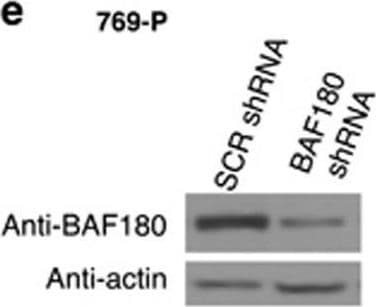
Western Blot: BAF180/PB1 Antibody - BSA Free [NB100-79833] -
BAF180 knockdown in BAF180-expressing H2 ccRCC cell lines reduces cell survival/proliferation. (a, c, e) Western blot analyses of BAF180 protein in 786-O (a), KC-12 (c) and 769-P (e) H2 ccRCC cells targeted with non-targeting scramble (SCR) shRNA or BAF180 shRNA. (b, d, f) Quantification and photos of the clonogenic survival assay for 786-O (b), KC-12 (d) and 769-P (f) cells targeted with control scr-shRNA or BAF180 shRNA. (g) The location of BAF180 sgRNA #1 and #2 relative to the BAF180-coding region are shown (upper). The diagram (lower) shows the type and frequency of mutations in the BAF180 gene, found in ccRCC tumors, adapted from the article by Valera et al.7 (h) DNA sequence and sequencing profiles of parental BAF180 DNA (parental) and BAF180 DNA after targeted by BAF180 sgRNA #1 (left) and #2 (right). The blue lines indicate the target sequences of sgRNAs and the red lines showing the protospacer adjacent motif sequence. The black arrows indicate the positions that double-strand DNA cleavages are expected to occur by the sgRNA-led Cas9 enzyme. The red boxes are to indicate the nucleotides that have been deleted by CRISPR–Cas9 system. SgRNA #2 Clone #1 shows a mixed sequence after the cleavage site, probably due to the fact that the deletion in the BAF180 allele 1 is different from the deletion in BAF180 allele 2. (i) Western blot analysis of BAF180 protein in 786-O/Cas9 cells expressing no sgRNA, or PBRM1 sgRNA #1 (clone #1) or #2 (clone #1). (j) Quantification and photos of the clonogenic survival assay for 786-O/Tet-on Cas9 clones without sgRNA expression, or with expression of BAF180 sgRNA #1 (clone #1) or #2 (clone #1). Image collected and cropped by CiteAb from the following open publication (https://pubmed.ncbi.nlm.nih.gov/28092369), licensed under a CC-BY license. Not internally tested by Novus Biologicals.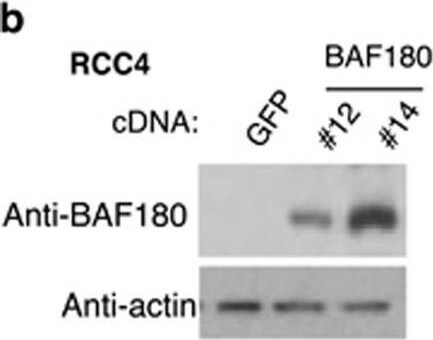
Western Blot: BAF180/PB1 Antibody - BSA Free [NB100-79833] -
Re-expression of BAF180 in H1H2 ccRCC lines of RCC4 and SLR25 reduces cell survival/proliferation. (a) Western blot analysis of BAF180 protein in ccRCC cell lines. Beta actin serves as a protein-loading control for this and other WB analysis in the paper. (b) Western blot analysis of BAF180 protein in RCC4 cell clones stably transfected with a BAF180 expression vector or a vector-expressing GFP. (c) Quantification and photos of clonogenic survival assays for RCC4/BAF180 or GFP cells. Quantification was performed using MetaMorph software to measure the total area covered by colonies. (d) Western blot analysis of BAF180 protein expression in SLR25/Tet-on BAF180 cell line with (+) or without (−) doxycycline treatment. (e) Quantification and photos of clonogenic survival assay for SLR25/Tet-on BAF180 cells in the presence (+) or absence (−) of doxcycline. Image collected and cropped by CiteAb from the following open publication (https://pubmed.ncbi.nlm.nih.gov/28092369), licensed under a CC-BY license. Not internally tested by Novus Biologicals.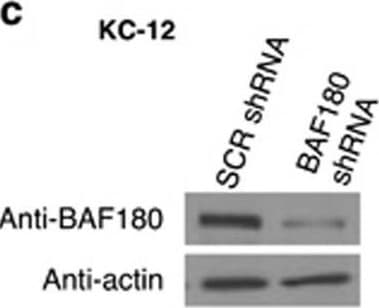
Western Blot: BAF180/PB1 Antibody - BSA Free [NB100-79833] -
BAF180 knockdown in BAF180-expressing H2 ccRCC cell lines reduces cell survival/proliferation. (a, c, e) Western blot analyses of BAF180 protein in 786-O (a), KC-12 (c) and 769-P (e) H2 ccRCC cells targeted with non-targeting scramble (SCR) shRNA or BAF180 shRNA. (b, d, f) Quantification and photos of the clonogenic survival assay for 786-O (b), KC-12 (d) and 769-P (f) cells targeted with control scr-shRNA or BAF180 shRNA. (g) The location of BAF180 sgRNA #1 and #2 relative to the BAF180-coding region are shown (upper). The diagram (lower) shows the type and frequency of mutations in the BAF180 gene, found in ccRCC tumors, adapted from the article by Valera et al.7 (h) DNA sequence and sequencing profiles of parental BAF180 DNA (parental) and BAF180 DNA after targeted by BAF180 sgRNA #1 (left) and #2 (right). The blue lines indicate the target sequences of sgRNAs and the red lines showing the protospacer adjacent motif sequence. The black arrows indicate the positions that double-strand DNA cleavages are expected to occur by the sgRNA-led Cas9 enzyme. The red boxes are to indicate the nucleotides that have been deleted by CRISPR–Cas9 system. SgRNA #2 Clone #1 shows a mixed sequence after the cleavage site, probably due to the fact that the deletion in the BAF180 allele 1 is different from the deletion in BAF180 allele 2. (i) Western blot analysis of BAF180 protein in 786-O/Cas9 cells expressing no sgRNA, or PBRM1 sgRNA #1 (clone #1) or #2 (clone #1). (j) Quantification and photos of the clonogenic survival assay for 786-O/Tet-on Cas9 clones without sgRNA expression, or with expression of BAF180 sgRNA #1 (clone #1) or #2 (clone #1). Image collected and cropped by CiteAb from the following open publication (https://pubmed.ncbi.nlm.nih.gov/28092369), licensed under a CC-BY license. Not internally tested by Novus Biologicals.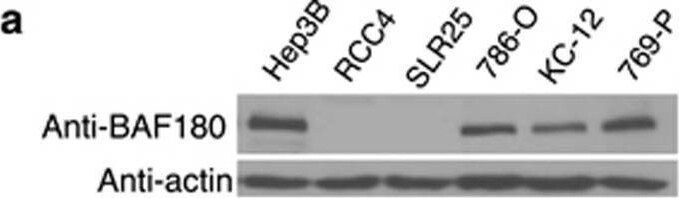
Western Blot: BAF180/PB1 Antibody - BSA Free [NB100-79833] -
Re-expression of BAF180 in H1H2 ccRCC lines of RCC4 and SLR25 reduces cell survival/proliferation. (a) Western blot analysis of BAF180 protein in ccRCC cell lines. Beta actin serves as a protein-loading control for this and other WB analysis in the paper. (b) Western blot analysis of BAF180 protein in RCC4 cell clones stably transfected with a BAF180 expression vector or a vector-expressing GFP. (c) Quantification and photos of clonogenic survival assays for RCC4/BAF180 or GFP cells. Quantification was performed using MetaMorph software to measure the total area covered by colonies. (d) Western blot analysis of BAF180 protein expression in SLR25/Tet-on BAF180 cell line with (+) or without (−) doxycycline treatment. (e) Quantification and photos of clonogenic survival assay for SLR25/Tet-on BAF180 cells in the presence (+) or absence (−) of doxcycline. Image collected and cropped by CiteAb from the following open publication (https://pubmed.ncbi.nlm.nih.gov/28092369), licensed under a CC-BY license. Not internally tested by Novus Biologicals.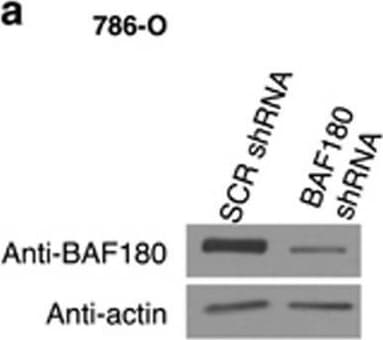
Western Blot: BAF180/PB1 Antibody - BSA Free [NB100-79833] -
BAF180 knockdown in BAF180-expressing H2 ccRCC cell lines reduces cell survival/proliferation. (a, c, e) Western blot analyses of BAF180 protein in 786-O (a), KC-12 (c) and 769-P (e) H2 ccRCC cells targeted with non-targeting scramble (SCR) shRNA or BAF180 shRNA. (b, d, f) Quantification and photos of the clonogenic survival assay for 786-O (b), KC-12 (d) and 769-P (f) cells targeted with control scr-shRNA or BAF180 shRNA. (g) The location of BAF180 sgRNA #1 and #2 relative to the BAF180-coding region are shown (upper). The diagram (lower) shows the type and frequency of mutations in the BAF180 gene, found in ccRCC tumors, adapted from the article by Valera et al.7 (h) DNA sequence and sequencing profiles of parental BAF180 DNA (parental) and BAF180 DNA after targeted by BAF180 sgRNA #1 (left) and #2 (right). The blue lines indicate the target sequences of sgRNAs and the red lines showing the protospacer adjacent motif sequence. The black arrows indicate the positions that double-strand DNA cleavages are expected to occur by the sgRNA-led Cas9 enzyme. The red boxes are to indicate the nucleotides that have been deleted by CRISPR–Cas9 system. SgRNA #2 Clone #1 shows a mixed sequence after the cleavage site, probably due to the fact that the deletion in the BAF180 allele 1 is different from the deletion in BAF180 allele 2. (i) Western blot analysis of BAF180 protein in 786-O/Cas9 cells expressing no sgRNA, or PBRM1 sgRNA #1 (clone #1) or #2 (clone #1). (j) Quantification and photos of the clonogenic survival assay for 786-O/Tet-on Cas9 clones without sgRNA expression, or with expression of BAF180 sgRNA #1 (clone #1) or #2 (clone #1). Image collected and cropped by CiteAb from the following open publication (https://pubmed.ncbi.nlm.nih.gov/28092369), licensed under a CC-BY license. Not internally tested by Novus Biologicals.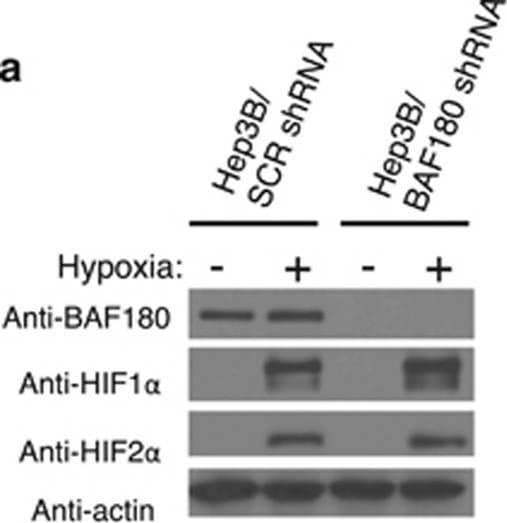
Western Blot: BAF180/PB1 Antibody - BSA Free [NB100-79833] -
BAF180 is required for strong expression of HIF1 and HIF2 target genes in hypoxic (HX) Hep3B cells and pVHL-deficient ccRCC cell lines. (a) Western blot analysis of BAF180, HIF1 alpha and HIF2 alpha proteins in normoxic (NX) and HX Hep3B cells stably transduced with non-targeting control (SCR shRNA) or BAF180 shRNA. (b–e) qRT–PCR analysis of messenger RNA (mRNA) levels of HIF1 target genes (b), HIF2 target genes (c), HIF1/HIF2 common target genes (d) and BRG1-independent HIF target genes (e) in NX and HX Hep3B cells stably targeted with control or BAF180 shRNA. (f) qRT–PCR analysis of mRNA levels of known HIF2 target genes in 786-O/Tet-on Cas9 cells with no sgRNA or BAF180 sgRNA #1 (right). Expression levels of BAF180, HIF2 alpha and ARNT protein in these cells were also shown (Left). (g) qRT–PCR analysis of mRNA levels of known HIF1 and HIF2 target genes, as well as HIF and ARNT in RCC4 cells stably expressing GFP (control) or BAF180 protein. Clones #12 and #14 express low and high BAF180 protein levels, respectively. Image collected and cropped by CiteAb from the following open publication (https://pubmed.ncbi.nlm.nih.gov/28092369), licensed under a CC-BY license. Not internally tested by Novus Biologicals.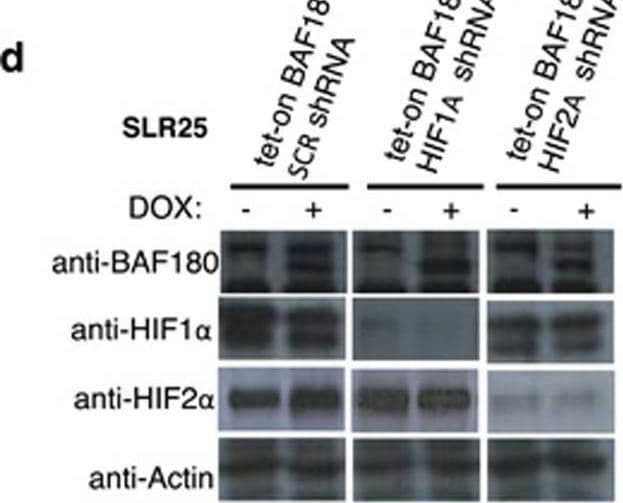
Western Blot: BAF180/PB1 Antibody - BSA Free [NB100-79833] -
BAF180's tumor-suppressive or -promoting activity in ccRCC cell lines is HIF1 alpha or HIF2 alpha dependent. (a) Western blot analysis of HIF1 alpha and BAF180 protein in parental 786-0 (parental), 786-0 with HIF1 alpha re-expression (BAF180 WT/HIF1A cDNA) and 786-0 with HIF1 alpha re-expression, but PBRM1 knockout by sgRNA #1, clone #1 and clone #2 (BAF180 KO-1 or -2/HIF1A cDNA). (b, c) Quantification (b) and photos (c) of clonogenic survival assay in the indicated 786-O cells. (d) Western blot analysis of BAF180, HIF1 alpha and HIF2 alpha proteins in SLR25/Tet-on BAF180 cells stably targeted with control, HIF1A or HIF2A shRNA in the absence of (−) or presence of doxycycline (+). (e, f) Quantification (e) and photos (f) of clonogenic survival assay of the SLR25/Tet-on BAF180 cells stably targeted with control, HIF1A or HIF2A shRNA in the absence of (−) or presence of doxycycline (+). All the samples are normalized to SCR non-targeting shRNA without doxycycline treatment. Image collected and cropped by CiteAb from the following open publication (https://pubmed.ncbi.nlm.nih.gov/28092369), licensed under a CC-BY license. Not internally tested by Novus Biologicals.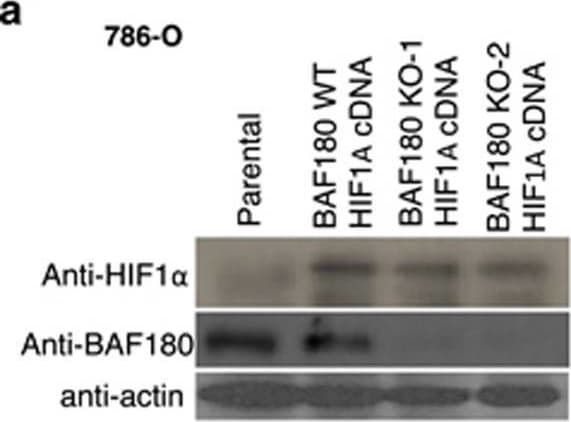
Western Blot: BAF180/PB1 Antibody - BSA Free [NB100-79833] -
BAF180's tumor-suppressive or -promoting activity in ccRCC cell lines is HIF1 alpha or HIF2 alpha dependent. (a) Western blot analysis of HIF1 alpha and BAF180 protein in parental 786-0 (parental), 786-0 with HIF1 alpha re-expression (BAF180 WT/HIF1A cDNA) and 786-0 with HIF1 alpha re-expression, but PBRM1 knockout by sgRNA #1, clone #1 and clone #2 (BAF180 KO-1 or -2/HIF1A cDNA). (b, c) Quantification (b) and photos (c) of clonogenic survival assay in the indicated 786-O cells. (d) Western blot analysis of BAF180, HIF1 alpha and HIF2 alpha proteins in SLR25/Tet-on BAF180 cells stably targeted with control, HIF1A or HIF2A shRNA in the absence of (−) or presence of doxycycline (+). (e, f) Quantification (e) and photos (f) of clonogenic survival assay of the SLR25/Tet-on BAF180 cells stably targeted with control, HIF1A or HIF2A shRNA in the absence of (−) or presence of doxycycline (+). All the samples are normalized to SCR non-targeting shRNA without doxycycline treatment. Image collected and cropped by CiteAb from the following open publication (https://pubmed.ncbi.nlm.nih.gov/28092369), licensed under a CC-BY license. Not internally tested by Novus Biologicals.Applications for BAF180/PB1 Antibody - BSA Free
Immunohistochemistry
Immunohistochemistry-Paraffin
Immunoprecipitation
Western Blot
Reviewed Applications
Read 1 review rated 4 using NB100-79833 in the following applications:
Formulation, Preparation, and Storage
Purification
Formulation
Format
Preservative
Concentration
Shipping
Stability & Storage
Background: BAF180/PB1
Long Name
Alternate Names
Entrez Gene IDs
Gene Symbol
UniProt
Additional BAF180/PB1 Products
Product Documents for BAF180/PB1 Antibody - BSA Free
Certificate of Analysis
To download a Certificate of Analysis, please enter a lot or batch number in the search box below.
Product Specific Notices for BAF180/PB1 Antibody - BSA Free
This product is for research use only and is not approved for use in humans or in clinical diagnosis. Primary Antibodies are guaranteed for 1 year from date of receipt.
Citations for BAF180/PB1 Antibody - BSA Free
 Powered by Bioz
Customer Reviews for BAF180/PB1 Antibody - BSA Free (1)
Have you used BAF180/PB1 Antibody - BSA Free?
Submit a review and receive an Amazon gift card!
$25/€18/£15/$25CAN/¥2500 for a review with an image
$10/€7/£6/$10CAN/¥1110 for a review without an image
Submit a review
Customer Images
-(01-ml)_NB100-79833_9761.jpg)
-
Application: Western BlotSample Tested: Clear cell renal cell carcinoma samplesSpecies: HumanVerified Customer | Posted 08/30/2014PBRM1 protein expression in clear cell renal cell carcinoma samples

There are no reviews that match your criteria.
Protocols
Find general support by application which include: protocols, troubleshooting, illustrated assays, videos and webinars.
- Antigen Retrieval Protocol (PIER)
- Antigen Retrieval for Frozen Sections Protocol
- Appropriate Fixation of IHC/ICC Samples
- Cellular Response to Hypoxia Protocols
- Chromogenic IHC Staining of Formalin-Fixed Paraffin-Embedded (FFPE) Tissue Protocol
- Chromogenic Immunohistochemistry Staining of Frozen Tissue
- ClariTSA™ Fluorophore Kits
- Detection & Visualization of Antibody Binding
- Fluorescent IHC Staining of Frozen Tissue Protocol
- Graphic Protocol for Heat-induced Epitope Retrieval
- Graphic Protocol for the Preparation and Fluorescent IHC Staining of Frozen Tissue Sections
- Graphic Protocol for the Preparation and Fluorescent IHC Staining of Paraffin-embedded Tissue Sections
- Graphic Protocol for the Preparation of Gelatin-coated Slides for Histological Tissue Sections
- ICC Cell Smear Protocol for Suspension Cells
- ICC Immunocytochemistry Protocol Videos
- ICC for Adherent Cells
- IHC Sample Preparation (Frozen sections vs Paraffin)
- Immunocytochemistry (ICC) Protocol
- Immunocytochemistry Troubleshooting
- Immunofluorescence of Organoids Embedded in Cultrex Basement Membrane Extract
- Immunofluorescent IHC Staining of Formalin-Fixed Paraffin-Embedded (FFPE) Tissue Protocol
- Immunohistochemistry (IHC) and Immunocytochemistry (ICC) Protocols
- Immunohistochemistry Frozen Troubleshooting
- Immunohistochemistry Paraffin Troubleshooting
- Immunoprecipitation Protocol
- Preparing Samples for IHC/ICC Experiments
- Preventing Non-Specific Staining (Non-Specific Binding)
- Primary Antibody Selection & Optimization
- Protocol for Heat-Induced Epitope Retrieval (HIER)
- Protocol for Making a 4% Formaldehyde Solution in PBS
- Protocol for VisUCyte™ HRP Polymer Detection Reagent
- Protocol for the Fluorescent ICC Staining of Cell Smears - Graphic
- Protocol for the Fluorescent ICC Staining of Cultured Cells on Coverslips - Graphic
- Protocol for the Preparation & Fixation of Cells on Coverslips
- Protocol for the Preparation and Chromogenic IHC Staining of Frozen Tissue Sections
- Protocol for the Preparation and Chromogenic IHC Staining of Frozen Tissue Sections - Graphic
- Protocol for the Preparation and Chromogenic IHC Staining of Paraffin-embedded Tissue Sections
- Protocol for the Preparation and Chromogenic IHC Staining of Paraffin-embedded Tissue Sections - Graphic
- Protocol for the Preparation and Fluorescent ICC Staining of Cells on Coverslips
- Protocol for the Preparation and Fluorescent ICC Staining of Non-adherent Cells
- Protocol for the Preparation and Fluorescent ICC Staining of Stem Cells on Coverslips
- Protocol for the Preparation and Fluorescent IHC Staining of Frozen Tissue Sections
- Protocol for the Preparation and Fluorescent IHC Staining of Paraffin-embedded Tissue Sections
- Protocol for the Preparation of Gelatin-coated Slides for Histological Tissue Sections
- Protocol for the Preparation of a Cell Smear for Non-adherent Cell ICC - Graphic
- R&D Systems Quality Control Western Blot Protocol
- TUNEL and Active Caspase-3 Detection by IHC/ICC Protocol
- The Importance of IHC/ICC Controls
- Troubleshooting Guide: Immunohistochemistry
- Troubleshooting Guide: Western Blot Figures
- Western Blot Conditions
- Western Blot Protocol
- Western Blot Protocol for Cell Lysates
- Western Blot Troubleshooting
- Western Blot Troubleshooting Guide
- View all Protocols, Troubleshooting, Illustrated assays and Webinars