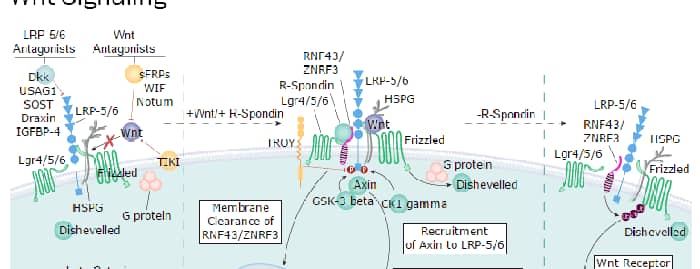
The glypicans (GPC) constitute a family of heparan sulfate proteoglycans that are attached to the cell surface by a lycosylphosphatidylinositol (GPI) anchor. Six members of this family have been identified in mammals (GPC1‑GPC6). All glypican core proteins contain an N‑terminal signal peptide, a large globular cysteine-rich domain (CRD) with 14 invariant cysteine residues, a stalk-like region containing the heparan sulfate attachment sites, and a C-terminal GPI attachment site. Based on the degree of their amino acid sequence similarity, two subfamilies of glypicans have been defined. One subfamily (sharing from 35‑63% sequence homology) includes GPC1, 2, 4, and 6, while the second subfamily (sharing 54% sequence identity) includes GPC3 and 5. Proteins between the two subfamilies also share 17‑25% sequence similarity (1‑4). Glypicans are widely expressed in adult and fetal tissues. During embryonic development, the expression level of the various glypicans changes in a stage and tissue specific manner. GPC2, also known as cerebroglycan, is primarily expressed in developing neuronal tissues including the brain, spinal cord, dorsal root ganglia, and cranial nerves. It is found on the tracts of actively growing axons (5). Cell surface GPC2 binds midkine, indicating midkine‑GPC2 interaction may participate in neuronal cell migration and neurite outgrowth (6).
Human Glypican 2 Antibody
R&D Systems | Catalog # AF2304


Key Product Details
Species Reactivity
Validated:
Human
Cited:
Human
Applications
Validated:
Immunohistochemistry, Western Blot, Blockade of Receptor-ligand Interaction
Cited:
ELISA Detection, ELISA Development
Label
Unconjugated
Antibody Source
Polyclonal Goat IgG
Loading...
Product Specifications
Immunogen
Mouse myeloma cell line NS0-derived recombinant human Glypican 2
Pro18-Ser553
Accession # Q8N158
Pro18-Ser553
Accession # Q8N158
Specificity
Detects human Glypican 2 in direct ELISAs and Western blots. In direct ELISAs and Western blots, approximately 45% cross-reactivity with recombinant mouse Glypican 2 is observed.
Clonality
Polyclonal
Host
Goat
Isotype
IgG
Endotoxin Level
<0.10 EU per 1 μg of the antibody by the LAL method.
Applications for Human Glypican 2 Antibody
Application
Recommended Usage
Blockade of Receptor-ligand Interaction
In a functional ELISA, 1-4 µg/mL of this antibody will block 50% of the binding of 25 ng/mL of Recombinant Human Midkine (Catalog # 258-MD) to immobilized Recombinant Human Glypican 2 (Catalog # 2304-GP) coated at 4 µg/mL (100 µL/well). At 200 μg/mL, this antibody will block >90% of the binding.
Immunohistochemistry
5-15 µg/mL
Sample: Immersion fixed frozen sections of mouse embryo (E13.5)
Sample: Immersion fixed frozen sections of mouse embryo (E13.5)
Western Blot
0.1 µg/mL
Sample: Recombinant Human Glypican 2 (Catalog # 2304-GP)
Sample: Recombinant Human Glypican 2 (Catalog # 2304-GP)
Formulation, Preparation, and Storage
Purification
Antigen Affinity-purified
Reconstitution
Reconstitute at 0.2 mg/mL in sterile PBS. For liquid material, refer to CoA for concentration.
Loading...
Formulation
Lyophilized from a 0.2 μm filtered solution in PBS with Trehalose. *Small pack size (SP) is supplied either lyophilized or as a 0.2 µm filtered solution in PBS.
Shipping
Lyophilized product is shipped at ambient temperature. Liquid small pack size (-SP) is shipped with polar packs. Upon receipt, store immediately at the temperature recommended below.
Stability & Storage
Use a manual defrost freezer and avoid repeated freeze-thaw cycles.
- 12 months from date of receipt, -20 to -70 °C as supplied.
- 1 month, 2 to 8 °C under sterile conditions after reconstitution.
- 6 months, -20 to -70 °C under sterile conditions after reconstitution.
Calculators
Background: Glypican 2
References
- Filmus, J and S.B. Selleck (2001) J. Clin. Invest. 108:497.
- De Cat, B and G. David (2001) Semin. Cell Dev. Biol. 12:117.
- Song, H. and J. Filmus (2002) Biochem. Biophys. Acta 1573:241.
- Veugelers, M. et al. (1999) J. Biol. Chem. 274:26968.
- Ivins, J.K. et al. (1997) Dev. Biol. 184:320.
- Kurosawa, N. et al. (2001) Glycoconj. J. 18:499.
Alternate Names
Cerebroglycan, GPC2
Gene Symbol
GPC2
UniProt
Additional Glypican 2 Products
Product Documents for Human Glypican 2 Antibody
Certificate of Analysis
To download a Certificate of Analysis, please enter a lot or batch number in the search box below.
Note: Certificate of Analysis not available for kit components.
Product Specific Notices for Human Glypican 2 Antibody
For research use only
Related Research Areas
Citations for Human Glypican 2 Antibody
 Powered by Bioz
Customer Reviews for Human Glypican 2 Antibody
There are currently no reviews for this product. Be the first to review Human Glypican 2 Antibody and earn rewards!
Have you used Human Glypican 2 Antibody?
Submit a review and receive an Amazon gift card!
$25/€18/£15/$25CAN/¥2500 for a review with an image
$10/€7/£6/$10CAN/¥1110 for a review without an image
Submit a review
Protocols
Find general support by application which include: protocols, troubleshooting, illustrated assays, videos and webinars.
- Antigen Retrieval Protocol (PIER)
- Antigen Retrieval for Frozen Sections Protocol
- Appropriate Fixation of IHC/ICC Samples
- Cellular Response to Hypoxia Protocols
- Chromogenic IHC Staining of Formalin-Fixed Paraffin-Embedded (FFPE) Tissue Protocol
- Chromogenic Immunohistochemistry Staining of Frozen Tissue
- ClariTSA™ Fluorophore Kits
- Detection & Visualization of Antibody Binding
- Fluorescent IHC Staining of Frozen Tissue Protocol
- Graphic Protocol for Heat-induced Epitope Retrieval
- Graphic Protocol for the Preparation and Fluorescent IHC Staining of Frozen Tissue Sections
- Graphic Protocol for the Preparation and Fluorescent IHC Staining of Paraffin-embedded Tissue Sections
- Graphic Protocol for the Preparation of Gelatin-coated Slides for Histological Tissue Sections
- IHC Sample Preparation (Frozen sections vs Paraffin)
- Immunofluorescent IHC Staining of Formalin-Fixed Paraffin-Embedded (FFPE) Tissue Protocol
- Immunohistochemistry (IHC) and Immunocytochemistry (ICC) Protocols
- Immunohistochemistry Frozen Troubleshooting
- Immunohistochemistry Paraffin Troubleshooting
- Preparing Samples for IHC/ICC Experiments
- Preventing Non-Specific Staining (Non-Specific Binding)
- Primary Antibody Selection & Optimization
- Protocol for Heat-Induced Epitope Retrieval (HIER)
- Protocol for Making a 4% Formaldehyde Solution in PBS
- Protocol for VisUCyte™ HRP Polymer Detection Reagent
- Protocol for the Preparation & Fixation of Cells on Coverslips
- Protocol for the Preparation and Chromogenic IHC Staining of Frozen Tissue Sections
- Protocol for the Preparation and Chromogenic IHC Staining of Frozen Tissue Sections - Graphic
- Protocol for the Preparation and Chromogenic IHC Staining of Paraffin-embedded Tissue Sections
- Protocol for the Preparation and Chromogenic IHC Staining of Paraffin-embedded Tissue Sections - Graphic
- Protocol for the Preparation and Fluorescent IHC Staining of Frozen Tissue Sections
- Protocol for the Preparation and Fluorescent IHC Staining of Paraffin-embedded Tissue Sections
- Protocol for the Preparation of Gelatin-coated Slides for Histological Tissue Sections
- R&D Systems Quality Control Western Blot Protocol
- TUNEL and Active Caspase-3 Detection by IHC/ICC Protocol
- The Importance of IHC/ICC Controls
- Troubleshooting Guide: Immunohistochemistry
- Troubleshooting Guide: Western Blot Figures
- Western Blot Conditions
- Western Blot Protocol
- Western Blot Protocol for Cell Lysates
- Western Blot Troubleshooting
- Western Blot Troubleshooting Guide
- View all Protocols, Troubleshooting, Illustrated assays and Webinars
Loading...
Associated Pathways