
Human IGF-I/IGF-1 Antibody (997211)
R&D Systems | Catalog # MAB2913

Scientific images may be resized, cropped, or adjusted for brightness or contrast for presentation purposes. These updates are limited to presentation and do not affect the underlying scientific interpretation of the data. Where available, additional source data may be provided upon request.
Key Product Details
Species Reactivity
Validated:
Human
Cited:
Human
Applications
Validated:
Immunocytochemistry
Cited:
Immunohistochemistry
Label
Unconjugated
Antibody Source
Monoclonal Rat IgG1 Clone # 997211
Loading...
Product Specifications
Immunogen
E. coli-derived recombinant human IGF-I/IGF-1
Gly49-Ala118
Accession # P05019
Gly49-Ala118
Accession # P05019
Specificity
Detects human IGF-I/IGF-1 in direct ELISAs.
Clonality
Monoclonal
Host
Rat
Isotype
IgG1
Scientific Data Images for Human IGF-I/IGF-1 Antibody (997211)
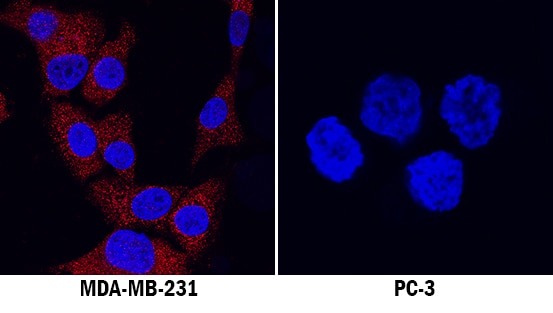
IGF-I/IGF-1 in MDA-MB-231 and PC-3 Human Cell Lines.
IGF-I/IGF-1 was detected in immersion fixed MDA-MB-123 human breast cancer cell line (left panel, positive stain) and PC-3 human prostate cancer cell line (right panel, negative stain) using Rat Anti-Human IGF-I/IGF-1 Monoclonal Antibody (Catalog # MAB2913) at 8 µg/mL for 3 hours at room temperature. Cells were stained using the NorthernLights™ 557-conjugated Anti-Rat IgG Secondary Antibody (red; Catalog # NL013) and counterstained with DAPI (blue). Specific staining was localized to cytoplasm. View our protocol for Fluorescent ICC Staining of Cells on Coverslips.Applications for Human IGF-I/IGF-1 Antibody (997211)
Application
Recommended Usage
Immunocytochemistry
8-25 µg/mL
Sample: MDA-MB-231 human breast cancer cell line
Sample: MDA-MB-231 human breast cancer cell line
Formulation, Preparation, and Storage
Purification
Protein A or G purified from ascites
Reconstitution
Reconstitute at 0.5 mg/mL in sterile PBS. For liquid material, refer to CoA for concentration.
Loading...
Formulation
Lyophilized from a 0.2 μm filtered solution in PBS with Trehalose. *Small pack size (SP) is supplied either lyophilized or as a 0.2 µm filtered solution in PBS.
Shipping
Lyophilized product is shipped at ambient temperature. Liquid small pack size (-SP) is shipped with polar packs. Upon receipt, store immediately at the temperature recommended below.
Stability & Storage
Use a manual defrost freezer and avoid repeated freeze-thaw cycles.
- 12 months from date of receipt, -20 to -70 °C as supplied.
- 1 month, 2 to 8 °C under sterile conditions after reconstitution.
- 6 months, -20 to -70 °C under sterile conditions after reconstitution.
Calculators
Background: IGF-I/IGF-1
IGF‑II. Circulating IGF‑I is produced by hepatocytes, while local IGF-I is produced by many other tissues in which it has paracrine effects (1). IGF-I induces the proliferation, migration, and differentiation of a wide variety of cell types during development and postnatally (3). IGF-I regulates glucose and fatty acid metabolism, steroid hormone activity, and cartilage and bone metabolism (4-7). It plays an important role in muscle regeneration and tumor progression (1, 8). IGF-I binds IGF‑I R, IGF-II R, and the insulin receptor, although its effects are mediated primarily by IGF-I R (9). IGF-I association with IGF binding proteins increases its plasma half‑life and modulates its interactions with receptors (10).
References
- Philippou, A. et al. (2007) In Vivo 21:45.
- Sandberg-Nordqvist, A.C. et al. (1992) Brain Res. Mol. Brain Res. 12:275.
- Guvakova, M.A. (2007) Int. J. Biochem. Cell Biol. 39:890.
- Clemmons, D.R. (2006) Curr. Opin. Pharmacol. 6:620.
- Bluher, S. et al. (2005) Best Pract. Res. Clin. Endocrinol. Metab. 19:577.
- Garcia-Segura, L.M. et al. (2006) Neuroendocrinology 84:275.
- Malemud, C.J. (2007) Clin. Chim. Acta 375:10.
- Samani, A.A. et al. (2007) Endocrine Rev. 28:20.
- LeRoith, D. and S. Yakar (2007) Nat. Clin. Pract. Endocrinol. Metab. 3:302.
- Denley, A. et al. (2005) Cytokine Growth Factor Rev. 16:421.
Long Name
Insulin-like Growth Factor I/Insulin-like Growth Factor 1
Alternate Names
IGF-1, IGF1, IGFI, Somatomedin A, Somatomedin C
Gene Symbol
IGF1
UniProt
Additional IGF-I/IGF-1 Products
Product Documents for Human IGF-I/IGF-1 Antibody (997211)
Certificate of Analysis
To download a Certificate of Analysis, please enter a lot or batch number in the search box below.
Note: Certificate of Analysis not available for kit components.
Product Specific Notices for Human IGF-I/IGF-1 Antibody (997211)
For research use only
Citations for Human IGF-I/IGF-1 Antibody (997211)
 Powered by Bioz
Customer Reviews for Human IGF-I/IGF-1 Antibody (997211)
There are currently no reviews for this product. Be the first to review Human IGF-I/IGF-1 Antibody (997211) and earn rewards!
Have you used Human IGF-I/IGF-1 Antibody (997211)?
Submit a review and receive an Amazon gift card!
$25/€18/£15/$25CAN/¥2500 for a review with an image
$10/€7/£6/$10CAN/¥1110 for a review without an image
Submit a review
Protocols
Find general support by application which include: protocols, troubleshooting, illustrated assays, videos and webinars.
- Appropriate Fixation of IHC/ICC Samples
- Cellular Response to Hypoxia Protocols
- ClariTSA™ Fluorophore Kits
- Detection & Visualization of Antibody Binding
- ICC Cell Smear Protocol for Suspension Cells
- ICC Immunocytochemistry Protocol Videos
- ICC for Adherent Cells
- Immunocytochemistry (ICC) Protocol
- Immunocytochemistry Troubleshooting
- Immunofluorescence of Organoids Embedded in Cultrex Basement Membrane Extract
- Immunohistochemistry (IHC) and Immunocytochemistry (ICC) Protocols
- Preparing Samples for IHC/ICC Experiments
- Preventing Non-Specific Staining (Non-Specific Binding)
- Primary Antibody Selection & Optimization
- Protocol for VisUCyte™ HRP Polymer Detection Reagent
- Protocol for the Fluorescent ICC Staining of Cell Smears - Graphic
- Protocol for the Fluorescent ICC Staining of Cultured Cells on Coverslips - Graphic
- Protocol for the Preparation and Fluorescent ICC Staining of Cells on Coverslips
- Protocol for the Preparation and Fluorescent ICC Staining of Non-adherent Cells
- Protocol for the Preparation and Fluorescent ICC Staining of Stem Cells on Coverslips
- Protocol for the Preparation of a Cell Smear for Non-adherent Cell ICC - Graphic
- TUNEL and Active Caspase-3 Detection by IHC/ICC Protocol
- The Importance of IHC/ICC Controls
- View all Protocols, Troubleshooting, Illustrated assays and Webinars


