Human TNF-alpha Antibody (6401)
R&D Systems | Catalog # MAB2101

Scientific images may be resized, cropped, or adjusted for brightness or contrast for presentation purposes. These updates are limited to presentation and do not affect the underlying scientific interpretation of the data. Where available, additional source data may be provided upon request.
Key Product Details
Validated by
Species Reactivity
Validated:
Cited:
Applications
Validated:
Cited:
Label
Antibody Source
Product Specifications
Immunogen
Gly57-Leu233 (predicted)
Accession # P01375
Specificity
Clonality
Host
Isotype
Endotoxin Level
Scientific Data Images for Human TNF-alpha Antibody (6401)
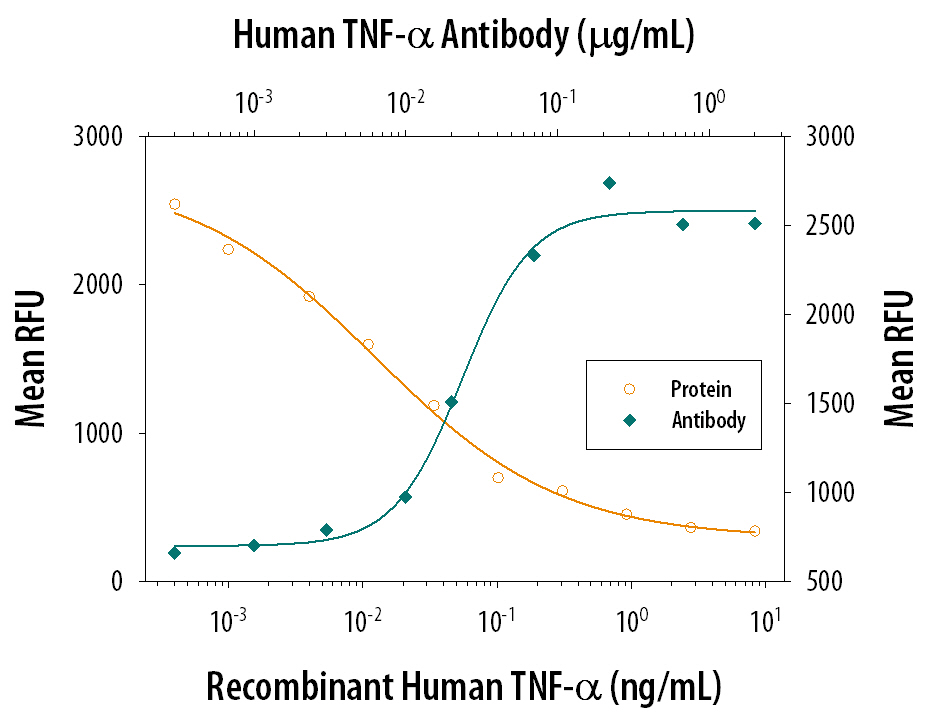
Cytotoxicity Induced by TNF‑ alpha and Neutralization by Human TNF‑ alpha Antibody.
Recombinant Human TNF-a (Catalog # 210-TA) induces cytotoxicity in the L-929 mouse fibroblast cell line in a dose-dependent manner (orange line). Cytotoxicity elicited by Recombinant Human TNF-a (0.25 ng/mL) is neutralized (green line) by increasing concentrations of Human TNF-a Monoclonal Antibody (Catalog # MAB2101). The ND50 is typically 0.015-0.06 µg/mL in the presence of the metabolic inhibitor actinomycin D (1 µg/mL).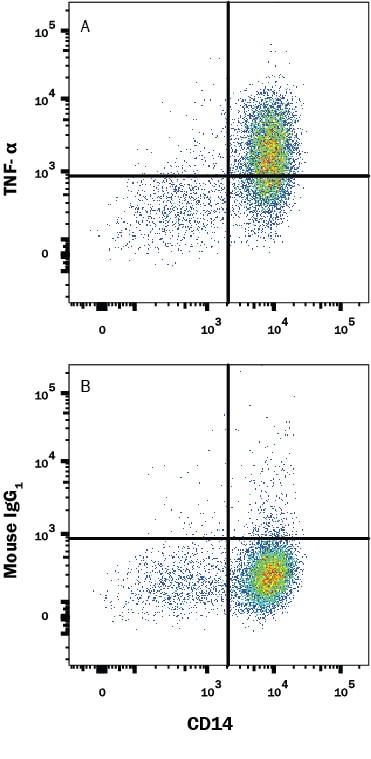
Detection of TNF‑ alpha in Human PBMC Monocytes by Flow Cytometry.
Human PBMCs were treated with 1μg/ml LPS for 4 hours then stained with (A) Mouse Anti-Human TNF-a Membrane Form Monoclonal Antibody (Catalog # MAB2101) or (B) isotype control antibody (MAB002) followed by anti-Mouse IgG PE-conjugated Secondary Antibody (F0102B) and Mouse anti-Human CD14 APC-conjugated Monoclonal Antibody (FAB3832A). Staining was perfomed using our Staining Membrane-associated Proteins protocol.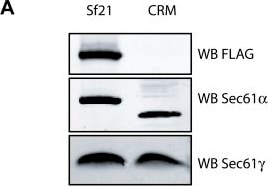
Detection of Insect TNF-alpha by Western Blot
The pre-integrated TMD docks to the cytosolic tip of the lateral gate.(A) Co-immunoprecipitation of recombinant FLAG-Sec61 alpha and Sec61 gamma. Sf21 insect cell microsomes were solubilized with 1% Deoxy BigChap (DBC) and subjected to anti-FLAG immunoprecipitation (IP). Eluted samples (Sf21) were analyzed by immunoblotting next to a sample of canine microsomal ER membranes (CRM). (B) Comparison of the relative CT7 photo-crosslinking efficiency of canine rough microsomes (CRM) and Sf21 microsomes containing wild-type FLAG-Sec61 alpha / gamma complex. CT7 crosslinking was performed as before. The relative crosslinking efficiency of recombinant Sec61 alpha was normalized to the native protein. (C) BMH crosslinking reactions using recombinant FLAG-Sec61 alpha / gamma complex. Cys49 TNF alpha 126-mers were prepared in the presence of Sf21 microsomes, and BMH crosslinking reactions were conducted as described previously. Reactions were either analyzed directly (Total) or after denaturing IP with anti-FLAG affinity resin. IP with the anti-HA affinity resin served as a specificity control. (D) Western blots of Sf21 microsomes co-expressing either wild-type or mutant FLAG-Sec61 alpha / gamma. Insect cell microsomes from cells infected with a baculovirus that lacked Sec61 genes (control virus) served as a control. (E) CT7 crosslinking of mutant Sec61 alpha / gamma complexes containing the indicated cysteine substitutions. The region of the gel corresponding to FLAG-Sec61 alpha is shown. Detection of photo-affinity labeling that is competed by CT9 indicates that the mutant Sec61 alpha / gamma complex is properly folded.DOI:https://dx.doi.org/10.7554/eLife.01483.010 Image collected and cropped by CiteAb from the following publication (https://elifesciences.org/articles/01483), licensed under a CC-BY license. Not internally tested by R&D Systems.Applications for Human TNF-alpha Antibody (6401)
CyTOF-ready
Flow Cytometry
Sample: Human PBMC treated with 1 μg/ml LPS for 4 hours
Neutralization
Flow Cytometry Panel Builder
Bio-Techne Knows Flow Cytometry
Save time and reduce costly mistakes by quickly finding compatible reagents using the Panel Builder Tool.
Advanced Features
- Spectra Viewer - Custom analysis of spectra from multiple fluorochromes
- Spillover Popups - Visualize the spectra of individual fluorochromes
- Antigen Density Selector - Match fluorochrome brightness with antigen density

Formulation, Preparation, and Storage
Purification
Reconstitution
Reconstitute at 0.5 mg/mL in sterile PBS. For liquid material, refer to CoA for concentration.
Formulation
Shipping
Stability & Storage
- 12 months from date of receipt, -20 to -70 °C as supplied.
- 1 month, 2 to 8 °C under sterile conditions after reconstitution.
- 6 months, -20 to -70 °C under sterile conditions after reconstitution.
Calculators
Background: TNF-alpha
Long Name
Alternate Names
Entrez Gene IDs
Gene Symbol
UniProt
Additional TNF-alpha Products
Product Documents for Human TNF-alpha Antibody (6401)
Certificate of Analysis
To download a Certificate of Analysis, please enter a lot or batch number in the search box below.
Note: Certificate of Analysis not available for kit components.
Product Specific Notices for Human TNF-alpha Antibody (6401)
For research use only
Related Research Areas
Citations for Human TNF-alpha Antibody (6401)
 Powered by Bioz
Customer Reviews for Human TNF-alpha Antibody (6401)
There are currently no reviews for this product. Be the first to review Human TNF-alpha Antibody (6401) and earn rewards!
Have you used Human TNF-alpha Antibody (6401)?
Submit a review and receive an Amazon gift card!
$25/€18/£15/$25CAN/¥2500 for a review with an image
$10/€7/£6/$10CAN/¥1110 for a review without an image
Submit a review
Protocols
Find general support by application which include: protocols, troubleshooting, illustrated assays, videos and webinars.
- 7-Amino Actinomycin D (7-AAD) Cell Viability Flow Cytometry Protocol
- Extracellular Membrane Flow Cytometry Protocol
- Flow Cytometry Protocol for Cell Surface Markers
- Flow Cytometry Protocol for Staining Membrane Associated Proteins
- Flow Cytometry Staining Protocols
- Flow Cytometry Troubleshooting Guide
- Intracellular Flow Cytometry Protocol Using Alcohol (Methanol)
- Intracellular Flow Cytometry Protocol Using Detergents
- Intracellular Nuclear Staining Flow Cytometry Protocol Using Detergents
- Intracellular Staining Flow Cytometry Protocol Using Alcohol Permeabilization
- Intracellular Staining Flow Cytometry Protocol Using Detergents to Permeabilize Cells
- Propidium Iodide Cell Viability Flow Cytometry Protocol
- Protocol for Liperfluo
- Protocol for the Characterization of Human Th22 Cells
- Protocol for the Characterization of Human Th9 Cells
- Protocol: Annexin V and PI Staining by Flow Cytometry
- Protocol: Annexin V and PI Staining for Apoptosis by Flow Cytometry
- Troubleshooting Guide: Fluorokine Flow Cytometry Kits
- View all Protocols, Troubleshooting, Illustrated assays and Webinars
FAQs for Human TNF-alpha Antibody (6401)
-
Q: Does Human TNF-alpha antibody, clone # 6401, detect membrane bound or soluble TNF-alpha?
A: Human TNF-alpha antibody, Clone # 6401, binds to and neutralizes Catalog # 210-TA, which is an E. coli-derived human TNF-alpha protein, Val77-Leu233, and has been shown to be cytotoxic to L‑929 mouse fibroblast cells. According to Uniprot, the soluble form of TNF-alpha is amino acids 77-233: https://www.uniprot.org/uniprot/P01375. We have also shown binding of Clone # 6401 to the membrane bound form of TNFa via flow cytometry. We are aware of a few citations showing the antibody acts to neutralize TNFa. See https://www.rndsystems.com/products/human-tnf-alpha-antibody-6401_mab2101#product-citations. Therefore, clone #6401 detects both membrane bound and soluble forms of TNF-alpha.
Associated Pathways