
LinkAble™ HRP Antibody Conjugation Kits
R&D Systems | Catalog # LNKHRP

Key Product Details
Applications
Assay Type
Conjugate
Product Summary for LinkAble™ HRP Antibody Conjugation Kits
LinkAble™ HRP Antibody Conjugation Kits enable rapid, in house antibody labeling and conjugation to horseradish peroxidase (HRP) through primary amine groups (e.g. lysines). Designed for straightforward, in-house use, the HRP conjugation kit supports reliable, reproducible conjugation with minimal hands-on time and no requirement for specialized expertise or additional purification steps. Conjugates are ready to use in approximately two hours, supporting efficient evaluation and comparison of antibodies in downstream assays.
The kits are optimized for single-use reactions and are also available in multipack formats to support higher-throughput or repeat experimental workflows.
Key Benefits
- Ease & Efficiency: Streamlined protocols ensure a simple, fast, and reliable conjugation process. The kit requires only 30 seconds of hands-on time and produces conjugates that are ready to use in 2 hours, without any loss of antibody associated with buffer exchange and purification.
- Reproducibility: Optimized reagents deliver consistent, high-quality results. The kit is available in 25 µg, 100 µg, and 1 mg antibody input sizes, which have been optimized to perform identically across all three sizes, allowing scaling of conjugation reactions.
- Streamlined & Optimized Usability: The ready-to-use format eliminates the need for extra steps in the procedure, minimizes hands-on time, maximizes convenience, and reduces the risk of erroneous calculations. An intuitive, user friendly design includes screw cap vials that can be easily centrifuged to recover the sample.
Starting Mass & Volume of Antibody
The kit produces high quality conjugates using IgG antibodies with a concentration of 100 µg/mL or greater. For optimal results, it is recommended to carry out the conjugation reaction with antibody concentration at 1 mg/mL.
| Reaction Size | Minimum (μg) | Optimal (μg) | Maximum (μg) |
|---|---|---|---|
| 25 μg | 10 | 25 | 100 |
| 100 μg | 25 | 100 | 400 |
| 1000 μg | 250 | 1000 | 4000 |
Technical Hints & Limitations
- Although it is recommended to use a purified antibody in a suitable buffer (e.g. PBS) and free from additives, the LinkAble™ HRP Antibody Conjugation Kit produces high quality conjugates in the presence of some buffers/additives.
Note: The kit is not compatible with certain components, as described in the table below.
| Components | Compatible |
|---|---|
| Amine-free buffer (MES, PBS, HEPES, bicarb, borate) | Yes |
| Tris | ≤ 100 mM |
| Sugars (trehalose / sucrose) | Yes |
| EDTA | Yes |
| Proclin | Yes |
| Sodium azide | No |
| BSA | ≤ 0.1% |
| Glycerol | ≤ 10% |
| Amine-containing reagents (glycine, arginine) | No |
- If multiple, non-optimal parameters are used in the conjugation reaction (concentration, additives, etc.) poor quality conjugates may result.
- Centrifuge all vials before resuspending to ensure all contents are at the bottom of the vials.
- In each step, gently pipette the sample up and down to mix.
- Purification of the conjugated antibody is not necessary, though a user may choose to do so.
Scientific Data Images for LinkAble™ HRP Antibody Conjugation Kits
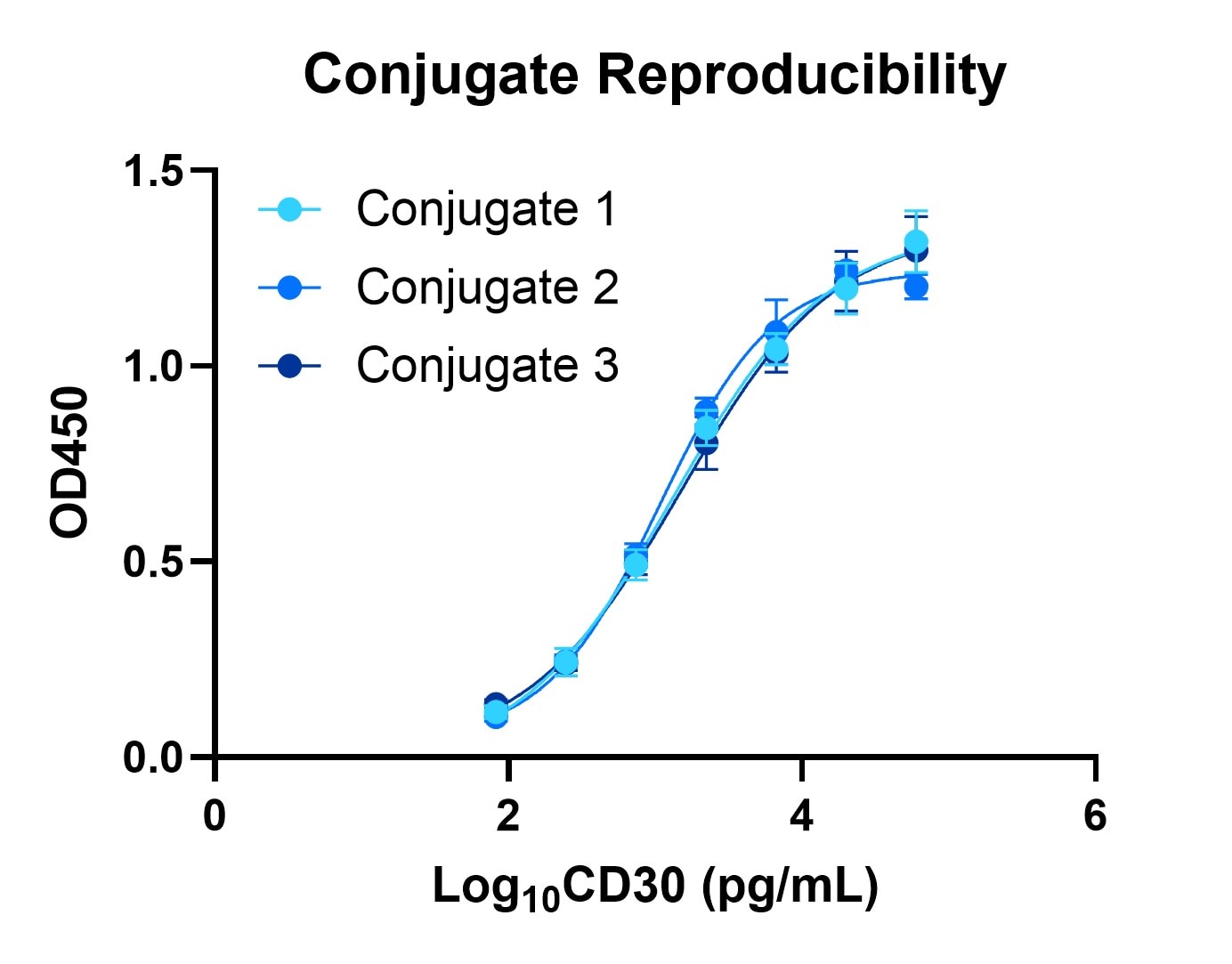
High Reproducibility of CD30-HRP Conjugates Made Using LinkAble™ HRP Antibody Conjugation Kits
Three independent Donkey anti-Goat IgG Antibody (AF109) conjugates were prepared using LinkAble™ HRP Antibody Conjugation Kits and evaluated by CD30 indirect ELISA. Plates were coated with recombinant CD30 (6126-CD), blocked with 1% BSA, and incubated with CD30 primary antibody (AF229) before addition of the HRP conjugates. Signal was developed with TMB substrate and measured at 450 nm. n=4, error bars represent standard deviation.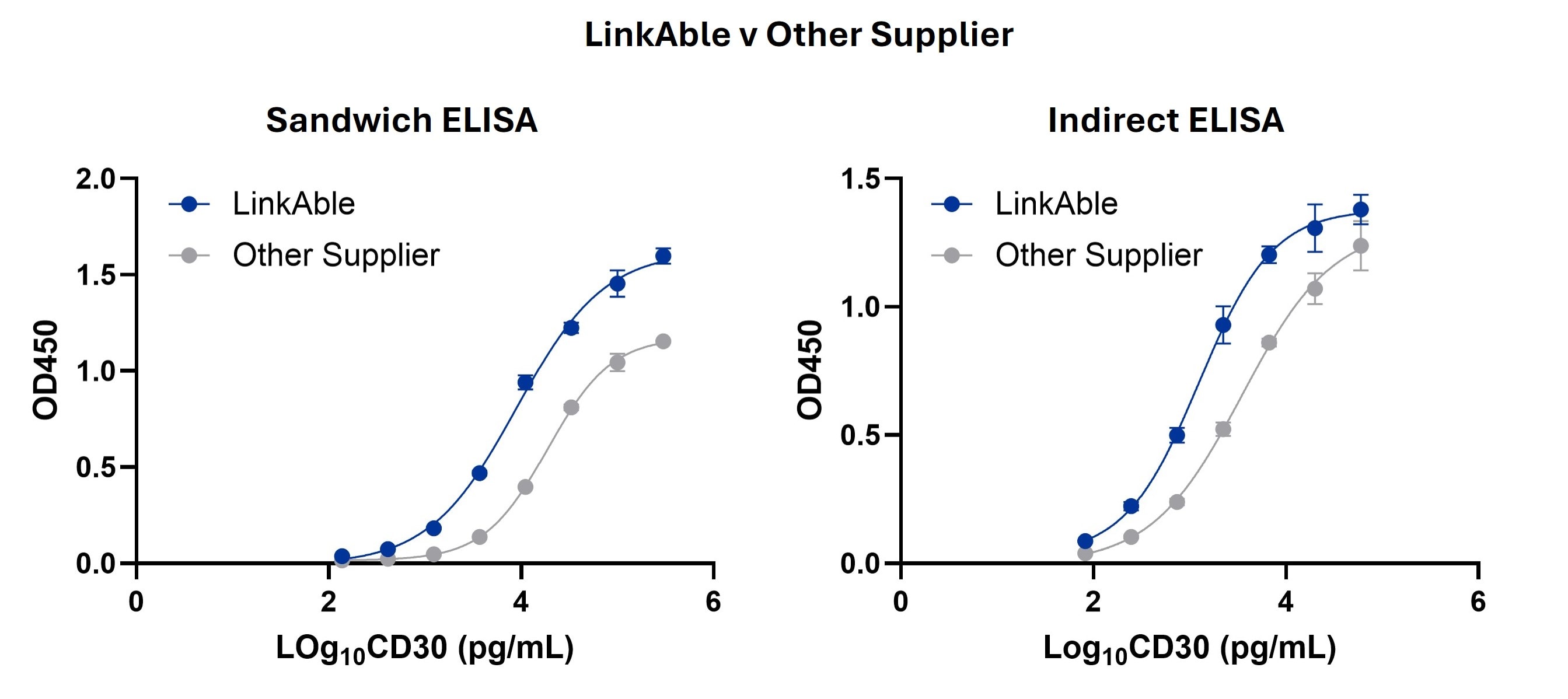
Enhanced Performance of HRP Conjugates Prepared Using LinkAble™ HRP Antibody Conjugation Kits Versus Other Supplier Kit
HRP conjugates were generated using the LinkAble™ HRP Antibody Conjugation Kit or an alternative supplier kit and evaluated by CD30 Sandwich (left) and Indirect (right) ELISA.For Sandwich ELISA, Goat anti-CD30 Antibody (AF229) was conjugated to HRP. Plates were coated with capture antibody (MAB2291), blocked with 1% BSA, and incubated with titrated CD30 antigen (6126-CD) prior to addition of CD30-HRP conjugates. For Indirect ELISA, Donkey anti-Goat IgG Antibody (AF109) was conjugated to HRP. Plates were coated with recombinant CD30 (6126-CD), blocked, and incubated with CD30 primary antibody (AF229), followed by HRP conjugates. Detection in both assays was performed using TMB substrate and absorbance measured at 450 nm. LinkAble™-generated conjugates demonstrated increased signal intensity and improved sensitivity compared to the alternative supplier across both assay formats. n=4, error bars represent standard deviation.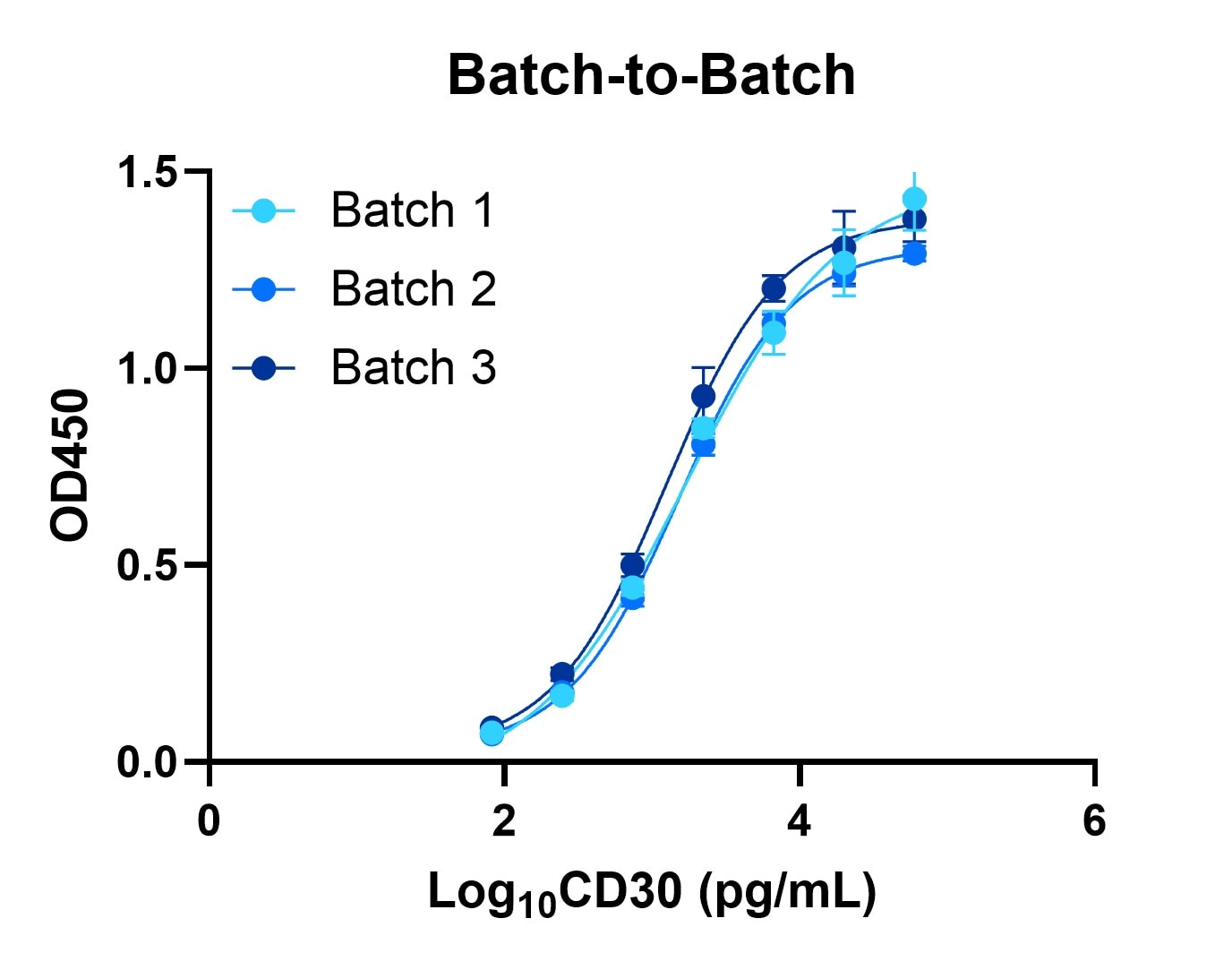
Consistent Batch-to-Batch Performance of CD30-HRP Conjugates Made Using LinkAble™ HRP Antibody Conjugation Kits
Donkey anti-Goat IgG Antibody (AF109) was conjugated to HRP using three independent batches of LinkAble™ HRP Antibody Conjugation Kits. Conjugates were evaluated by CD30 indirect ELISA using plates coated with recombinant CD30 (6126-CD), blocked with 1% BSA, and incubated with CD30 primary antibody (AF229) before addition of the HRP conjugates. Signal was developed with TMB substrate and measured at 450 nm. n=4, error bars represent standard deviation.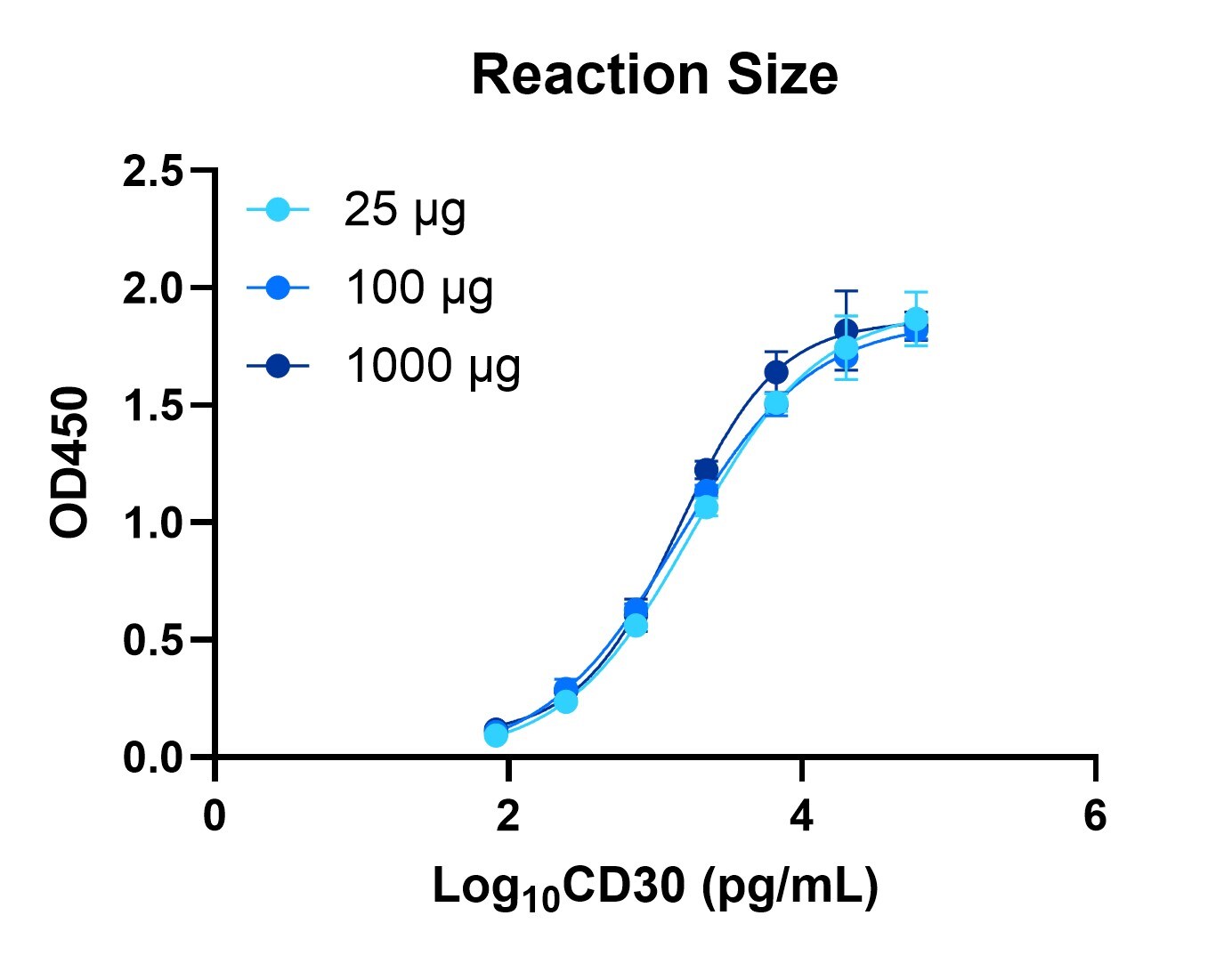
Consistent CD30-HRP Conjugate Performance Across Reaction Sizes Made Using LinkAble™ HRP Antibody Conjugation Kits
Donkey anti-Goat IgG Antibody (AF109) was conjugated to HRP using LinkAble™ HRP Antibody Conjugation Kits at 25 µg, 100 µg, and 1000 µg reaction sizes. Conjugates were evaluated by CD30 indirect ELISA using plates coated with recombinant CD30 (6126-CD), blocked with 1% BSA, and incubated with CD30 primary antibody (AF229) before addition of the HRP conjugates. Signal was developed with TMB substrate and measured at 450 nm. n=4, error bars represent standard deviation.Kit Contents for LinkAble™ HRP Antibody Conjugation Kits
- 10X Buffer: 200 μL (3 x 200 µL for 5 x 1 mg kit)
- Reagent A: 1 vial (Lyophilized; x3 or x5 for multi-pack kits)
- Reagent B: 1 vial (Lyophilized; x3 or x5 for multi-pack kits)
Other Materials Required
Antibody to be conjugated. Refer to Technical Hints and Limitations for more information on the antibody requirements.
Formulation, Preparation, and Storage
Shipping
Storage
The conjugated antibody should be stored at 4 °C.
Product Documents for LinkAble™ HRP Antibody Conjugation Kits
Certificate of Analysis
To download a Certificate of Analysis, please enter a lot or batch number in the search box below.
Note: Certificate of Analysis not available for kit components.
Product Specific Notices for LinkAble™ HRP Antibody Conjugation Kits
LinkAbleTM is a trademark of Bio-Techne.
Wear appropriate protective gloves, clothing, and eye/face protection. Wash hands thoroughly after handling. Consult the Safety Data Sheet (SDS) on our website prior to use. Review SDS information for all kit components, including the borate buffer.
For research use only
Customer Reviews for LinkAble™ HRP Antibody Conjugation Kits
There are currently no reviews for this product. Be the first to review LinkAble™ HRP Antibody Conjugation Kits and earn rewards!
Have you used LinkAble™ HRP Antibody Conjugation Kits?
Submit a review and receive an Amazon gift card!
$25/€18/£15/$25CAN/¥2500 for a review with an image
$10/€7/£6/$10CAN/¥1110 for a review without an image
Submit a review
Protocols
View specific protocols for LinkAble™ HRP Antibody Conjugation Kits (LNKHRP):
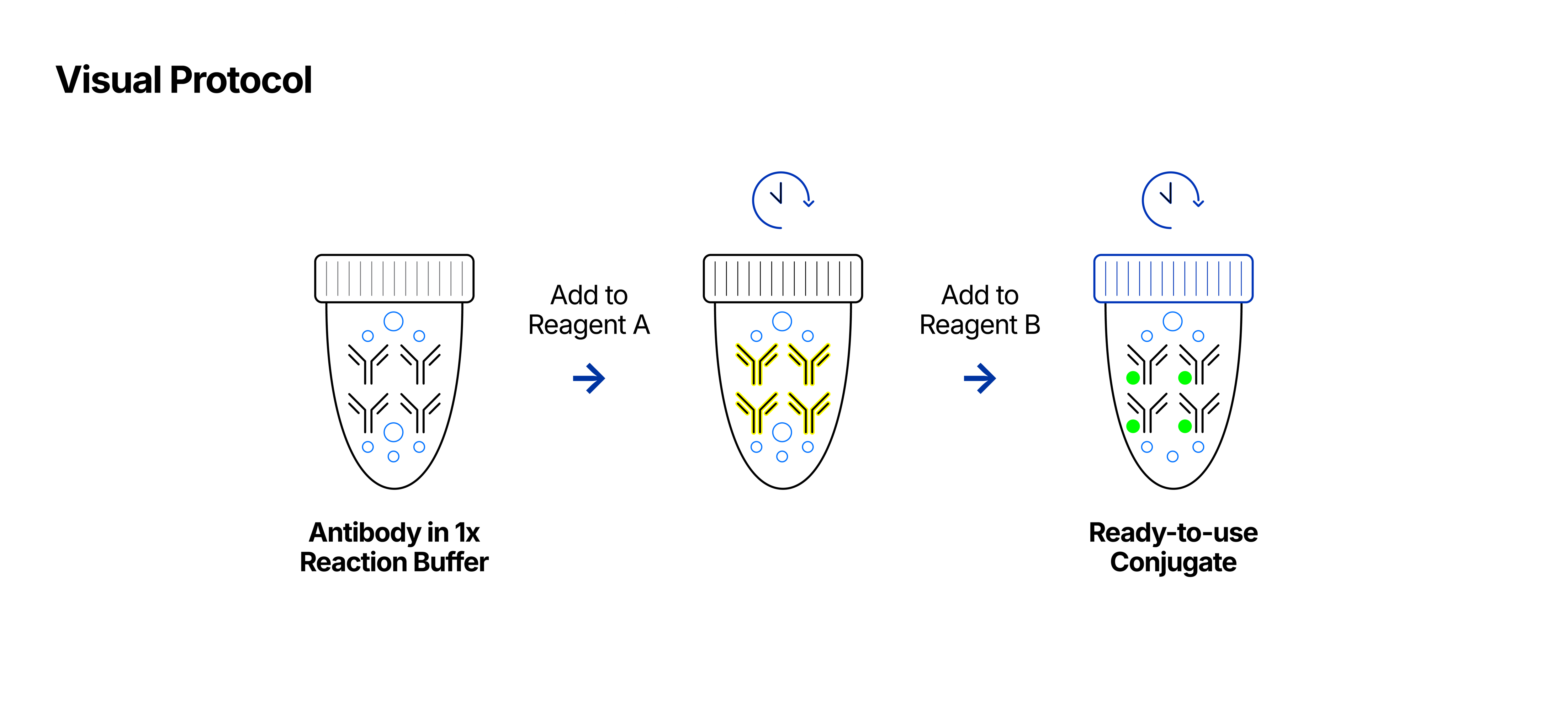
General Protocol
- Add sufficient volume of 10X Reaction Buffer to the antibody solution so the final Reaction Buffer concentration is 1X.
- Transfer the antibody solution in 1X Reaction Buffer to the Reagent A tube and gently pipette up and down to dissolve.
- Incubate the tube at room temperature for 60 minutes in the dark.
- Transfer the antibody solution to the Reagent B tube and gently pipette up and down to dissolve.
- Incubate the tube at room temperature for 60 minutes in the dark.
- The conjugated antibody is now ready to use.
Note: No conjugation clean-up is required before the labeled antibody can be used. Do not add sodium azide for long term storage.
Conjugate Storage
The conjugated antibody should be stored at 4 °C.
Troubleshooting
The efficiency of the conjugation reaction means there are small quantities of materials in each of the vials. We recommend centrifuging before starting the conjugation to ensure all material is at the bottom of the vial. For additional troubleshooting assistance or any other questions, contact our technical support team.
Find general support by application which include: protocols, troubleshooting, illustrated assays, videos and webinars.
- Antigen Retrieval Protocol (PIER)
- Antigen Retrieval for Frozen Sections Protocol
- Appropriate Fixation of IHC/ICC Samples
- Cellular Response to Hypoxia Protocols
- Chromogenic IHC Staining of Formalin-Fixed Paraffin-Embedded (FFPE) Tissue Protocol
- Chromogenic Immunohistochemistry Staining of Frozen Tissue
- ClariTSA™ Fluorophore Kits
- Detection & Visualization of Antibody Binding
- ELISA Sample Preparation & Collection Guide
- ELISA Troubleshooting Guide
- Fluorescent IHC Staining of Frozen Tissue Protocol
- Graphic Protocol for Heat-induced Epitope Retrieval
- Graphic Protocol for the Preparation and Fluorescent IHC Staining of Frozen Tissue Sections
- Graphic Protocol for the Preparation and Fluorescent IHC Staining of Paraffin-embedded Tissue Sections
- Graphic Protocol for the Preparation of Gelatin-coated Slides for Histological Tissue Sections
- How to Run an R&D Systems DuoSet ELISA
- How to Run an R&D Systems Quantikine ELISA
- How to Run an R&D Systems Quantikine™ QuicKit™ ELISA
- IHC Sample Preparation (Frozen sections vs Paraffin)
- Immunofluorescent IHC Staining of Formalin-Fixed Paraffin-Embedded (FFPE) Tissue Protocol
- Immunohistochemistry (IHC) and Immunocytochemistry (ICC) Protocols
- Immunohistochemistry Frozen Troubleshooting
- Immunohistochemistry Paraffin Troubleshooting
- Preparing Samples for IHC/ICC Experiments
- Preventing Non-Specific Staining (Non-Specific Binding)
- Primary Antibody Selection & Optimization
- Protocol for Heat-Induced Epitope Retrieval (HIER)
- Protocol for Making a 4% Formaldehyde Solution in PBS
- Protocol for VisUCyte™ HRP Polymer Detection Reagent
- Protocol for the Preparation & Fixation of Cells on Coverslips
- Protocol for the Preparation and Chromogenic IHC Staining of Frozen Tissue Sections
- Protocol for the Preparation and Chromogenic IHC Staining of Frozen Tissue Sections - Graphic
- Protocol for the Preparation and Chromogenic IHC Staining of Paraffin-embedded Tissue Sections
- Protocol for the Preparation and Chromogenic IHC Staining of Paraffin-embedded Tissue Sections - Graphic
- Protocol for the Preparation and Fluorescent IHC Staining of Frozen Tissue Sections
- Protocol for the Preparation and Fluorescent IHC Staining of Paraffin-embedded Tissue Sections
- Protocol for the Preparation of Gelatin-coated Slides for Histological Tissue Sections
- Quantikine HS ELISA Kit Assay Principle, Alkaline Phosphatase
- Quantikine HS ELISA Kit Principle, Streptavidin-HRP Polymer
- R&D Systems Quality Control Western Blot Protocol
- Sandwich ELISA (Colorimetric) – Biotin/Streptavidin Detection Protocol
- Sandwich ELISA (Colorimetric) – Direct Detection Protocol
- TUNEL and Active Caspase-3 Detection by IHC/ICC Protocol
- The Importance of IHC/ICC Controls
- Troubleshooting Guide: ELISA
- Troubleshooting Guide: Immunohistochemistry
- Troubleshooting Guide: Western Blot Figures
- Western Blot Conditions
- Western Blot Protocol
- Western Blot Protocol for Cell Lysates
- Western Blot Troubleshooting
- Western Blot Troubleshooting Guide
- View all Protocols, Troubleshooting, Illustrated assays and Webinars