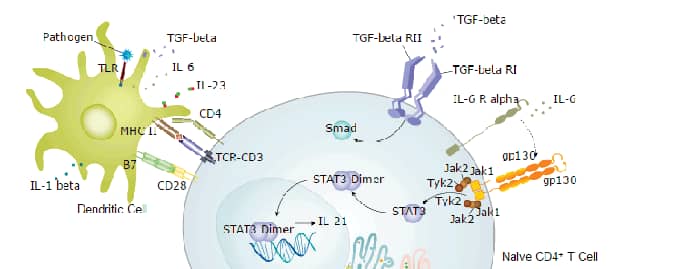
CD28 and CTLA-4, together with their ligands B7‑1 and B7‑2, constitute one of the dominant co‑stimulatory pathways that regulate T‑ and B‑cell responses. CD28 and CTLA-4 are structurally homologous molecules that are members of the immunoglobulin (Ig) gene superfamily. Both CD28 and CTLA-4 are composed of a single Ig V‑like extracellular domain, a transmembrane domain and an intracellular domain. CD28 and CTLA-4 are both expressed on the cell surface as disulfide-linked homodimers or as monomers. The genes encoding these two molecules are closely linked on human chromosome 2 and mouse chromosome 1. Mouse CD28 is expressed constitutively on virtually 100% of mouse T cells and on developing thymocytes. Cell surface expression of mouse CD28 is down‑regulated upon ligation of CD28 in the presence of PMA or PHA. In contrast, CTLA-4 is not expressed constitutively but is up‑regulated rapidly following T cell activation and CD28 ligation. Cell surface expression of CTLA-4 peaks approximately 48 hours after activation. Although both CTLA-4 and CD28 can bind to the same ligands, CTLA-4 binds to B7‑1 and B7‑2 with a 20‑100 fold higher affinity than CD28. CD28/B7 interaction has been shown to prevent apoptosis of activated T cells via the up‑regulation of bcl‑XL. CD28 ligation has also been shown to regulate Th1/Th2 differentiation.

![Mouse CD28 Antibody [Biotin]](https://resources.rndsystems.com/images/icons/RnD-Default-Product-Image_Antibodies-Icon.svg "Mouse CD28 Antibody [Biotin]")
Key Product Details
Species Reactivity
Mouse
Applications
Western Blot
Label
Biotin
Antibody Source
Polyclonal Goat IgG
Loading...
Product Specifications
Immunogen
Mouse myeloma cell line NS0-derived recombinant mouse CD28
Lys21-Lys149
Accession # P31041
Lys21-Lys149
Accession # P31041
Specificity
Detects mouse CD28 in Western blots. In Western blots, approximately 5% cross-reactivity with recombinant human CD28 and recombinant mouse CTLA-4 is observed.
Clonality
Polyclonal
Host
Goat
Isotype
IgG
Applications for Mouse CD28 Antibody [Biotin]
Application
Recommended Usage
Western Blot
0.1 µg/mL
Sample: Recombinant Mouse CD28 Fc Chimera (Catalog # 483-CD)
Sample: Recombinant Mouse CD28 Fc Chimera (Catalog # 483-CD)
Formulation, Preparation, and Storage
Purification
Antigen Affinity-purified
Reconstitution
Reconstitute at 0.2 mg/mL in sterile PBS.
Loading...
Formulation
Lyophilized from a 0.2 μm filtered solution in PBS with BSA as a carrier protein.
Shipping
The product is shipped at ambient temperature. Upon receipt, store it immediately at the temperature recommended below.
Stability & Storage
Use a manual defrost freezer and avoid repeated freeze-thaw cycles.
- 12 months from date of receipt, -20 to -70 °C as supplied.
- 1 month, 2 to 8 °C under sterile conditions after reconstitution.
- 6 months, -20 to -70 °C under sterile conditions after reconstitution.
Calculators
Background: CD28
References
- Lenschow, D.J. et al. (1996) Annu. Rev. Immunol. 14:233.
- Hathcock, K.S. and R.J. Hodes (1996) Advances in Immunol. 62:131.
- Ward, S.G. (1996) Biochem. J. 318:361.
Alternate Names
CD28
Gene Symbol
CD28
UniProt
Additional CD28 Products
Product Documents for Mouse CD28 Antibody [Biotin]
Certificate of Analysis
To download a Certificate of Analysis, please enter a lot or batch number in the search box below.
Note: Certificate of Analysis not available for kit components.
Product Specific Notices for Mouse CD28 Antibody [Biotin]
For research use only
Customer Reviews for Mouse CD28 Antibody [Biotin]
There are currently no reviews for this product. Be the first to review Mouse CD28 Antibody [Biotin] and earn rewards!
Have you used Mouse CD28 Antibody [Biotin]?
Submit a review and receive an Amazon gift card!
$25/€18/£15/$25CAN/¥2500 for a review with an image
$10/€7/£6/$10CAN/¥1110 for a review without an image
Submit a review
Protocols
Find general support by application which include: protocols, troubleshooting, illustrated assays, videos and webinars.
- Cellular Response to Hypoxia Protocols
- R&D Systems Quality Control Western Blot Protocol
- Troubleshooting Guide: Western Blot Figures
- Western Blot Conditions
- Western Blot Protocol
- Western Blot Protocol for Cell Lysates
- Western Blot Troubleshooting
- Western Blot Troubleshooting Guide
- View all Protocols, Troubleshooting, Illustrated assays and Webinars