
PARP10 Antibody - BSA Free
Novus Biologicals | Catalog # NB100-2157

![Western Blot: PARP10 Antibody [NB100-2157]](https://resources.rndsystems.com/images/products/PARP10-Antibody-Western-Blot-NB100-2157-img0007.jpg "Western Blot: PARP10 Antibody [NB100-2157]")
Key Product Details
Validated by
Independent Antibodies
Species Reactivity
Validated:
Human
Cited:
Human
Applications
Validated:
Immunohistochemistry, Immunohistochemistry-Paraffin, Western Blot, Immunoprecipitation
Cited:
Western Blot, Knockdown Validated
Label
Unconjugated
Antibody Source
Polyclonal Rabbit IgG
Format
BSA Free
Loading...
Product Specifications
Immunogen
The immunogen recognized by this antibody maps to a region between residue 300 and 350 of Poly (ADP-ribose) Polymerase Family, member 10 using the numbering given in entry NP_116178.1 (GeneID 84875)
Localization
Nuclear
Clonality
Polyclonal
Host
Rabbit
Isotype
IgG
Scientific Data Images for PARP10 Antibody - BSA Free
![Immunohistochemistry-Paraffin: PARP10 Antibody [NB100-2157]](https://resources.rndsystems.com/images/products/PARP10-Antibody-Immunohistochemistry-Paraffin-NB100-2157-img0009.jpg "Immunohistochemistry-Paraffin: PARP10 Antibody [NB100-2157]")
Immunohistochemistry-Paraffin: PARP10 Antibody [NB100-2157]
Immunohistochemistry-Paraffin: PARP10 Antibody [NB100-2157] - Human ovarian carcinoma. Antibody: Affinity purified rabbit anti- PARP10 used at a dilution of 1:1,000 (1ug/ml). Detection: DAB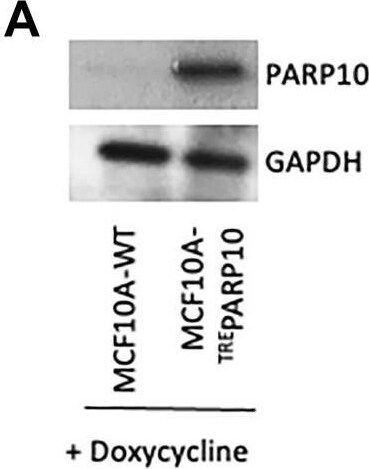
Western Blot: PARP10 Antibody - BSA Free [NB100-2157] -
Identification of genes necessary for proliferation of PARP10-overexpressing MCF10A breast epithelial cells by CRISPR-mediated genome-wide loss-of-function screening.(A) Western blot showing doxycycline-induced overexpression of PARP10 in MCF10A cells. (B) Overview of the CRISPR knockout screens to identify genes that are specifically required for proliferation of PARP10-overexpressing MCF10A cells. (C) Scatterplot showing the results of genome-wide CRISPR knockout screens to identify genes that are specifically required for proliferation of PARP10-overexpressing MCF10A cells. Each gene targeted by the library was ranked according to the MAGeCK score indicating genes which, when inactivated, specifically cause reduced proliferation in PARP10-overexpressing MCF10A-TREPARP10 cells compared to control MCF10A cells. Top hits chosen for validation are indicated. (D, E) Biological pathway analyses using KEGG (D) or Gene Ontology (E) analyses of the top hits with p-values lower than 0.02 which specifically cause reduced proliferation in PARP10-overexpressing MCF10A-TREPARP10 cells compared to control MCF10A cells. KEGG terms with negative logP greater than 1 are shown. GO_BP terms with negative logP greater than 1.24 are presented (corresponding to the top 20 pathways). Image collected and cropped by CiteAb from the following open publication (https://pubmed.ncbi.nlm.nih.gov/36187556), licensed under a CC-BY license. Not internally tested by Novus Biologicals.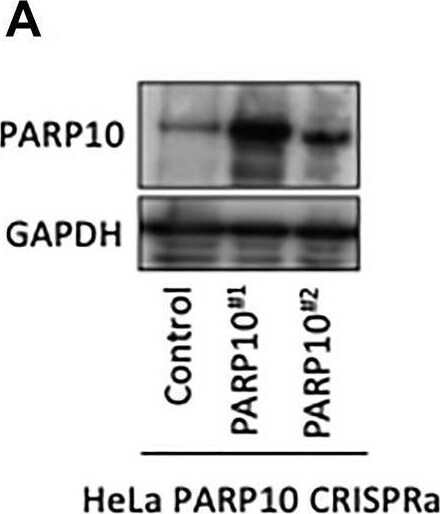
Western Blot: PARP10 Antibody - BSA Free [NB100-2157] -
Functional interaction between ATM and PARP10 expression.(A) Western blot showing overexpression of PARP10 in two independent HeLa PARP10 CRISPRa cell lines. (B) CellTiterGlo cellular proliferation assays showing that knockdown of ATM, using two separate siRNA oligonucleotides, specifically reduces the proliferation of two different PARP10-overexpressing CRISPRa HeLa cell lines compared to control HeLa cells. The average of three experiments is shown (normalized to control siRNA). Error bars represent standard deviations, and asterisks indicate statistical significance (t-test, two-tailed, unpaired). (C) DNA fiber combing assays showing that ATM depletion does not differentially impact replication fork progression in PARP10-overexpressing CRISPRa HeLa cell lines compared to control HeLa cells. Replication tracts labeled by both IdU and CldU, indicating ongoing replication forks, were quantified, and their labeled tract length (IdU+CldU) is presented, with the median values marked on the graph and listed at the top. At least 60 tracts were quantified for each sample. Asterisks indicate statistical significance (Mann-Whitney test). A schematic representation of the assay conditions is shown at the top. (D–F) ATM SIRF experiments showing that PARP10 overexpression in HeLa cells increases HU-induced ATM binding to nascent DNA. HeLa cells were treated with 4 mM HU for 3 hours. ATM depletion was used as control, to demonstrate the specificity of the SIRF signal. Representative micrographs (D) and quantifications (E, F) are shown. Bars indicate the mean values, error bars represent standard errors, and asterisks indicate statistical significance (t-test, two-tailed, unpaired). Schematic representations of the assay conditions are shown at the top. Image collected and cropped by CiteAb from the following open publication (https://pubmed.ncbi.nlm.nih.gov/36187556), licensed under a CC-BY license. Not internally tested by Novus Biologicals.Applications for PARP10 Antibody - BSA Free
Application
Recommended Usage
Immunohistochemistry
1:500 -1:2000
Immunohistochemistry-Paraffin
1:500 -1:2000
Immunoprecipitation
1-4 ug/mg of lysate
Western Blot
1:500-1:2500
Application Notes
Epitope retrieval with citrate buffer pH6.0 is recommended for FFPE tissue sections.
Formulation, Preparation, and Storage
Purification
Immunogen affinity purified
Formulation
Tris-Citrate/Phosphate (pH 7.0 - 8.0)
Format
BSA Free
Preservative
0.09% Sodium Azide
Concentration
1.0 mg/ml
Shipping
The product is shipped with polar packs. Upon receipt, store it immediately at the temperature recommended below.
Stability & Storage
Store at 4C. Do not freeze.
Background: PARP10
Long Name
Protein mono-ADP-ribosyltransferase PARP10
Alternate Names
ARTD10, PARP-10
Entrez Gene IDs
84875 (Human)
Gene Symbol
PARP10
UniProt
Additional PARP10 Products
Product Documents for PARP10 Antibody - BSA Free
Certificate of Analysis
To download a Certificate of Analysis, please enter a lot or batch number in the search box below.
Product Specific Notices for PARP10 Antibody - BSA Free
This product is for research use only and is not approved for use in humans or in clinical diagnosis. Primary Antibodies are guaranteed for 1 year from date of receipt.
Citations for PARP10 Antibody - BSA Free
 Powered by Bioz
Customer Reviews for PARP10 Antibody - BSA Free
There are currently no reviews for this product. Be the first to review PARP10 Antibody - BSA Free and earn rewards!
Have you used PARP10 Antibody - BSA Free?
Submit a review and receive an Amazon gift card!
$25/€18/£15/$25CAN/¥2500 Yen for a review with an image
$10/€7/£6/$10CAN/¥1110 Yen for a review without an image
Submit a review
Protocols
Find general support by application which include: protocols, troubleshooting, illustrated assays, videos and webinars.
- Antigen Retrieval Protocol (PIER)
- Antigen Retrieval for Frozen Sections Protocol
- Appropriate Fixation of IHC/ICC Samples
- Cellular Response to Hypoxia Protocols
- Chromogenic IHC Staining of Formalin-Fixed Paraffin-Embedded (FFPE) Tissue Protocol
- Chromogenic Immunohistochemistry Staining of Frozen Tissue
- ClariTSA™ Fluorophore Kits
- Detection & Visualization of Antibody Binding
- Fluorescent IHC Staining of Frozen Tissue Protocol
- Graphic Protocol for Heat-induced Epitope Retrieval
- Graphic Protocol for the Preparation and Fluorescent IHC Staining of Frozen Tissue Sections
- Graphic Protocol for the Preparation and Fluorescent IHC Staining of Paraffin-embedded Tissue Sections
- Graphic Protocol for the Preparation of Gelatin-coated Slides for Histological Tissue Sections
- IHC Sample Preparation (Frozen sections vs Paraffin)
- Immunofluorescent IHC Staining of Formalin-Fixed Paraffin-Embedded (FFPE) Tissue Protocol
- Immunohistochemistry (IHC) and Immunocytochemistry (ICC) Protocols
- Immunohistochemistry Frozen Troubleshooting
- Immunohistochemistry Paraffin Troubleshooting
- Immunoprecipitation Protocol
- Preparing Samples for IHC/ICC Experiments
- Preventing Non-Specific Staining (Non-Specific Binding)
- Primary Antibody Selection & Optimization
- Protocol for Heat-Induced Epitope Retrieval (HIER)
- Protocol for Making a 4% Formaldehyde Solution in PBS
- Protocol for VisUCyte™ HRP Polymer Detection Reagent
- Protocol for the Preparation & Fixation of Cells on Coverslips
- Protocol for the Preparation and Chromogenic IHC Staining of Frozen Tissue Sections
- Protocol for the Preparation and Chromogenic IHC Staining of Frozen Tissue Sections - Graphic
- Protocol for the Preparation and Chromogenic IHC Staining of Paraffin-embedded Tissue Sections
- Protocol for the Preparation and Chromogenic IHC Staining of Paraffin-embedded Tissue Sections - Graphic
- Protocol for the Preparation and Fluorescent IHC Staining of Frozen Tissue Sections
- Protocol for the Preparation and Fluorescent IHC Staining of Paraffin-embedded Tissue Sections
- Protocol for the Preparation of Gelatin-coated Slides for Histological Tissue Sections
- R&D Systems Quality Control Western Blot Protocol
- TUNEL and Active Caspase-3 Detection by IHC/ICC Protocol
- The Importance of IHC/ICC Controls
- Troubleshooting Guide: Immunohistochemistry
- Troubleshooting Guide: Western Blot Figures
- Western Blot Conditions
- Western Blot Protocol
- Western Blot Protocol for Cell Lysates
- Western Blot Troubleshooting
- Western Blot Troubleshooting Guide
- View all Protocols, Troubleshooting, Illustrated assays and Webinars
Loading...