
SPOP Antibody - Azide and BSA Free
Novus Biologicals | Catalog # H00008405-B01P

![Western Blot: SPOP Antibody [H00008405-B01P]](https://resources.rndsystems.com/images/products/SPOP-Antibody-Western-Blot-H00008405-B01P-img0007.jpg "Western Blot: SPOP Antibody [H00008405-B01P]")
Loading...
Key Product Details
Validated by
Knockout/Knockdown
Species Reactivity
Validated:
Human
Cited:
Human
Applications
Validated:
Immunohistochemistry, Immunohistochemistry-Paraffin, Western Blot, Immunocytochemistry/ Immunofluorescence, Knockdown Validated
Cited:
Immunohistochemistry-Paraffin, Western Blot
Label
Unconjugated
Antibody Source
Polyclonal Mouse IgG
Format
Azide and BSA Free
Loading...
Product Specifications
Immunogen
SPOP (NP_001007227.1, 1 a.a. - 374 a.a.) full-length human protein. MSRVPSPPPPAEMSSGPVAESWCYTQIKVVKFSYMWTINNFSFCREEMGEVIKSSTFSSGANDKLKWCLRVNPKGLDEESKDYLSLYLLLVSCPKSEVRAKFKFSILNAKGEETKAMESQRAYRFVQGKDWGFKKFIRRDFLLDEANGLLPDDKLTLFCEVSVVQDSVNISGQNTMNMVKVPECRLADELGGLWENSRFTDCCLCVAGQEFQAHKAILAARSPVFSAMFEHEMEESKKNRVEINDVEPEVFKEMMCFIYTGKAPNLDKMADDLLAAADKYALERLKVMCEDALCSNLSVENAAEILILADLHSADQLKTQAVDFINYHASDVLETSGWKSMVVSHPHLVAEAYRSLASAQCPFLGPPRKRLKQS
Specificity
SPOP - speckle-type POZ protein,
Clonality
Polyclonal
Host
Mouse
Isotype
IgG
Description
Quality control test: Antibody reactive against mammalian transfected lysate.
Scientific Data Images for SPOP Antibody - Azide and BSA Free
Western Blot: SPOP Antibody [H00008405-B01P]
SPOP-Antibody-Western-Blot-H00008405-B01P-img0007.jpg![Immunocytochemistry/ Immunofluorescence: SPOP Antibody [H00008405-B01P]](https://resources.rndsystems.com/images/products/SPOP-Antibody-Immunocytochemistry-Immunofluorescence-H00008405-B01P-img0003.jpg "Immunocytochemistry/ Immunofluorescence: SPOP Antibody [H00008405-B01P]")
Immunocytochemistry/ Immunofluorescence: SPOP Antibody [H00008405-B01P]
Immunocytochemistry/Immunofluorescence: SPOP Antibody [H00008405-B01P] - Analysis of purified antibody to SPOP on HeLa cell. (antibody concentration 10 ug/ml)![Western Blot: SPOP Antibody [H00008405-B01P]](https://resources.rndsystems.com/images/products/SPOP-Antibody-Western-Blot-H00008405-B01P-img0004.jpg "Western Blot: SPOP Antibody [H00008405-B01P]")
Western Blot: SPOP Antibody [H00008405-B01P]
Western Blot: SPOP Antibody [H00008405-B01P] - Analysis of SPOP expression in transfected 293T cell line by SPOP polyclonal antibody. Lane 1: SPOP transfected lysate(41.14 KDa). Lane 2: Non-transfected lysate.![Western Blot: SPOP Antibody [H00008405-B01P]](https://resources.rndsystems.com/images/products/SPOP-Antibody-Western-Blot-H00008405-B01P-img0005.jpg "Western Blot: SPOP Antibody [H00008405-B01P]")
Western Blot: SPOP Antibody [H00008405-B01P]
SPOP-Antibody-Western-Blot-H00008405-B01P-img0005.jpg![Knockdown Validated: SPOP Antibody [H00008405-B01P]](https://resources.rndsystems.com/images/products/SPOP-Antibody-Knockdown-Validated-H00008405-B01P-img0006.jpg "Western Blot: SPOP Antibody [H00008405-B01P]")
Western Blot: SPOP Antibody [H00008405-B01P] -
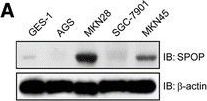
Western Blot: SPOP Antibody [H00008405-B01P] - SPOP inhibits gastric cancer cell proliferation & migration. (A) The expression of SPOP protein in human GC cell lines - MKN45, MKN28, AGS, SGC7901, & human gastric mucosal cell line GES-1 by Western blotting. (B) Detection of SPOP expression in transfected AGS cells. Expression of SPOP was detected in cell lysates of SPOP-V5 transfected AGS cells by Western blotting. Control, AGS cells with empty vector plasmid; #1 & #2 represent different groups of stable AGS cell lines transfected with SPOP. (C) Decreased viability of gastric cancer cells transfected with SPOP. The viability of AGS cells was assessed by using an MTT assay. Data represent the average of three experiments (mean ± SD). **P < 0.01, compared to control cells. (D, E) Reduced migration of AGS cells following treatment with SPOP transfection. Cell migration was examined using a scratch assay. D, images acquired at indicated time points. E, quantification of cell migration rates. Data represent the average of three experiments (mean ± SD). **P < 0.01, compared to DMSO treated cells. (F, G) Colony formation of SPOP over-expressed AGS cells. One or two hundred stable cell lines with SPOP over-expression were seeded into 12-well plates for 2 weeks. Colonies were fixed & stained with crystal violet, then counted if the colonies > 50 cells. G, histograms show the rate of colony formation. Data represent the average of three experiments (mean ± SD). **P < 0.01, compared to DMSO treated cells. Image collected & cropped by CiteAb from the following publication (https://pubmed.ncbi.nlm.nih.gov/25204354), licensed under a CC-BY license. Not internally tested by Novus Biologicals.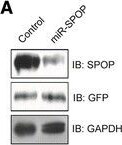
Western Blot: SPOP Antibody [H00008405-B01P] -
Western Blot: SPOP Antibody [H00008405-B01P] - Repression of SPOP promotes proliferation & migration of gastric cancer cells. (A) MKN45 cells were transfected with GFP-tagged miR-SPOP & screened by flow cytometry for the stable cells. Western blotting was performed to detect SPOP expression. (B) Repression of SPOP enhances gastric cancer cell viability. The viability of MKN45 cells was assessed using an MTT assay. Data represent the average of three experiments (mean ± SD). *P < 0.05, compared to control cells. (C) Repression of SPOP promotes Ki-67 expression in nucleus. Immunofluorescent stainings of transfected miR-SPOP & endogenous Ki-67 were performed in MKN45 cells. MKN45 cells were transfected with GFP-tagged miR-SPOP for 48 h. Ki-67 was detected by incubating cells with mouse anti-Ki-67 & subsequently with Alexa Fluor 594 goat anti-mouse antibodies. Nucleus was identified by DAPI staining. (D, E) Repression of SPOP accelerates MKN45 cell migration in a scratch assay. Bars represent the standard deviation of three independent experiments. **P < 0.01, compared to DMSO treated control. (F) Repression of SPOP increases gastric cancer cell colony formation. Two hundred stable miR-SPOP transfected MKN45 cells were seeded into 12-well plates for 2 weeks. Colonies were fixed & stained with crystal violet & then counted if the colonies > 50 cells. (G) Histograms show the colony formation rate. Data represent the average of three experiments (mean ± SD). **P < 0.01, compared to DMSO treated cells. Image collected & cropped by CiteAb from the following publication (https://pubmed.ncbi.nlm.nih.gov/25204354), licensed under a CC-BY license. Not internally tested by Novus Biologicals.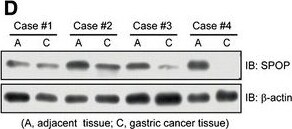
Western Blot: SPOP Antibody [H00008405-B01P] -
Western Blot: SPOP Antibody [H00008405-B01P] - SPOP expression in gastric cancer. (A) The representative photos of SPOP expression in gastric cancer tissues & adjacent gastric tissues by using immunohistochemical staining (DAB staining, scale bar, 40 μm). Magnified local images reflecting detailed information were shown on the bottom. (B, C) SPOP expression was plotted using the immunochemical scores as described in the Methods. B, plot of SPOP scores in each gastric carcinoma & adjacent tissues. C, scores of SPOP expression are shown as box plots. The horizontal lines represent the median. The bottom & top edges of the boxes represent the 25th & 75th percentiles, respectively. & the vertical bars represent the range of the data. n = 88. (D) Representative immunoblotting of SPOP protein in gastric cancer samples. C refers to gastric cancer tissue & A refers to paired adjacent non-tumor gastric tissue from the same patient. Image collected & cropped by CiteAb from the following publication (https://pubmed.ncbi.nlm.nih.gov/25204354), licensed under a CC-BY license. Not internally tested by Novus Biologicals.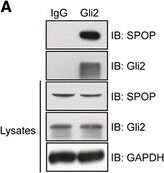
Western Blot: SPOP Antibody [H00008405-B01P] -
Western Blot: SPOP Antibody [H00008405-B01P] - SPOP inhibits Hh/Gli signaling activity. (A) SPOP interacts with Gli2 protein in MKN28 cells by co-immunoprecipitation method. Goat anti-rabbit IgG is used as negative control. (B) Quantification of Gli1 & Gli2 mRNA in Myc-SPOP transfected MKN28 cells. (C) Increasing SPOP reduced Gli2 expression. AGS cells were transfected with different amount of Myc-SPOP for 48 h. Full length of Gli2 is detected in cell lysates by Western blotting. (D) SPOP promotes Gli2 degradation through proteasome pathway. MKN45 cells were treated with vehicle (DMSO) or miR-SPOP for 48 h, with or without 10 mM MG-132. In order to limit toxicity, MG-132 was added 4 h before cell harvest. Lysates were subjected to immunoblotting with indicated antibodies. (E) Dual luciferase reporter assay is performed in HEK293T cells. Myc-SPOP were transfected into the cells & lysed after 48 h incubation. The percentage of decrease in luciferase activity was calculated. (F) SPOP affects Gli2 abundance in cytoplasm. Immunofluorescent stainings of transfected Myc-SPOP & endogenous Gli2 were performed in MKN45 cells. MKN45 cells were transfected with Myc-SPOP for 48 h. Myc-SPOP was detected by incubating cells with mouse anti-Myc antibody & subsequently Alexa Fluor 594 goat anti-mouse antibody. Gli2 was detected by incubating cells with rabbit anti-Gli2 antibody & subsequently Alexa Fluor 488 donkey anti-rabbit antibody. Nucleus was identified by DAPI staining. Image collected & cropped by CiteAb from the following publication (https://pubmed.ncbi.nlm.nih.gov/25204354), licensed under a CC-BY license. Not internally tested by Novus Biologicals.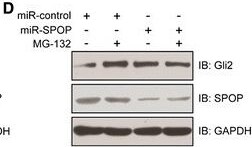
Western Blot: SPOP Antibody [H00008405-B01P] -
Western Blot: SPOP Antibody [H00008405-B01P] - SPOP inhibits Hh/Gli signaling activity. (A) SPOP interacts with Gli2 protein in MKN28 cells by co-immunoprecipitation method. Goat anti-rabbit IgG is used as negative control. (B) Quantification of Gli1 & Gli2 mRNA in Myc-SPOP transfected MKN28 cells. (C) Increasing SPOP reduced Gli2 expression. AGS cells were transfected with different amount of Myc-SPOP for 48 h. Full length of Gli2 is detected in cell lysates by Western blotting. (D) SPOP promotes Gli2 degradation through proteasome pathway. MKN45 cells were treated with vehicle (DMSO) or miR-SPOP for 48 h, with or without 10 mM MG-132. In order to limit toxicity, MG-132 was added 4 h before cell harvest. Lysates were subjected to immunoblotting with indicated antibodies. (E) Dual luciferase reporter assay is performed in HEK293T cells. Myc-SPOP were transfected into the cells & lysed after 48 h incubation. The percentage of decrease in luciferase activity was calculated. (F) SPOP affects Gli2 abundance in cytoplasm. Immunofluorescent stainings of transfected Myc-SPOP & endogenous Gli2 were performed in MKN45 cells. MKN45 cells were transfected with Myc-SPOP for 48 h. Myc-SPOP was detected by incubating cells with mouse anti-Myc antibody & subsequently Alexa Fluor 594 goat anti-mouse antibody. Gli2 was detected by incubating cells with rabbit anti-Gli2 antibody & subsequently Alexa Fluor 488 donkey anti-rabbit antibody. Nucleus was identified by DAPI staining. Image collected & cropped by CiteAb from the following publication (https://pubmed.ncbi.nlm.nih.gov/25204354), licensed under a CC-BY license. Not internally tested by Novus Biologicals.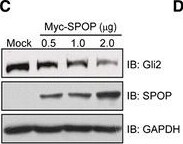
Western Blot: SPOP Antibody [H00008405-B01P] -
Western Blot: SPOP Antibody [H00008405-B01P] - SPOP inhibits Hh/Gli signaling activity. (A) SPOP interacts with Gli2 protein in MKN28 cells by co-immunoprecipitation method. Goat anti-rabbit IgG is used as negative control. (B) Quantification of Gli1 & Gli2 mRNA in Myc-SPOP transfected MKN28 cells. (C) Increasing SPOP reduced Gli2 expression. AGS cells were transfected with different amount of Myc-SPOP for 48 h. Full length of Gli2 is detected in cell lysates by Western blotting. (D) SPOP promotes Gli2 degradation through proteasome pathway. MKN45 cells were treated with vehicle (DMSO) or miR-SPOP for 48 h, with or without 10 mM MG-132. In order to limit toxicity, MG-132 was added 4 h before cell harvest. Lysates were subjected to immunoblotting with indicated antibodies. (E) Dual luciferase reporter assay is performed in HEK293T cells. Myc-SPOP were transfected into the cells & lysed after 48 h incubation. The percentage of decrease in luciferase activity was calculated. (F) SPOP affects Gli2 abundance in cytoplasm. Immunofluorescent stainings of transfected Myc-SPOP & endogenous Gli2 were performed in MKN45 cells. MKN45 cells were transfected with Myc-SPOP for 48 h. Myc-SPOP was detected by incubating cells with mouse anti-Myc antibody & subsequently Alexa Fluor 594 goat anti-mouse antibody. Gli2 was detected by incubating cells with rabbit anti-Gli2 antibody & subsequently Alexa Fluor 488 donkey anti-rabbit antibody. Nucleus was identified by DAPI staining. Image collected & cropped by CiteAb from the following publication (https://pubmed.ncbi.nlm.nih.gov/25204354), licensed under a CC-BY license. Not internally tested by Novus Biologicals.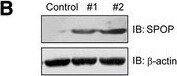
Western Blot: SPOP Antibody [H00008405-B01P] -
Western Blot: SPOP Antibody [H00008405-B01P] - SPOP inhibits gastric cancer cell proliferation & migration. (A) The expression of SPOP protein in human GC cell lines - MKN45, MKN28, AGS, SGC7901, & human gastric mucosal cell line GES-1 by Western blotting. (B) Detection of SPOP expression in transfected AGS cells. Expression of SPOP was detected in cell lysates of SPOP-V5 transfected AGS cells by Western blotting. Control, AGS cells with empty vector plasmid; #1 & #2 represent different groups of stable AGS cell lines transfected with SPOP. (C) Decreased viability of gastric cancer cells transfected with SPOP. The viability of AGS cells was assessed by using an MTT assay. Data represent the average of three experiments (mean ± SD). **P < 0.01, compared to control cells. (D, E) Reduced migration of AGS cells following treatment with SPOP transfection. Cell migration was examined using a scratch assay. D, images acquired at indicated time points. E, quantification of cell migration rates. Data represent the average of three experiments (mean ± SD). **P < 0.01, compared to DMSO treated cells. (F, G) Colony formation of SPOP over-expressed AGS cells. One or two hundred stable cell lines with SPOP over-expression were seeded into 12-well plates for 2 weeks. Colonies were fixed & stained with crystal violet, then counted if the colonies > 50 cells. G, histograms show the rate of colony formation. Data represent the average of three experiments (mean ± SD). **P < 0.01, compared to DMSO treated cells. Image collected & cropped by CiteAb from the following publication (https://pubmed.ncbi.nlm.nih.gov/25204354), licensed under a CC-BY license. Not internally tested by Novus Biologicals.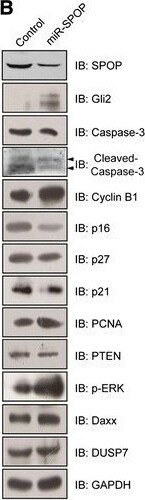
Western Blot: SPOP Antibody [H00008405-B01P] -
Western Blot: SPOP Antibody [H00008405-B01P] - SPOP promotes tumor cell apoptosis. (A) Overexpression of SPOP upregulates the expression of apoptotic proteins. MKN45 cells were transfected with Myc-SPOP & incubated for 48 h. Target proteins in cell lysates were detected by indicated antibodies using Western blotting. (B) Repression of SPOP inhibits cancer cell apoptosis. MKN45 cells were transfected with miR-SPOP-1430 & incubated for 48 h. Target proteins in cell lysates were probed with indicated antibodies using Western blotting. (C) Overexpressed SPOP promotes cleaved Caspase-3 expression. AGS cells were transfected with Myc-SPOP for 48 h & then fixed. Myc-SPOP was detected by incubating cells with mouse anti-Myc antibody & subsequently Alexa Fluor 488 goat anti-mouse antibody. Cleaved Caspase-3 was detected by incubating cells with rabbit anti-cleaved Caspase-3 & subsequently Alexa Fluor 594 donkey anti-rabbit antibody. Nucleus was identified by DAPI staining. (D) The representative photos of cleaved Caspase-3 expression in gastric cancer tissues & adjacent gastric tissues by using immunohistochemical staining (DAB staining, scale bar, 100 μm). Magnified local images reflecting detailed information were shown on the bottom. Image collected & cropped by CiteAb from the following publication (https://pubmed.ncbi.nlm.nih.gov/25204354), licensed under a CC-BY license. Not internally tested by Novus Biologicals.Applications for SPOP Antibody - Azide and BSA Free
Application
Recommended Usage
Western Blot
1:500
Application Notes
Antibody reactivity against Recombinant Protein with GST tag on ELISA and WB and also on transfected lysate in WB. GST tag alone is used as a negative control. It has been used for IF. Use in Immunohistochemistry-paraffin reported in scientific literature (PMID: 24912477).
Formulation, Preparation, and Storage
Purification
Protein A purified
Formulation
PBS (pH 7.4)
Format
Azide and BSA Free
Preservative
No Preservative
Concentration
Concentrations vary lot to lot. See vial label for concentration. If unlisted please contact technical services.
Shipping
The product is shipped with polar packs. Upon receipt, store it immediately at the temperature recommended below.
Stability & Storage
Aliquot and store at -20C or -80C. Avoid freeze-thaw cycles.
Background: SPOP
Alternate Names
HIB homolog 1, Roadkill homolog 1, speckle-type POZ protein, TEF2
Entrez Gene IDs
8405 (Human)
Gene Symbol
SPOP
UniProt
Additional SPOP Products
Product Documents for SPOP Antibody - Azide and BSA Free
Certificate of Analysis
To download a Certificate of Analysis, please enter a lot or batch number in the search box below.
Product Specific Notices for SPOP Antibody - Azide and BSA Free
This product is produced by and distributed for Abnova, a company based in Taiwan.
This product is for research use only and is not approved for use in humans or in clinical diagnosis. Primary Antibodies are guaranteed for 1 year from date of receipt.
Citations for SPOP Antibody - Azide and BSA Free
 Powered by Bioz
Customer Reviews for SPOP Antibody - Azide and BSA Free
There are currently no reviews for this product. Be the first to review SPOP Antibody - Azide and BSA Free and earn rewards!
Have you used SPOP Antibody - Azide and BSA Free?
Submit a review and receive an Amazon gift card!
$25/€18/£15/$25CAN/¥2500 for a review with an image
$10/€7/£6/$10CAN/¥1110 for a review without an image
Submit a review
Protocols
Find general support by application which include: protocols, troubleshooting, illustrated assays, videos and webinars.
- Antigen Retrieval Protocol (PIER)
- Antigen Retrieval for Frozen Sections Protocol
- Appropriate Fixation of IHC/ICC Samples
- Cellular Response to Hypoxia Protocols
- Chromogenic IHC Staining of Formalin-Fixed Paraffin-Embedded (FFPE) Tissue Protocol
- Chromogenic Immunohistochemistry Staining of Frozen Tissue
- ClariTSA™ Fluorophore Kits
- Detection & Visualization of Antibody Binding
- Fluorescent IHC Staining of Frozen Tissue Protocol
- Graphic Protocol for Heat-induced Epitope Retrieval
- Graphic Protocol for the Preparation and Fluorescent IHC Staining of Frozen Tissue Sections
- Graphic Protocol for the Preparation and Fluorescent IHC Staining of Paraffin-embedded Tissue Sections
- Graphic Protocol for the Preparation of Gelatin-coated Slides for Histological Tissue Sections
- ICC Cell Smear Protocol for Suspension Cells
- ICC Immunocytochemistry Protocol Videos
- ICC for Adherent Cells
- IHC Sample Preparation (Frozen sections vs Paraffin)
- Immunocytochemistry (ICC) Protocol
- Immunocytochemistry Troubleshooting
- Immunofluorescence of Organoids Embedded in Cultrex Basement Membrane Extract
- Immunofluorescent IHC Staining of Formalin-Fixed Paraffin-Embedded (FFPE) Tissue Protocol
- Immunohistochemistry (IHC) and Immunocytochemistry (ICC) Protocols
- Immunohistochemistry Frozen Troubleshooting
- Immunohistochemistry Paraffin Troubleshooting
- Preparing Samples for IHC/ICC Experiments
- Preventing Non-Specific Staining (Non-Specific Binding)
- Primary Antibody Selection & Optimization
- Protocol for Heat-Induced Epitope Retrieval (HIER)
- Protocol for Making a 4% Formaldehyde Solution in PBS
- Protocol for VisUCyte™ HRP Polymer Detection Reagent
- Protocol for the Fluorescent ICC Staining of Cell Smears - Graphic
- Protocol for the Fluorescent ICC Staining of Cultured Cells on Coverslips - Graphic
- Protocol for the Preparation & Fixation of Cells on Coverslips
- Protocol for the Preparation and Chromogenic IHC Staining of Frozen Tissue Sections
- Protocol for the Preparation and Chromogenic IHC Staining of Frozen Tissue Sections - Graphic
- Protocol for the Preparation and Chromogenic IHC Staining of Paraffin-embedded Tissue Sections
- Protocol for the Preparation and Chromogenic IHC Staining of Paraffin-embedded Tissue Sections - Graphic
- Protocol for the Preparation and Fluorescent ICC Staining of Cells on Coverslips
- Protocol for the Preparation and Fluorescent ICC Staining of Non-adherent Cells
- Protocol for the Preparation and Fluorescent ICC Staining of Stem Cells on Coverslips
- Protocol for the Preparation and Fluorescent IHC Staining of Frozen Tissue Sections
- Protocol for the Preparation and Fluorescent IHC Staining of Paraffin-embedded Tissue Sections
- Protocol for the Preparation of Gelatin-coated Slides for Histological Tissue Sections
- Protocol for the Preparation of a Cell Smear for Non-adherent Cell ICC - Graphic
- R&D Systems Quality Control Western Blot Protocol
- TUNEL and Active Caspase-3 Detection by IHC/ICC Protocol
- The Importance of IHC/ICC Controls
- Troubleshooting Guide: Immunohistochemistry
- Troubleshooting Guide: Western Blot Figures
- Western Blot Conditions
- Western Blot Protocol
- Western Blot Protocol for Cell Lysates
- Western Blot Troubleshooting
- Western Blot Troubleshooting Guide
- View all Protocols, Troubleshooting, Illustrated assays and Webinars
Loading...