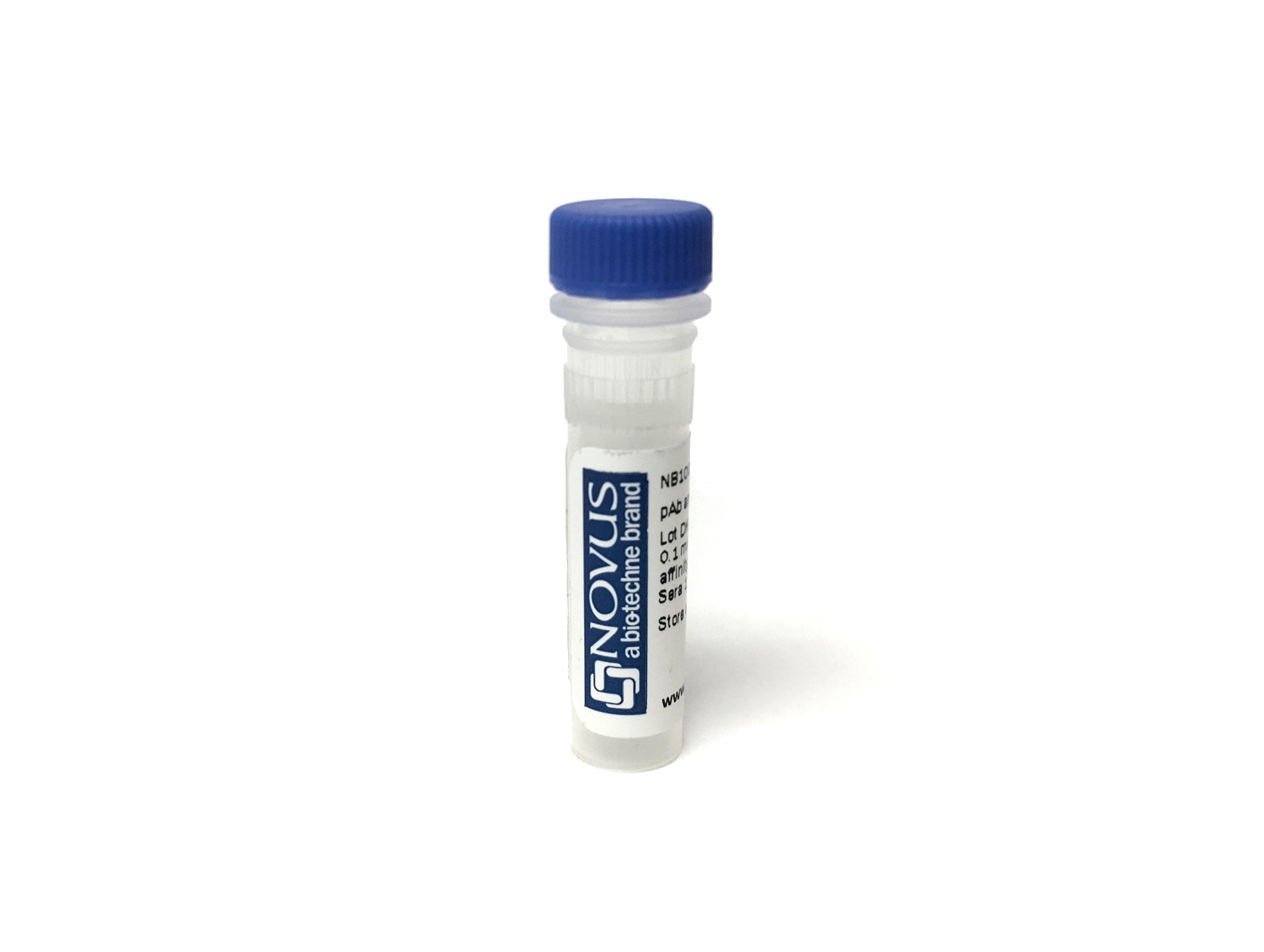
ACE-2 Antibody (1038216) [DyLight 405]
Novus Biologicals | Catalog # FAB9335E

Key Product Details
Species Reactivity
Human
Applications
Immunohistochemistry, Immunocytochemistry
Label
DyLight 405 (Excitation = 400 nm, Emission = 420 nm)
Antibody Source
Monoclonal Mouse IgG1 Clone # 1038216
Loading...
Product Specifications
Immunogen
Mouse myeloma cell line NS0-derived human ACE-2 protein
Gln18-Ser740
Accession # Q9BYF1
Gln18-Ser740
Accession # Q9BYF1
Specificity
Detects human ACE-2 in direct ELISAs.
Clonality
Monoclonal
Host
Mouse
Isotype
IgG1
Applications for ACE-2 Antibody (1038216) [DyLight 405]
Application
Recommended Usage
Immunocytochemistry
Optimal dilutions of this antibody should be experimentally determined.
Immunohistochemistry
Optimal dilutions of this antibody should be experimentally determined.
Application Notes
Optimal dilution of this antibody should be experimentally determined.
Formulation, Preparation, and Storage
Purification
Protein A or G purified from hybridoma culture supernatant
Formulation
50mM Sodium Borate
Preservative
0.05% Sodium Azide
Concentration
Please see the vial label for concentration. If unlisted please contact technical services.
Shipping
The product is shipped with polar packs. Upon receipt, store it immediately at the temperature recommended below.
Stability & Storage
Store at 4C in the dark.
Background: ACE-2
Genetic data from Drosophila, mice and rats show that the ACE2 protein is an essential regulator of heart function in vivo. ACE2 mRNA is found at high levels in testis, kidney and heart with moderate levels in colon, small intestine, and ovary. The ACE2 protein contributes to organ function through the renin-angiotensin system, playing a central role in vascular, renal, and myocardial physiology.
Virology research has demonstrated that the severe acute respiratory syndrome coronavirus (SARS-CoV) spike protein binds to its functional receptor, ACE2 (1). Vimentin is a type III intermediate filament protein expressed in mesenchymal cells that helps comprise the cytoskeleton in all animal cells. Studies have demonstrated that vimentin allows cell binding that allows the uptake of SARS-CoV spike protein into a host (2). This direct interaction of SARS-CoV with vimentin has been identified as an entry mechanism for the virus into a host, mediated by the SARS-CoV receptor ACE2 (1,2). It has been shown that ACE2 is the SARS-CoV-2 receptor required for cell entry and plays a physiological role in the replication of SARS-CoV in an infected host (1). Studies using human ACE2 antibody demonstrated a blockade of SARS-CoV-2 and ACE2 interaction, indicating an important physiological component of viral transmission and potential anti-viral therapeutic strategies (3).
References
1. Li, W., Moore, M. J., Vasilieva, N., Sui, J., Wong, S. K., Berne, M. A.,... Farzan, M. (2003). Angiotensin-converting enzyme 2 is a functional receptor for the SARS coronavirus. Nature, 426(6965), 450-454. doi:10.1038/nature02145
2. Yu YT, Chien SC, Chen IY, Lai CT, Tsay YG, Chang SC, Chang MF. (2016) Surface vimentin is critical for the cell entry of SARS-CoV. J Biomed Sci. doi: 10.1186/s12929-016-0234-7
3. Hoffmann, M., Kleine-Weber, H., Schroeder, S., Kruger, N., Herrler, T., Erichsen, S.,... Pohlmann, S. (2020). SARS-CoV-2 Cell Entry Depends on ACE2 and TMPRSS2 and Is Blocked by a Clinically Proven Protease Inhibitor. Cell. doi:10.1016/j.cell.2020.02.052
Long Name
Angiotensin I Converting Enzyme 2
Alternate Names
ACE2, ACEH
Additional ACE-2 Products
Product Documents for ACE-2 Antibody (1038216) [DyLight 405]
Certificate of Analysis
To download a Certificate of Analysis, please enter a lot or batch number in the search box below.
Product Specific Notices for ACE-2 Antibody (1038216) [DyLight 405]
DyLight (R) is a trademark of Thermo Fisher Scientific Inc. and its subsidiaries.
This product is for research use only and is not approved for use in humans or in clinical diagnosis. Primary Antibodies are guaranteed for 1 year from date of receipt.
Related Research Areas
Customer Reviews for ACE-2 Antibody (1038216) [DyLight 405]
There are currently no reviews for this product. Be the first to review ACE-2 Antibody (1038216) [DyLight 405] and earn rewards!
Have you used ACE-2 Antibody (1038216) [DyLight 405]?
Submit a review and receive an Amazon gift card!
$25/€18/£15/$25CAN/¥2500 Yen for a review with an image
$10/€7/£6/$10CAN/¥1110 Yen for a review without an image
Submit a review
Protocols
Find general support by application which include: protocols, troubleshooting, illustrated assays, videos and webinars.
- Antigen Retrieval Protocol (PIER)
- Antigen Retrieval for Frozen Sections Protocol
- Appropriate Fixation of IHC/ICC Samples
- Cellular Response to Hypoxia Protocols
- Chromogenic IHC Staining of Formalin-Fixed Paraffin-Embedded (FFPE) Tissue Protocol
- Chromogenic Immunohistochemistry Staining of Frozen Tissue
- ClariTSA™ Fluorophore Kits
- Detection & Visualization of Antibody Binding
- Fluorescent IHC Staining of Frozen Tissue Protocol
- Graphic Protocol for Heat-induced Epitope Retrieval
- Graphic Protocol for the Preparation and Fluorescent IHC Staining of Frozen Tissue Sections
- Graphic Protocol for the Preparation and Fluorescent IHC Staining of Paraffin-embedded Tissue Sections
- Graphic Protocol for the Preparation of Gelatin-coated Slides for Histological Tissue Sections
- ICC Cell Smear Protocol for Suspension Cells
- ICC Immunocytochemistry Protocol Videos
- ICC for Adherent Cells
- IHC Sample Preparation (Frozen sections vs Paraffin)
- Immunocytochemistry (ICC) Protocol
- Immunocytochemistry Troubleshooting
- Immunofluorescence of Organoids Embedded in Cultrex Basement Membrane Extract
- Immunofluorescent IHC Staining of Formalin-Fixed Paraffin-Embedded (FFPE) Tissue Protocol
- Immunohistochemistry (IHC) and Immunocytochemistry (ICC) Protocols
- Immunohistochemistry Frozen Troubleshooting
- Immunohistochemistry Paraffin Troubleshooting
- Preparing Samples for IHC/ICC Experiments
- Preventing Non-Specific Staining (Non-Specific Binding)
- Primary Antibody Selection & Optimization
- Protocol for Heat-Induced Epitope Retrieval (HIER)
- Protocol for Making a 4% Formaldehyde Solution in PBS
- Protocol for VisUCyte™ HRP Polymer Detection Reagent
- Protocol for the Fluorescent ICC Staining of Cell Smears - Graphic
- Protocol for the Fluorescent ICC Staining of Cultured Cells on Coverslips - Graphic
- Protocol for the Preparation & Fixation of Cells on Coverslips
- Protocol for the Preparation and Chromogenic IHC Staining of Frozen Tissue Sections
- Protocol for the Preparation and Chromogenic IHC Staining of Frozen Tissue Sections - Graphic
- Protocol for the Preparation and Chromogenic IHC Staining of Paraffin-embedded Tissue Sections
- Protocol for the Preparation and Chromogenic IHC Staining of Paraffin-embedded Tissue Sections - Graphic
- Protocol for the Preparation and Fluorescent ICC Staining of Cells on Coverslips
- Protocol for the Preparation and Fluorescent ICC Staining of Non-adherent Cells
- Protocol for the Preparation and Fluorescent ICC Staining of Stem Cells on Coverslips
- Protocol for the Preparation and Fluorescent IHC Staining of Frozen Tissue Sections
- Protocol for the Preparation and Fluorescent IHC Staining of Paraffin-embedded Tissue Sections
- Protocol for the Preparation of Gelatin-coated Slides for Histological Tissue Sections
- Protocol for the Preparation of a Cell Smear for Non-adherent Cell ICC - Graphic
- TUNEL and Active Caspase-3 Detection by IHC/ICC Protocol
- The Importance of IHC/ICC Controls
- Troubleshooting Guide: Immunohistochemistry
- View all Protocols, Troubleshooting, Illustrated assays and Webinars
Loading...
Associated Pathways