
Adropin Antibody - BSA Free
Novus Biologicals | Catalog # NBP1-26387

![Western Blot: Adropin AntibodyBSA Free [NBP1-26387]](https://resources.rndsystems.com/images/products/Adropin-Antibody-Western-Blot-NBP1-26387-img0004.jpg "Western Blot: Adropin AntibodyBSA Free [NBP1-26387]")
Scientific images may be resized, cropped, or adjusted for brightness or contrast for presentation purposes. These updates are limited to presentation and do not affect the underlying scientific interpretation of the data. Where available, additional source data may be provided upon request.
Key Product Details
Species Reactivity
Validated:
Cited:
Applications
Validated:
Cited:
Label
Antibody Source
Format
Product Specifications
Immunogen
Reactivity Notes
Localization
Clonality
Host
Isotype
Theoretical MW
Disclaimer note: The observed molecular weight of the protein may vary from the listed predicted molecular weight due to post translational modifications, post translation cleavages, relative charges, and other experimental factors.
Scientific Data Images for Adropin Antibody - BSA Free
Western Blot: Adropin AntibodyBSA Free [NBP1-26387]
Western Blot: Adropin Antibody [NBP1-26387] - Total protein from Human and Mouse brain was separated on a 4-20% gel by SDS-PAGE, transferred to PVDF membrane and blocked in 5% non-fat milk in TBST. The membrane was probed with 2.0 ug/mL anti-Adropin in 1% non-fat milk in TBST and detected with an anti-rabbit HRP secondary antibody using chemiluminescence.![Western Blot: Adropin AntibodyBSA Free [NBP1-26387]](https://resources.rndsystems.com/images/products/Adropin-Antibody-Western-Blot-NBP1-26387-img0003.jpg "Western Blot: Adropin AntibodyBSA Free [NBP1-26387]")
Western Blot: Adropin AntibodyBSA Free [NBP1-26387]
Western Blot: Adropin Antibody [NBP1-26387] - Western blot on Adropin overexpression lysate.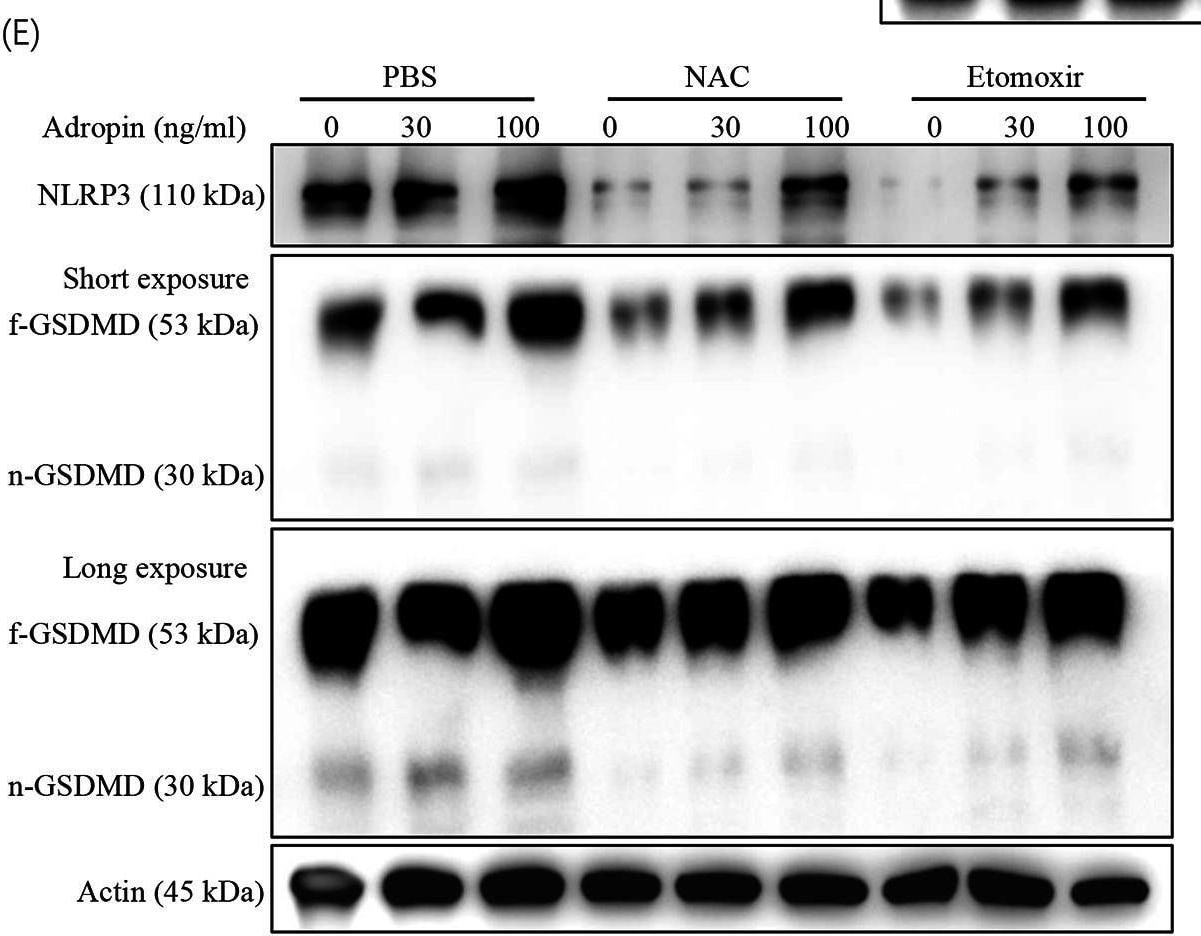
Western Blot: Adropin Antibody - BSA Free [NBP1-26387] -
Metabolic molecules in macrophage with adropin treatment. (A) Variations of key molecules involved in glycol–lipid metabolism. (B) Akt, mTOR, and AMPK levels of adropin-treated macrophages. (C) Detection of the above metabolism molecules in ENHO−/− macrophages. (D) Akt, mTOR, and AMPK levels of ENHO−/− macrophages. (E) Effect of ROS depletion or CPT1 alpha inhibition on inflammasome activation. Each experiment was repeated at least twice Image collected and cropped by CiteAb from the following open publication (https://pubmed.ncbi.nlm.nih.gov/37904094), licensed under a CC-BY license. Not internally tested by Novus Biologicals.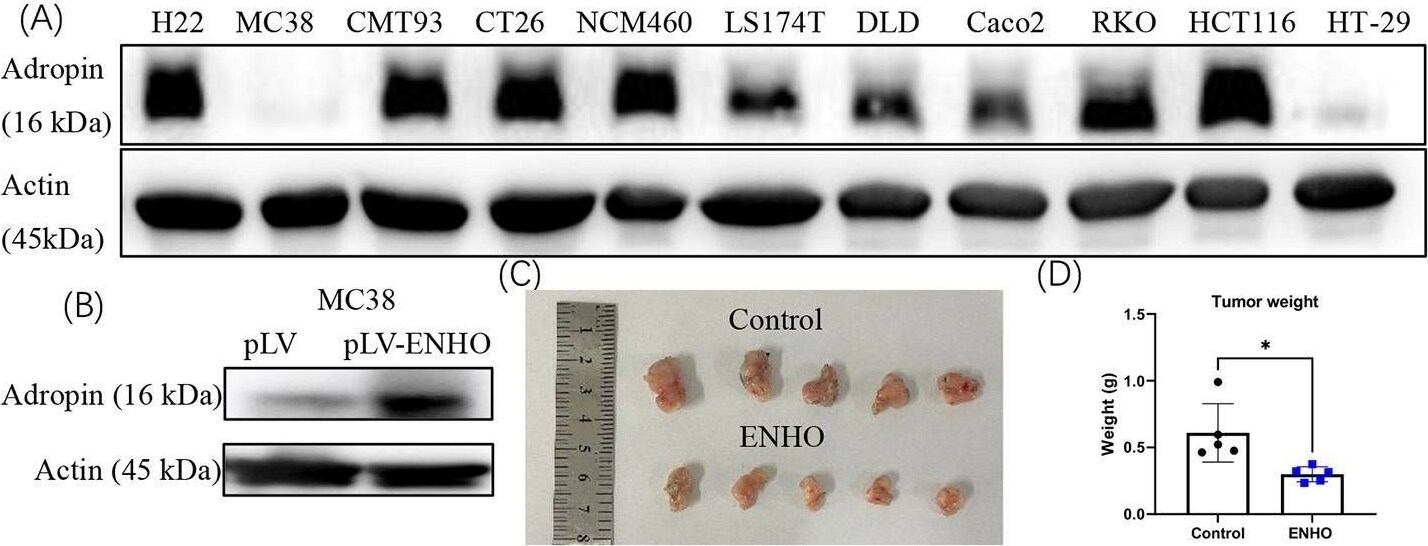
Western Blot: Adropin Antibody - BSA Free [NBP1-26387] -
Ectopic adropin expression inhibits tumor growth in vivo. (A) Presence of adropin in the indicated cell lines. (B) Ectopic adropin expression in MC38 cells by lentivirus transfection. (C) In vivo tumors formed by MC38 and MC38-ENHO cells. (D) Weights of tumors. Detection of macrophages (E) and CD8+ T cells (F) in tumors. (G) Phenotypic analysis of tumor-infiltrated macrophages. The experiment was repeated twice. ns, no significance; *, P < 0.05; **, P < 0.01; ***, P < 0.001 Image collected and cropped by CiteAb from the following open publication (https://pubmed.ncbi.nlm.nih.gov/37904094), licensed under a CC-BY license. Not internally tested by Novus Biologicals.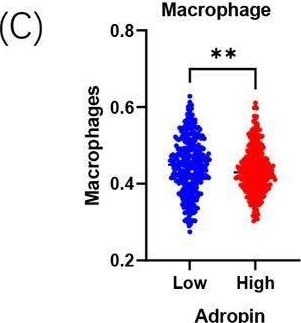
Flow Cytometry: Adropin Antibody - BSA Free [NBP1-26387] -
Correlational analysis of adropin level with local macrophages in CRC. Correlation study of adropin with CD68, ARG1, or iNOS in tumor foci (A) or stromal cells (B). (C) Comparison of infiltrated macrophages between high and low ENHO transcriptions. (D) Correlation study of GPR19 with adropin in foci and stroma. (E) Correlation study of GPR19 with CD68, ARG1, or iNOS. Double staining of adropin and CD68, ARG1, iNOS, or PD-L1 (F) and statistics (G). Double staining of GPR19 and CD68, ARG1, iNOS, or PD-L1 (H) and statistics (I). ns, no significance; *, P < 0.05; **, P < 0.01; ***, P < 0.001 Image collected and cropped by CiteAb from the following open publication (https://pubmed.ncbi.nlm.nih.gov/37904094), licensed under a CC-BY license. Not internally tested by Novus Biologicals.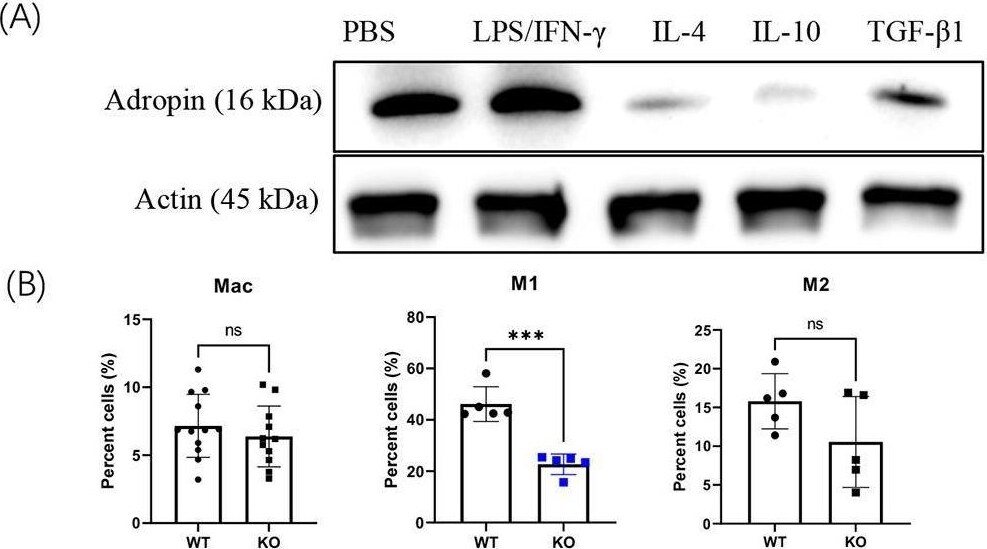
Western Blot: Adropin Antibody - BSA Free [NBP1-26387] -
Macrophages in ENHO−/− mice. (A) Adropin variations in macrophages after the treatment of LPS/IFN gamma, IL-4, IL-10, or TGF-beta 1. (B) Macrophage subsets in ENHO−/− mice. (C) CD86 and CD206 expression on WT or KO macrophages treated by LPS/IFN gamma or IL-4. (D) Inhibitory effects of WT or KO macrophages on CD8+ T cells. Inflammasome-associated molecules (E) and effector molecules (F) of WT or KO macrophages. The experiment was carried-out three times. ns, no significance; *, P < 0.05; **, P < 0.01; ***, P < 0.001 Image collected and cropped by CiteAb from the following open publication (https://pubmed.ncbi.nlm.nih.gov/37904094), licensed under a CC-BY license. Not internally tested by Novus Biologicals.Applications for Adropin Antibody - BSA Free
Western Blot
Formulation, Preparation, and Storage
Purification
Formulation
Format
Preservative
Concentration
Shipping
Stability & Storage
Background: Adropin
Additional Adropin Products
Product Documents for Adropin Antibody - BSA Free
Certificate of Analysis
To download a Certificate of Analysis, please enter a lot or batch number in the search box below.
Product Specific Notices for Adropin Antibody - BSA Free
This product is for research use only and is not approved for use in humans or in clinical diagnosis. Primary Antibodies are guaranteed for 1 year from date of receipt.
Related Research Areas
Citations for Adropin Antibody - BSA Free
 Powered by Bioz
Customer Reviews for Adropin Antibody - BSA Free
There are currently no reviews for this product. Be the first to review Adropin Antibody - BSA Free and earn rewards!
Have you used Adropin Antibody - BSA Free?
Submit a review and receive an Amazon gift card!
$25/€18/£15/$25CAN/¥2500 for a review with an image
$10/€7/£6/$10CAN/¥1110 for a review without an image
Submit a review
Protocols
View specific protocols for Adropin Antibody - BSA Free (NBP1-26387):
Procedure Guide for NBP1-26387 - Adropin Antibody
Western Blot Protocol
1. Perform SDS-PAGE (4-12% MOPS) on samples to be analyzed, loading 40 ug of total protein per lane.
2. Transfer proteins to Nitrocellulose according to the instructions provided by the manufacturer of the transfer
apparatus.
3. Rinse membrane with dH2O and then stain the blot using Ponceau S for 1-2 minutes to access the transfer of
proteins onto the nitrocellulose membrane. Rinse the blot in water to remove excess stain and mark the lane locations
and locations of molecular weight markers using a pencil.
4. Rinse the blot in TBS for approximately 5 minutes.
5. Block the membrane using 5% BSA in TBS + Tween, 1 hour at RT.
6. Rinse the membrane in dH2O and then wash the membrane in wash buffer [TBS + 0.1% Tween] 3 times for 10
minutes each.
7. Dilute the rabbit anti-Adropin primary antibody (NBP1-26387) in blocking buffer and incubate 1 hour at room
temperature.
8. Rinse the membrane in dH2O and then wash the membrane in wash buffer [TBS + 0.1% Tween] 3 times for 10
minutes each.
9. Apply the diluted rabbit-IgG HRP-conjugated secondary antibody in blocking buffer (as per manufacturers
instructions) and incubate 1 hour at room temperature.
10. Wash the blot in wash buffer [TBS + 0.1% Tween] 3 times for 10 minutes each (this step can be repeated as
required to reduce background).
11. Apply the detection reagent of choice in accordance with the manufacturers instructions (Pierce ECL).
Note: Tween-20 can be added to the blocking or antibody dilution buffer at a final concentration of 0.05-0.2%, provided
it does not interfere with antibody-antigen binding.
(c) 2009 Novus Biologicals - Adropin Antibody - Page 1
Find general support by application which include: protocols, troubleshooting, illustrated assays, videos and webinars.
- Cellular Response to Hypoxia Protocols
- R&D Systems Quality Control Western Blot Protocol
- Troubleshooting Guide: Western Blot Figures
- Western Blot Conditions
- Western Blot Protocol
- Western Blot Protocol for Cell Lysates
- Western Blot Troubleshooting
- Western Blot Troubleshooting Guide
- View all Protocols, Troubleshooting, Illustrated assays and Webinars