
AHR Antibody - Azide and BSA Free
Novus Biologicals | Catalog # NB100-128

![Immunocytochemistry/ Immunofluorescence: AHR Antibody [NB100-128]](https://resources.rndsystems.com/images/products/AHR-Antibody-Immunocytochemistry-Immunofluorescence-NB100-128-img0004.jpg "Immunocytochemistry/ Immunofluorescence: AHR Antibody [NB100-128]")
Scientific images may be resized, cropped, or adjusted for brightness or contrast for presentation purposes. These updates are limited to presentation and do not affect the underlying scientific interpretation of the data. Where available, additional source data may be provided upon request.
Key Product Details
Species Reactivity
Validated:
Cited:
Applications
Validated:
Cited:
Label
Antibody Source
Format
Product Specifications
Immunogen
Clonality
Host
Scientific Data Images for AHR Antibody - Azide and BSA Free
Immunocytochemistry/ Immunofluorescence: AHR Antibody [NB100-128]
Immunocytochemistry/Immunofluorescence: AHR Antibody [NB100-128] - HeLa cells were fixed for 10 minutes using 10% formalin and then permeabilized for 5 minutes using 1X TBS + 0.5% Triton X-100. The cells were incubated with anti AHR [NB100-128] at a 1:100 dilution overnight at 4C and detected with an anti-goat DyLight 488 (Green) at a 1:500 dilution. Actin was detected with Phalloidin 568 (Red) at a 1:200 dilution. Nuclei were counterstained with DAPI (Blue). Cells were imaged using a 40X objective.![Immunohistochemistry-Paraffin: AHR Antibody [NB100-128]](https://resources.rndsystems.com/images/products/AHR-Antibody-Immunohistochemistry-Paraffin-NB100-128-img0006.jpg "Immunohistochemistry-Paraffin: AHR Antibody [NB100-128]")
Immunohistochemistry-Paraffin: AHR Antibody [NB100-128]
Immunohistochemistry-Paraffin: AHR Antibody [NB100-128] - Analysis of FFPE human liver using 1:200 conc. of AHR antibody on a Bond Rx autostainer (Leica Biosystems). The assay involved 20 minutes of heat induced antigen retrieval (HIER) using 10mM sodium citrate buffer (pH 6.0) and endogenous peroxidase quenching with peroxide block. The sections were incubated with primary antibody for 30 minutes and Bond Polymer Refine Detection (Leica Biosystems) with DAB was used for signal development followed by counterstaining with hematoxylin. Whole slide scanning and capturing of representative images was performed using Aperio AT2 (Leica Biosystems). Staining was performed by Histowiz.![Gel Super Shift Assays: AHR Antibody [NB100-128]](https://resources.rndsystems.com/images/products/AHR-Antibody-Gel-Super-Shift-Assays-NB100-128-img0003.jpg "Gel Super Shift Assays: AHR Antibody [NB100-128]")
Gel Super Shift Assays: AHR Antibody [NB100-128]
Gel Super Shift Assays: AHR Antibody [NB100-128] - EMSA validation of AHR antibody on U937 cells nuclear protein. Image submitted by verified customer - see review for protocol details.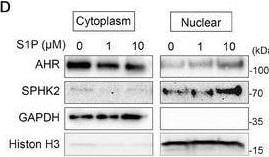
Western Blot: AHR Antibody - Azide and BSA Free [NB100-128] -
AHR agonist activates the SPHK2/S1P pathway resulting in rapid nuclear retention of the AHR and SPHK2. A) Immunofluorescent images of HeLa cells for p‐SPHK2 levels after TCDF (0.1 uM) incubation for 20 min. Arrowheads indicate the peri‐nuclear region staining of p‐SPHK2 in control cells and arrows indicate the nuclear expression of p‐SPHK2 in TCDF treated cells. Hoechst 33342 was used for the counter staining of nuclei. Bar = 20 um. Data are representative images from three independent experiments. B) Western blot analysis of HeLa cells after TCDF treatment for 15 min. C, Control; T, TCDF (n = 3). C) qRT‐PCR analysis of HeLa cells for AHR and SPHK2 mRNA levels after S1P incubation for 30 min. C: Control. Data are mean +/- S.D. (n = 3). ****p < 0.0001, *p < 0.05. D) Western blotting analysis of HeLa cells after S1P treatment for 5 min. Cytoplasmic and nuclear extracts were obtained and western blotting analysis conducted with the antibodies indicated (n = 3). E) Western blotting analysis of HeLa cell extracts after 5‐ and 10‐min treatment with S1P (10 uM). GAPDH and histone H3 (H3) antibodies were used as internal controls for cytoplasmic and nuclear extracts, respectively. All data are representative images of three independent experiments (n = 3). F) Pulldown assays using S1P immobilized on agarose beads or equivalent control beads. After extensive washing, bound proteins were dissolved in SDS sample buffer and separated by SDS‐PAGE and subjected to western blotting analysis (n = 3). C, Control; T, TCDF treated, respectively. Images are representative of three independent experiments. Image collected and cropped by CiteAb from the following open publication (https://pubmed.ncbi.nlm.nih.gov/39207053), licensed under a CC-BY license. Not internally tested by Novus Biologicals.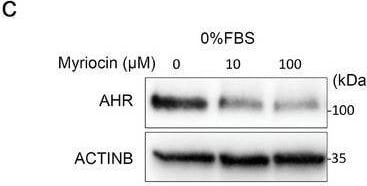
Western Blot: AHR Antibody - Azide and BSA Free [NB100-128] -
Inhibition of serine palmitoyltransferase with myriocin causes decreased AHR expression. A) Western blotting analysis of HeLa cells after myriocin (uM) treatment for 3 h. SPTLC1 and SPTLC2 antibodies were used for the conformation of myriocin effects for the inhibition under this culture condition (10%FBS/DMEM). B) qPCR analysis using AHR‐ and SPTLC1‐specific primers for 2 or 3 h after myriocin treatment. C) Western blotting analysis of HeLa cell whole lysates after myriocin (uM) treatment under serum free conditions for 1 h. D) CCK8 assay results after overnight culture in 10%FBS/DMEM or 2 h in 0%FBS/DMEM with or without myriocin. All data and images are representative from three independent replicates. ****p < 0.0001, ***p < 0.001, **p < 0.01. Image collected and cropped by CiteAb from the following open publication (https://pubmed.ncbi.nlm.nih.gov/39207053), licensed under a CC-BY license. Not internally tested by Novus Biologicals.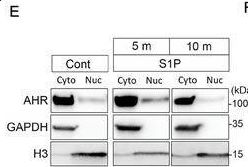
Western Blot: AHR Antibody - Azide and BSA Free [NB100-128] -
AHR agonist activates the SPHK2/S1P pathway resulting in rapid nuclear retention of the AHR and SPHK2. A) Immunofluorescent images of HeLa cells for p‐SPHK2 levels after TCDF (0.1 uM) incubation for 20 min. Arrowheads indicate the peri‐nuclear region staining of p‐SPHK2 in control cells and arrows indicate the nuclear expression of p‐SPHK2 in TCDF treated cells. Hoechst 33342 was used for the counter staining of nuclei. Bar = 20 um. Data are representative images from three independent experiments. B) Western blot analysis of HeLa cells after TCDF treatment for 15 min. C, Control; T, TCDF (n = 3). C) qRT‐PCR analysis of HeLa cells for AHR and SPHK2 mRNA levels after S1P incubation for 30 min. C: Control. Data are mean +/- S.D. (n = 3). ****p < 0.0001, *p < 0.05. D) Western blotting analysis of HeLa cells after S1P treatment for 5 min. Cytoplasmic and nuclear extracts were obtained and western blotting analysis conducted with the antibodies indicated (n = 3). E) Western blotting analysis of HeLa cell extracts after 5‐ and 10‐min treatment with S1P (10 uM). GAPDH and histone H3 (H3) antibodies were used as internal controls for cytoplasmic and nuclear extracts, respectively. All data are representative images of three independent experiments (n = 3). F) Pulldown assays using S1P immobilized on agarose beads or equivalent control beads. After extensive washing, bound proteins were dissolved in SDS sample buffer and separated by SDS‐PAGE and subjected to western blotting analysis (n = 3). C, Control; T, TCDF treated, respectively. Images are representative of three independent experiments. Image collected and cropped by CiteAb from the following open publication (https://pubmed.ncbi.nlm.nih.gov/39207053), licensed under a CC-BY license. Not internally tested by Novus Biologicals.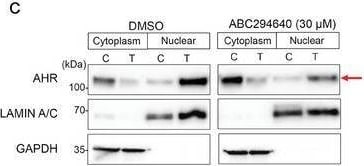
Western Blot: AHR Antibody - Azide and BSA Free [NB100-128] -
Knockdown of SPHK2 downregulates AHR expression. A) qRT‐PCR analysis of CYP1A1 expression in HeLa cells after incubation with or without TCDF (0.1 uM) for 2 h or pretreatment with SPHK2 inhibitor (ABC, ABC294640) for 2 h. Carrier solvent DMSO was used as a control. B) CCK8 assay results after 2 h incubation with different doses of ABC294640 (uM). C) HeLa cells after treatment with 0.1 uM TCDF for 30 min or pretreatment with ABC294640 for 2 h followed by 0.1 uM TCDF for 30 min, cells were fractionated into cytoplasmic and nuclear extracts and subjected to western blotting analysis with the indicated antibodies. Red arrow indicates the reduced level of AHR protein in the ABC294640 + TCDF treated nucleus. LAMIN A/C antibody and GAPDH antibody were used for the loading control of nuclear and cytoplasmic extracts, respectively. n = 3 D) HeLa cells were transfected with SPHK2 shRNA for 48 h and the efficiency of each shRNA plasmid knockdown was assessed by qRT‐PCR (left) and western blotting (right). n = 3 E) Western blot analysis of HeLa cells transfected with SPHK2 shRNA or shRNA‐scramble (scr) for 48 h. Cells were treated 30 min with or without 0.1 uM TCDF, extracted, and proteins detected with the indicated antibodies. n = 3 F) ABC294640 incubation in HeLa cells for 2 h decreased AHR expression as determined by western blotting analysis. n = 3 G) shRNA for SPHK2 for 48 h decreases AHR mRNA in HeLa cells. (H) Transient overexpression of human SPHK2 for 48 h and qRT‐PCR was performed. All data mean +/- S.D. (n = 3). ****p < 0.0001, ***p < 0.001, **p < 0.01, *p < 0.05. Image collected and cropped by CiteAb from the following open publication (https://pubmed.ncbi.nlm.nih.gov/39207053), licensed under a CC-BY license. Not internally tested by Novus Biologicals.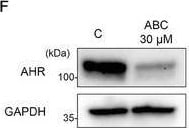
Western Blot: AHR Antibody - Azide and BSA Free [NB100-128] -
Knockdown of SPHK2 downregulates AHR expression. A) qRT‐PCR analysis of CYP1A1 expression in HeLa cells after incubation with or without TCDF (0.1 uM) for 2 h or pretreatment with SPHK2 inhibitor (ABC, ABC294640) for 2 h. Carrier solvent DMSO was used as a control. B) CCK8 assay results after 2 h incubation with different doses of ABC294640 (uM). C) HeLa cells after treatment with 0.1 uM TCDF for 30 min or pretreatment with ABC294640 for 2 h followed by 0.1 uM TCDF for 30 min, cells were fractionated into cytoplasmic and nuclear extracts and subjected to western blotting analysis with the indicated antibodies. Red arrow indicates the reduced level of AHR protein in the ABC294640 + TCDF treated nucleus. LAMIN A/C antibody and GAPDH antibody were used for the loading control of nuclear and cytoplasmic extracts, respectively. n = 3 D) HeLa cells were transfected with SPHK2 shRNA for 48 h and the efficiency of each shRNA plasmid knockdown was assessed by qRT‐PCR (left) and western blotting (right). n = 3 E) Western blot analysis of HeLa cells transfected with SPHK2 shRNA or shRNA‐scramble (scr) for 48 h. Cells were treated 30 min with or without 0.1 uM TCDF, extracted, and proteins detected with the indicated antibodies. n = 3 F) ABC294640 incubation in HeLa cells for 2 h decreased AHR expression as determined by western blotting analysis. n = 3 G) shRNA for SPHK2 for 48 h decreases AHR mRNA in HeLa cells. (H) Transient overexpression of human SPHK2 for 48 h and qRT‐PCR was performed. All data mean +/- S.D. (n = 3). ****p < 0.0001, ***p < 0.001, **p < 0.01, *p < 0.05. Image collected and cropped by CiteAb from the following open publication (https://pubmed.ncbi.nlm.nih.gov/39207053), licensed under a CC-BY license. Not internally tested by Novus Biologicals.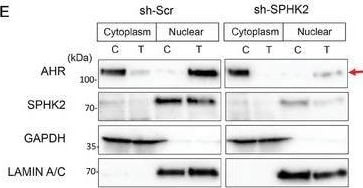
Western Blot: AHR Antibody - Azide and BSA Free [NB100-128] -
Knockdown of SPHK2 downregulates AHR expression. A) qRT‐PCR analysis of CYP1A1 expression in HeLa cells after incubation with or without TCDF (0.1 uM) for 2 h or pretreatment with SPHK2 inhibitor (ABC, ABC294640) for 2 h. Carrier solvent DMSO was used as a control. B) CCK8 assay results after 2 h incubation with different doses of ABC294640 (uM). C) HeLa cells after treatment with 0.1 uM TCDF for 30 min or pretreatment with ABC294640 for 2 h followed by 0.1 uM TCDF for 30 min, cells were fractionated into cytoplasmic and nuclear extracts and subjected to western blotting analysis with the indicated antibodies. Red arrow indicates the reduced level of AHR protein in the ABC294640 + TCDF treated nucleus. LAMIN A/C antibody and GAPDH antibody were used for the loading control of nuclear and cytoplasmic extracts, respectively. n = 3 D) HeLa cells were transfected with SPHK2 shRNA for 48 h and the efficiency of each shRNA plasmid knockdown was assessed by qRT‐PCR (left) and western blotting (right). n = 3 E) Western blot analysis of HeLa cells transfected with SPHK2 shRNA or shRNA‐scramble (scr) for 48 h. Cells were treated 30 min with or without 0.1 uM TCDF, extracted, and proteins detected with the indicated antibodies. n = 3 F) ABC294640 incubation in HeLa cells for 2 h decreased AHR expression as determined by western blotting analysis. n = 3 G) shRNA for SPHK2 for 48 h decreases AHR mRNA in HeLa cells. (H) Transient overexpression of human SPHK2 for 48 h and qRT‐PCR was performed. All data mean +/- S.D. (n = 3). ****p < 0.0001, ***p < 0.001, **p < 0.01, *p < 0.05. Image collected and cropped by CiteAb from the following open publication (https://pubmed.ncbi.nlm.nih.gov/39207053), licensed under a CC-BY license. Not internally tested by Novus Biologicals.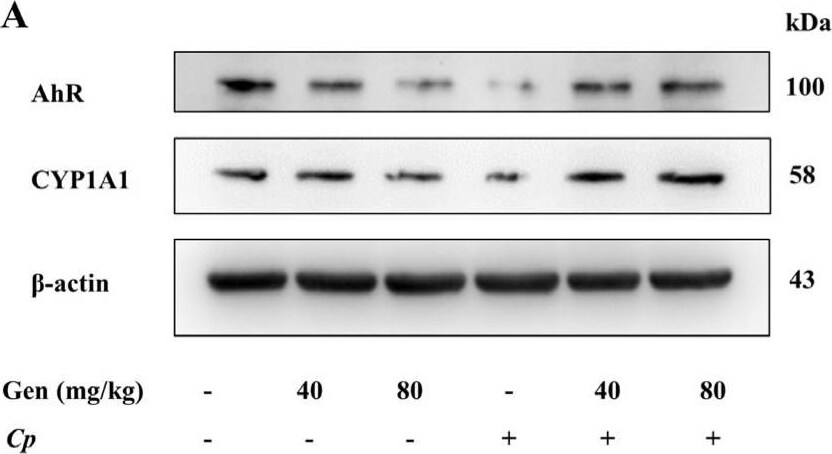
Western Blot: AHR Antibody - Azide and BSA Free [NB100-128] -
Genistein activates the intestinal AhR pathway in broilers challenged with NE. (A) Western blot of AhR and CYP1A1 in the jejunum of broilers. (B) Quantification of AhR and CYP1A1 protein levels, n = 3. Con, basal diet; Gen40, basal diet supplemented with 40 mg/kg genistein; Gen80, Gen80 diet; Cp, basal diet and Cp infection; Cp+Gen40, Gen40 diet and Cp infection; Cp+Gen80, Gen80 diet and Cp infection. The differences among groups were determined by ANOVA using Duncan’s test. The results are presented as mean +/- SEM. Letter a indicates p < 0.05 vs. Con group; letter b indicates p < 0.05 vs. Cp group. Image collected and cropped by CiteAb from the following open publication (https://www.mdpi.com/1422-0067/25/12/6656), licensed under a CC-BY license. Not internally tested by Novus Biologicals.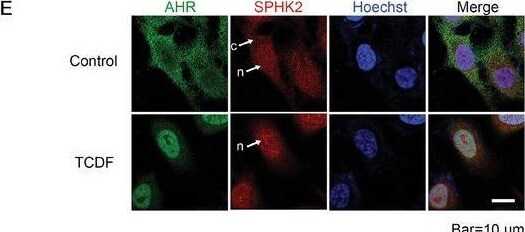
Immunocytochemistry/ Immunofluorescence: AHR Antibody - Azide and BSA Free [NB100-128] -
Endogenous AHR and SPHK2 interact in HeLa cells. A,B) HeLa cells treated with or without TCDF were subjected to cytoplasmic/nuclear extract fractionation and immunoprecipitated using AHR antibody and western blotting analysis was performed using an (A) AHR antibody or (B) SPHK2 antibody. C, Control; T, TCDF treated samples. C) After IP of SPHK2, western blotting analysis was performed with AHR, ARNT and SPHK2 antibodies. C, Control; T, TCDF treated samples. D) After IP of ARNT, western blotting analysis was performed with AHR, SPHK2 and ARNT antibodies. C, Control; T, TCDF treated samples. E) Immunofluorescent double staining using anti‐AHR and anti‐SPHK2 antibodies. The nucleus was counterstained with Hoechst 33 342. Arrows c indicate the cytoplasm, n indicate the nucleus. Bar is 10 um. Data are representative images from three independent experiments. Image collected and cropped by CiteAb from the following open publication (https://pubmed.ncbi.nlm.nih.gov/39207053), licensed under a CC-BY license. Not internally tested by Novus Biologicals.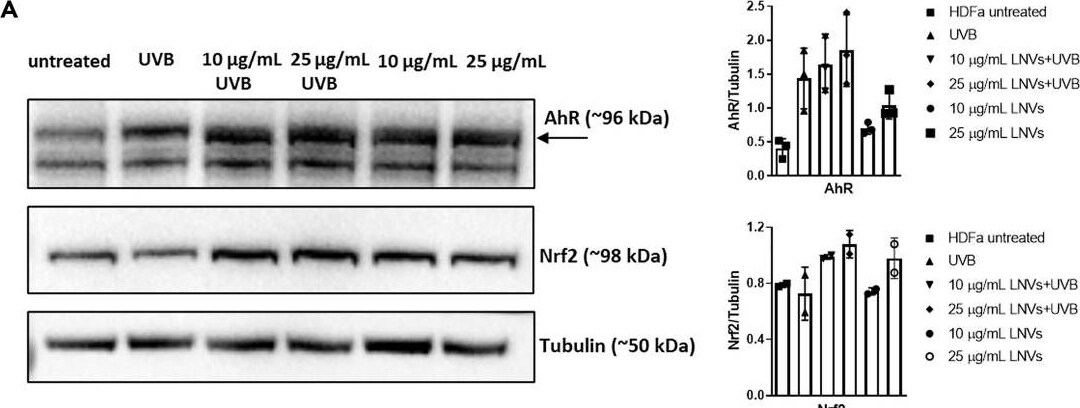
Western Blot: AHR Antibody - Azide and BSA Free [NB100-128] -
LNVs activate the AhR/Nrf2 signaling pathway(A) Western blot analysis of AhR (n = 3) and Nrf2 (n = 2) levels in HDF alpha cell line pre-treated with LNVs (10 and 25 μg/mL) for 24 h and then stimulated with UVB irradiation (20 mJ/cm2) for 25 s. Data are represented as mean +/- SD.(B and C) Confocal analysis of AhR (B, red signal) and Nrf2 (C, green signal) levels in HDF alpha cell line untreated, or treated with LNVs (10 and 25 μg/mL) for 24h in the presence of UVB; actin was stained with actin green (in green), nuclei with Hoechst (in blue). Scale bar 50 μm. Image collected and cropped by CiteAb from the following open publication (https://pubmed.ncbi.nlm.nih.gov/37426343), licensed under a CC-BY license. Not internally tested by Novus Biologicals.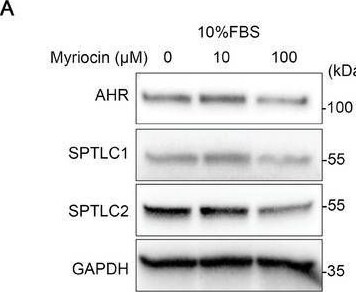
Western Blot: AHR Antibody - Azide and BSA Free [NB100-128] -
Inhibition of serine palmitoyltransferase with myriocin causes decreased AHR expression. A) Western blotting analysis of HeLa cells after myriocin (uM) treatment for 3 h. SPTLC1 and SPTLC2 antibodies were used for the conformation of myriocin effects for the inhibition under this culture condition (10%FBS/DMEM). B) qPCR analysis using AHR‐ and SPTLC1‐specific primers for 2 or 3 h after myriocin treatment. C) Western blotting analysis of HeLa cell whole lysates after myriocin (uM) treatment under serum free conditions for 1 h. D) CCK8 assay results after overnight culture in 10%FBS/DMEM or 2 h in 0%FBS/DMEM with or without myriocin. All data and images are representative from three independent replicates. ****p < 0.0001, ***p < 0.001, **p < 0.01. Image collected and cropped by CiteAb from the following open publication (https://pubmed.ncbi.nlm.nih.gov/39207053), licensed under a CC-BY license. Not internally tested by Novus Biologicals.Applications for AHR Antibody - Azide and BSA Free
Chromatin Immunoprecipitation
Immunocytochemistry/ Immunofluorescence
Immunohistochemistry
Immunohistochemistry-Paraffin
Western Blot
Reviewed Applications
Read 1 review rated 5 using NB100-128 in the following applications:
Formulation, Preparation, and Storage
Purification
Formulation
Format
Preservative
Concentration
Shipping
Stability & Storage
Background: AHR
Long Name
Alternate Names
Gene Symbol
Additional AHR Products
Product Documents for AHR Antibody - Azide and BSA Free
Certificate of Analysis
To download a Certificate of Analysis, please enter a lot or batch number in the search box below.
Product Specific Notices for AHR Antibody - Azide and BSA Free
This product is for research use only and is not approved for use in humans or in clinical diagnosis. Primary Antibodies are guaranteed for 1 year from date of receipt.
Citations for AHR Antibody - Azide and BSA Free
 Powered by Bioz
Customer Reviews for AHR Antibody - Azide and BSA Free (1)
Have you used AHR Antibody - Azide and BSA Free?
Submit a review and receive an Amazon gift card!
$25/€18/£15/$25CAN/¥2500 for a review with an image
$10/€7/£6/$10CAN/¥1110 for a review without an image
Submit a review
Customer Images
-(1-ml)_NB100-128_6746.jpg)
-
Application: Western BlotSample Tested: U937 cell nuclear proteinSpecies: HumanVerified Customer | Posted 04/02/2014

There are no reviews that match your criteria.
Protocols
Find general support by application which include: protocols, troubleshooting, illustrated assays, videos and webinars.
- Antigen Retrieval Protocol (PIER)
- Antigen Retrieval for Frozen Sections Protocol
- Appropriate Fixation of IHC/ICC Samples
- Cellular Response to Hypoxia Protocols
- Chromogenic IHC Staining of Formalin-Fixed Paraffin-Embedded (FFPE) Tissue Protocol
- Chromogenic Immunohistochemistry Staining of Frozen Tissue
- ClariTSA™ Fluorophore Kits
- Detection & Visualization of Antibody Binding
- Fluorescent IHC Staining of Frozen Tissue Protocol
- Graphic Protocol for Heat-induced Epitope Retrieval
- Graphic Protocol for the Preparation and Fluorescent IHC Staining of Frozen Tissue Sections
- Graphic Protocol for the Preparation and Fluorescent IHC Staining of Paraffin-embedded Tissue Sections
- Graphic Protocol for the Preparation of Gelatin-coated Slides for Histological Tissue Sections
- ICC Cell Smear Protocol for Suspension Cells
- ICC Immunocytochemistry Protocol Videos
- ICC for Adherent Cells
- IHC Sample Preparation (Frozen sections vs Paraffin)
- Immunocytochemistry (ICC) Protocol
- Immunocytochemistry Troubleshooting
- Immunofluorescence of Organoids Embedded in Cultrex Basement Membrane Extract
- Immunofluorescent IHC Staining of Formalin-Fixed Paraffin-Embedded (FFPE) Tissue Protocol
- Immunohistochemistry (IHC) and Immunocytochemistry (ICC) Protocols
- Immunohistochemistry Frozen Troubleshooting
- Immunohistochemistry Paraffin Troubleshooting
- Preparing Samples for IHC/ICC Experiments
- Preventing Non-Specific Staining (Non-Specific Binding)
- Primary Antibody Selection & Optimization
- Protocol for Heat-Induced Epitope Retrieval (HIER)
- Protocol for Making a 4% Formaldehyde Solution in PBS
- Protocol for VisUCyte™ HRP Polymer Detection Reagent
- Protocol for the Fluorescent ICC Staining of Cell Smears - Graphic
- Protocol for the Fluorescent ICC Staining of Cultured Cells on Coverslips - Graphic
- Protocol for the Preparation & Fixation of Cells on Coverslips
- Protocol for the Preparation and Chromogenic IHC Staining of Frozen Tissue Sections
- Protocol for the Preparation and Chromogenic IHC Staining of Frozen Tissue Sections - Graphic
- Protocol for the Preparation and Chromogenic IHC Staining of Paraffin-embedded Tissue Sections
- Protocol for the Preparation and Chromogenic IHC Staining of Paraffin-embedded Tissue Sections - Graphic
- Protocol for the Preparation and Fluorescent ICC Staining of Cells on Coverslips
- Protocol for the Preparation and Fluorescent ICC Staining of Non-adherent Cells
- Protocol for the Preparation and Fluorescent ICC Staining of Stem Cells on Coverslips
- Protocol for the Preparation and Fluorescent IHC Staining of Frozen Tissue Sections
- Protocol for the Preparation and Fluorescent IHC Staining of Paraffin-embedded Tissue Sections
- Protocol for the Preparation of Gelatin-coated Slides for Histological Tissue Sections
- Protocol for the Preparation of a Cell Smear for Non-adherent Cell ICC - Graphic
- R&D Systems Quality Control Western Blot Protocol
- TUNEL and Active Caspase-3 Detection by IHC/ICC Protocol
- The Importance of IHC/ICC Controls
- Troubleshooting Guide: Immunohistochemistry
- Troubleshooting Guide: Western Blot Figures
- Western Blot Conditions
- Western Blot Protocol
- Western Blot Protocol for Cell Lysates
- Western Blot Troubleshooting
- Western Blot Troubleshooting Guide
- View all Protocols, Troubleshooting, Illustrated assays and Webinars
FAQs for AHR Antibody - Azide and BSA Free
-
Q: What is the sodium azide percentage for this product?
A: No preservative
Associated Pathways
