
alpha Tubulin Antibody (RM113)
Novus Biologicals | Catalog # NBP2-77401
Recombinant Monoclonal Antibody

Key Product Details
Species Reactivity
All Species
Applications
Immunohistochemistry, Western Blot, Immunocytochemistry/ Immunofluorescence, Immunoprecipitation, Chromatin Immunoprecipitation (ChIP)
Label
Unconjugated
Antibody Source
Recombinant Monoclonal Rabbit IgG Clone # RM113 expressed in HEK293
Loading...
Product Specifications
Immunogen
This alpha Tubulin Antibody (RM113) was developed against a peptide corresponding to the C-terminus of alpha Tubulin
Specificity
This alpha Tubulin Antibody (RM113) reacts to alpha Tubulin, including Tubulin alpha-1A chain and Tubulin alpha-1B chain.
Clonality
Monoclonal
Host
Rabbit
Isotype
IgG
Theoretical MW
50 kDa.
Disclaimer note: The observed molecular weight of the protein may vary from the listed predicted molecular weight due to post translational modifications, post translation cleavages, relative charges, and other experimental factors.
Disclaimer note: The observed molecular weight of the protein may vary from the listed predicted molecular weight due to post translational modifications, post translation cleavages, relative charges, and other experimental factors.
Scientific Data Images for alpha Tubulin Antibody (RM113)
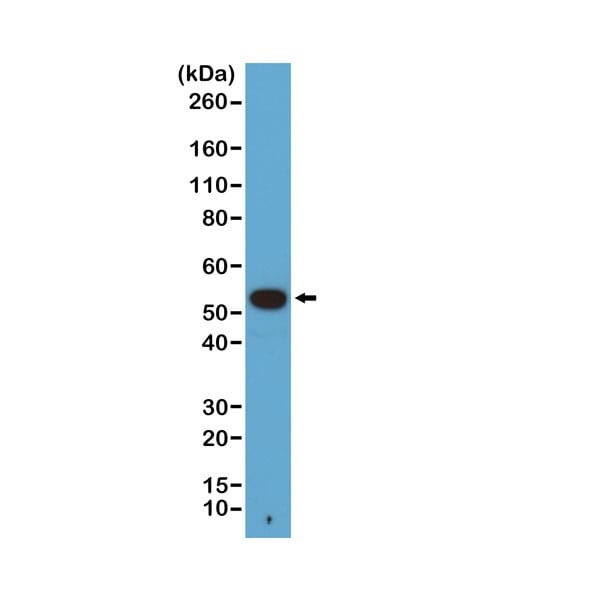
Western Blot: alpha Tubulin Antibody (RM113) [Biotin] [NBP2-77401] -
Western Blot: alpha Tubulin Antibody (RM113) [Biotin] [NBP2-77401] - Western blot of A431 cells, using NBP3-18536 at 1/1000 dilution, showed a band of alpha Tubulin at the predicted MW (~50 kDa).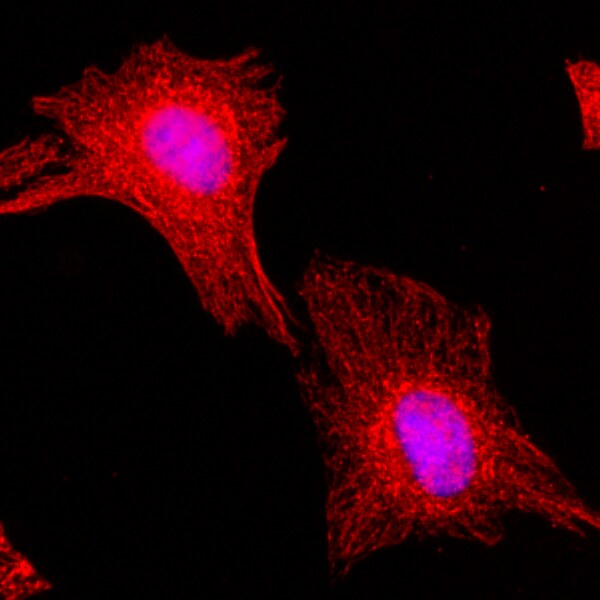
Immunocytochemistry/Immunofluorescence: alpha Tubulin Antibody (RM113) [NBP2-77401] -
Immunocytochemistry/Immunofluorescence: alpha Tubulin Antibody (RM113) [NBP2-77401] - Staining of HeLa cells, using NBP2-77401 (red). Nuclei have been labeled with DAPI (blue).Applications for alpha Tubulin Antibody (RM113)
Application
Recommended Usage
Chromatin Immunoprecipitation (ChIP)
1:200
Immunocytochemistry/ Immunofluorescence
1:200
Immunohistochemistry
1:200
Immunoprecipitation
1:200
Western Blot
1:1000
Formulation, Preparation, and Storage
Purification
Protein A purified
Formulation
50% Glycerol/PBS, 1% BSA
Preservative
0.09% Sodium Azide
Concentration
Please see the vial label for concentration. If unlisted please contact technical services.
Shipping
The product is shipped with polar packs. Upon receipt, store it immediately at the temperature recommended below.
Stability & Storage
Store at -20C. Avoid freeze-thaw cycles.
Background: alpha Tubulin
Tyrosine ligase adds a C-terminal tyrosine to monomeric alpha tubulin. Assembled microtubules can again be detyrosinated by a cytoskeleton associated carboxypeptidase. Detyrosinated alpha tubulin is referred to as Glu-tubulin. Another post-translational modification of detyrosinated alpha tubulin is C-terminal polyglutamylation which is characteristic for microtubules in neuronal cells and the mitotic spindle.
Like GAPDH and beta-actin, alpha/beta tubulin is often used as a loading control in immunoblot applications (1). Alpha/beta tubulin is also good for counterstaining microtubules in immunofluorescence (2).
References
1. Hannen, R., Selmansberger, M., Hauswald, M., Pagenstecher, A., Nist, A., Stiewe, T.,... Bartsch, J. W. (2019). Comparative Transcriptomic Analysis of Temozolomide Resistant Primary GBM Stem-Like Cells and Recurrent GBM Identifies Up-Regulation of the Carbonic Anhydrase CA2 Gene as Resistance Factor. Cancers (Basel), 11(7). doi:10.3390/cancers11070921
2. Nel, M., Joubert, A. M., Dohle, W., Potter, B. V., & Theron, A. E. (2018). Modes of cell death induced by tetrahydroisoquinoline-based analogs in MDA-MB-231 breast and A549 lung cancer cell lines. Drug Des Devel Ther, 12, 1881-1904. doi:10.2147/dddt.S152718
Long Name
Tubulin Alpha 1a
Alternate Names
Alpha-Tubulin 3, B-ALPHA-1, LIS3, TUBA1A, TUBA3, Tubulin B-Alpha-1
Gene Symbol
TUBA1A
Additional alpha Tubulin Products
Product Documents for alpha Tubulin Antibody (RM113)
Certificate of Analysis
To download a Certificate of Analysis, please enter a lot or batch number in the search box below.
Product Specific Notices for alpha Tubulin Antibody (RM113)
This product is for research use only and is not approved for use in humans or in clinical diagnosis. Primary Antibodies are guaranteed for 1 year from date of receipt.
Related Research Areas
Customer Reviews for alpha Tubulin Antibody (RM113)
There are currently no reviews for this product. Be the first to review alpha Tubulin Antibody (RM113) and earn rewards!
Have you used alpha Tubulin Antibody (RM113)?
Submit a review and receive an Amazon gift card!
$25/€18/£15/$25CAN/¥2500 for a review with an image
$10/€7/£6/$10CAN/¥1110 for a review without an image
Submit a review
Protocols
Find general support by application which include: protocols, troubleshooting, illustrated assays, videos and webinars.
- Antigen Retrieval Protocol (PIER)
- Antigen Retrieval for Frozen Sections Protocol
- Appropriate Fixation of IHC/ICC Samples
- Cellular Response to Hypoxia Protocols
- ChIP Protocol Video
- Chromatin Immunoprecipitation (ChIP) Protocol
- Chromatin Immunoprecipitation Protocol
- Chromogenic IHC Staining of Formalin-Fixed Paraffin-Embedded (FFPE) Tissue Protocol
- Chromogenic Immunohistochemistry Staining of Frozen Tissue
- ClariTSA™ Fluorophore Kits
- Detection & Visualization of Antibody Binding
- Fluorescent IHC Staining of Frozen Tissue Protocol
- Graphic Protocol for Heat-induced Epitope Retrieval
- Graphic Protocol for the Preparation and Fluorescent IHC Staining of Frozen Tissue Sections
- Graphic Protocol for the Preparation and Fluorescent IHC Staining of Paraffin-embedded Tissue Sections
- Graphic Protocol for the Preparation of Gelatin-coated Slides for Histological Tissue Sections
- ICC Cell Smear Protocol for Suspension Cells
- ICC Immunocytochemistry Protocol Videos
- ICC for Adherent Cells
- IHC Sample Preparation (Frozen sections vs Paraffin)
- Immunocytochemistry (ICC) Protocol
- Immunocytochemistry Troubleshooting
- Immunofluorescence of Organoids Embedded in Cultrex Basement Membrane Extract
- Immunofluorescent IHC Staining of Formalin-Fixed Paraffin-Embedded (FFPE) Tissue Protocol
- Immunohistochemistry (IHC) and Immunocytochemistry (ICC) Protocols
- Immunohistochemistry Frozen Troubleshooting
- Immunohistochemistry Paraffin Troubleshooting
- Immunoprecipitation Protocol
- Preparing Samples for IHC/ICC Experiments
- Preventing Non-Specific Staining (Non-Specific Binding)
- Primary Antibody Selection & Optimization
- Protocol for Heat-Induced Epitope Retrieval (HIER)
- Protocol for Making a 4% Formaldehyde Solution in PBS
- Protocol for VisUCyte™ HRP Polymer Detection Reagent
- Protocol for the Fluorescent ICC Staining of Cell Smears - Graphic
- Protocol for the Fluorescent ICC Staining of Cultured Cells on Coverslips - Graphic
- Protocol for the Preparation & Fixation of Cells on Coverslips
- Protocol for the Preparation and Chromogenic IHC Staining of Frozen Tissue Sections
- Protocol for the Preparation and Chromogenic IHC Staining of Frozen Tissue Sections - Graphic
- Protocol for the Preparation and Chromogenic IHC Staining of Paraffin-embedded Tissue Sections
- Protocol for the Preparation and Chromogenic IHC Staining of Paraffin-embedded Tissue Sections - Graphic
- Protocol for the Preparation and Fluorescent ICC Staining of Cells on Coverslips
- Protocol for the Preparation and Fluorescent ICC Staining of Non-adherent Cells
- Protocol for the Preparation and Fluorescent ICC Staining of Stem Cells on Coverslips
- Protocol for the Preparation and Fluorescent IHC Staining of Frozen Tissue Sections
- Protocol for the Preparation and Fluorescent IHC Staining of Paraffin-embedded Tissue Sections
- Protocol for the Preparation of Gelatin-coated Slides for Histological Tissue Sections
- Protocol for the Preparation of a Cell Smear for Non-adherent Cell ICC - Graphic
- R&D Systems Quality Control Western Blot Protocol
- TUNEL and Active Caspase-3 Detection by IHC/ICC Protocol
- The Importance of IHC/ICC Controls
- Troubleshooting Guide: Immunohistochemistry
- Troubleshooting Guide: Western Blot Figures
- Western Blot Conditions
- Western Blot Protocol
- Western Blot Protocol for Cell Lysates
- Western Blot Troubleshooting
- Western Blot Troubleshooting Guide
- View all Protocols, Troubleshooting, Illustrated assays and Webinars
FAQs for alpha Tubulin Antibody (RM113)
Showing
1
-
2 of
2 FAQs
Showing All
-
Q: We would like to stain cilia with an acetylated alpha tubulin antibody in our cells, but I am unsure if this antibody will be able to conclusively differentiate cilia from other structures such as spindle pole bodies. Does anyone know what acetylated alpha tubulin antibodies might bind to apart from cilia?
A: Acetylated alpha tubulin is found in relatively stable microtubules. It is best practice to use this marker together with a centrosome/centriole marker, which will stain the basal bodies at the base of the cilium. After that, it is relatively straightforward to identify the acetylated alpha tubulin signal that corresponds to the cilium.
-
Q: Will this alpha tubulin antibody recognize both isoforms of alpha tubulin?
A: The epitope for this alpha tubulin antibody lies on the C-terminus of the protein and the difference between the two major isoforms is within the first 35 aa of the N-terminus so this alpha tubulin antibody will recognize both isoforms.
-
Q: We would like to stain cilia with an acetylated alpha tubulin antibody in our cells, but I am unsure if this antibody will be able to conclusively differentiate cilia from other structures such as spindle pole bodies. Does anyone know what acetylated alpha tubulin antibodies might bind to apart from cilia?
A: Acetylated alpha tubulin is found in relatively stable microtubules. It is best practice to use this marker together with a centrosome/centriole marker, which will stain the basal bodies at the base of the cilium. After that, it is relatively straightforward to identify the acetylated alpha tubulin signal that corresponds to the cilium.
-
Q: Will this alpha tubulin antibody recognize both isoforms of alpha tubulin?
A: The epitope for this alpha tubulin antibody lies on the C-terminus of the protein and the difference between the two major isoforms is within the first 35 aa of the N-terminus so this alpha tubulin antibody will recognize both isoforms.
Loading...