
Calcium-sensing R/CaSR Antibody (HL 1499) - BSA Free
Novus Biologicals | Catalog # NB100-1830

![Western Blot: Calcium-sensing R/CaSR Antibody (HL 1499)BSA Free [NB100-1830]](https://resources.rndsystems.com/images/products/Calcium-sensing-R-CaSR-Antibody-HL-1499-Western-Blot-NB100-1830-img0012.jpg "Western Blot: Calcium-sensing R/CaSR Antibody (HL 1499)BSA Free [NB100-1830]")
Scientific images may be resized, cropped, or adjusted for brightness or contrast for presentation purposes. These updates are limited to presentation and do not affect the underlying scientific interpretation of the data. Where available, additional source data may be provided upon request.
Key Product Details
Species Reactivity
Validated:
Cited:
Applications
Validated:
Cited:
Label
Antibody Source
Format
Product Specifications
Immunogen
Localization
Clonality
Host
Isotype
Theoretical MW
Disclaimer note: The observed molecular weight of the protein may vary from the listed predicted molecular weight due to post translational modifications, post translation cleavages, relative charges, and other experimental factors.
Scientific Data Images for Calcium-sensing R/CaSR Antibody (HL 1499) - BSA Free
Western Blot: Calcium-sensing R/CaSR Antibody (HL 1499)BSA Free [NB100-1830]
Western Blot: Calcium-sensing R/CaSR Antibody (HL 1499) [NB100-1830] - Detection of Calcium Sensing Receptor in transfected 293 cell lysate using NB 100-1830. ECL exposure, 5 minutes. In this photo, the protein has aggregated and thus the higher MW band as expected.![Western Blot: Calcium-sensing R/CaSR Antibody (HL 1499)BSA Free [NB100-1830]](https://resources.rndsystems.com/images/products/Calcium-sensing-R-CaSR-Antibody-HL-1499-Western-Blot-NB100-1830-img0011.jpg "Western Blot: Calcium-sensing R/CaSR Antibody (HL 1499)BSA Free [NB100-1830]")
Western Blot: Calcium-sensing R/CaSR Antibody (HL 1499)BSA Free [NB100-1830]
Western Blot: Calcium-sensing R/CaSR Antibody (HL 1499) [NB100-1830] - Analysis of Calcium Sensing Receptor expression in rat kidney tissue.![Simple Western: Calcium-sensing R/CaSR Antibody (HL 1499)BSA Free [NB100-1830]](https://resources.rndsystems.com/images/products/Calcium-sensing-R-CaSR-Antibody-HL-1499-Simple-Western-NB100-1830-img0010.jpg "Simple Western: Calcium-sensing R/CaSR Antibody (HL 1499)BSA Free [NB100-1830]")
Simple Western: Calcium-sensing R/CaSR Antibody (HL 1499)BSA Free [NB100-1830]
Simple Western: Calcium-sensing R/CaSR Antibody (HL 1499) [NB100-1830] - Image shows a specific band for Calcium Sensing Receptor in 0.5 mg/mL of HEK293 lysate. This experiment was performed under reducing conditions using the 12-230 kDa separation system.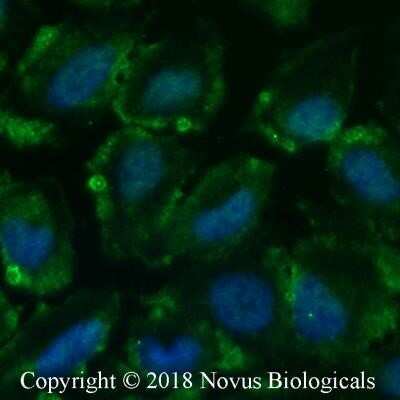
Immunocytochemistry/ Immunofluorescence: Calcium-sensing R/CaSR Antibody (HL 1499) - BSA Free [NB100-1830] -
Immunocytochemistry/ Immunofluorescence: Calcium-sensing R/CaSR Antibody (HL 1499) - BSA Free [NB100-1830] - U2OS cells were fixed for 10 minutes using 10% formalin and then permeabilized for 5 minutes using 1X PBS + 0.05% Triton X-100. The cells were incubated with antibody at 5 ug/mL overnight at 4C and detected with an anti-mouse Dylight 488 (Green) at 1:500. Nuclei were counterstained with DAPI (Blue). Cells were imaged using a 40X objective.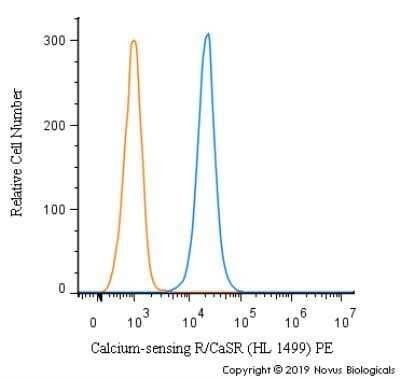
Flow Cytometry: Calcium-sensing R/CaSR Antibody (HL 1499) - BSA Free [NB100-1830] -
Flow Cytometry: Calcium-sensing R/CaSR Antibody (HL 1499) - BSA Free [NB100-1830] - An intracellular stain was performed on Hek293 cells with Calcium-sensing R/CaSR Antibody (HL 1499) NB100-1830PE (blue) and a matched isotype control (orange). Cells were fixed with 4% PFA and then permeablized with 0.1% saponin. Cells were incubated in an antibody dilution of 2.5 ug/mL for 30 minutes at room temperature. Both antibodies were directly conjugated to Phycoerythrin.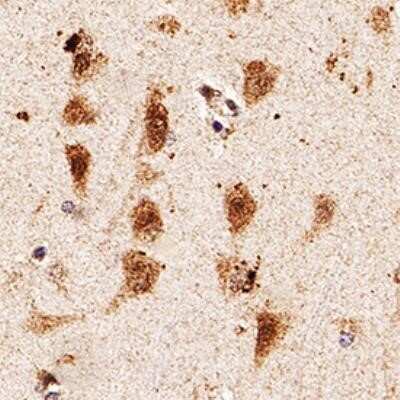
Immunohistochemistry-Paraffin: Calcium-sensing R/CaSR Antibody (HL 1499) - BSA Free [NB100-1830] -
Immunohistochemistry-Paraffin: Calcium-sensing R/CaSR Antibody (HL 1499) - BSA Free [NB100-1830] - Analysis of FFPE human brain using Calcium-sensing R/CaSR antibody at 1:50 on a Bond Rx autostainer (Leica Biosystems). The assay involved 20 minutes of heat induced antigen retrieval (HIER) using 10mM sodium citrate buffer (pH 6.0) and endogenous peroxid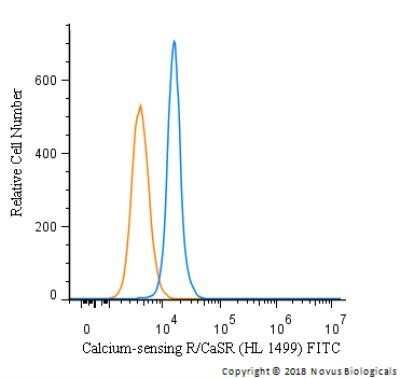
Flow Cytometry: Calcium-sensing R/CaSR Antibody (HL 1499) - BSA Free [NB100-1830] -
Flow Cytometry: Calcium-sensing R/CaSR Antibody (HL 1499) - BSA Free [NB100-1830] - An intracellular stain was performed on HEK293 cells with Calcium-sensing R/CaSR Antibody [HL 1499] NB100-1830F (blue) and a matched isotype control (orange). Cells were fixed with 4% PFA and then permeabilized with 0.1% saponin. Cells were incubated in an antibody dilution of 5 ug/mL for 30 minutes at room temperature. Both antibodies were directly conjugated to FITC.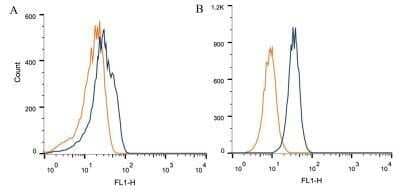
Flow Cytometry: Calcium-sensing R/CaSR Antibody (HL 1499) - BSA Free [NB100-1830] -
Flow Cytometry: Calcium-sensing R/CaSR Antibody (HL 1499) - BSA Free [NB100-1830] - Intracellular flow cytometric staining of 1 x 10^6 CHO (A) and HEK-293 (B) cells using calcium sensing receptor antibody (dark blue). Isotype control shown in orange. Antibody at 1 ug/1 x 10^6 cells.Applications for Calcium-sensing R/CaSR Antibody (HL 1499) - BSA Free
ELISA
Flow Cytometry
Immunoprecipitation
Simple Western
Western Blot
See Simple Western Antibody Database for Simple Western validation: Tested in Hek293 lysate 0.5 mg/mL, separated by Size, antibody dilution of 1:200, apparent MW was 148 kDa. Separated by Size-Wes, Sally Sue/Peggy Sue.
The observed molecular weight of the protein may vary from the listed predicted molecular weight due to post translational modifications, post translation cleavages, relative charges, and other experimental factors.
Flow Cytometry Panel Builder
Bio-Techne Knows Flow Cytometry
Save time and reduce costly mistakes by quickly finding compatible reagents using the Panel Builder Tool.
Advanced Features
- Spectra Viewer - Custom analysis of spectra from multiple fluorochromes
- Spillover Popups - Visualize the spectra of individual fluorochromes
- Antigen Density Selector - Match fluorochrome brightness with antigen density

Formulation, Preparation, and Storage
Purification
Formulation
Format
Preservative
Concentration
Shipping
Stability & Storage
Background: Calcium-sensing R/CaSR
Long Name
Alternate Names
Gene Symbol
Additional Calcium-sensing R/CaSR Products
Product Documents for Calcium-sensing R/CaSR Antibody (HL 1499) - BSA Free
Certificate of Analysis
To download a Certificate of Analysis, please enter a lot or batch number in the search box below.
Product Specific Notices for Calcium-sensing R/CaSR Antibody (HL 1499) - BSA Free
This product is for research use only and is not approved for use in humans or in clinical diagnosis. Primary Antibodies are guaranteed for 1 year from date of receipt.
Related Research Areas
Citations for Calcium-sensing R/CaSR Antibody (HL 1499) - BSA Free
 Powered by Bioz
Customer Reviews for Calcium-sensing R/CaSR Antibody (HL 1499) - BSA Free
There are currently no reviews for this product. Be the first to review Calcium-sensing R/CaSR Antibody (HL 1499) - BSA Free and earn rewards!
Have you used Calcium-sensing R/CaSR Antibody (HL 1499) - BSA Free?
Submit a review and receive an Amazon gift card!
$25/€18/£15/$25CAN/¥2500 for a review with an image
$10/€7/£6/$10CAN/¥1110 for a review without an image
Submit a review
Protocols
View specific protocols for Calcium-sensing R/CaSR Antibody (HL 1499) - BSA Free (NB100-1830):
Western Blot Protocol
1. Perform SDS-PAGE (3-8%) on samples to be analyzed, loading 25 ug of total protein per lane.
2. Transfer proteins to Nitrocellulose according to the instructions provided by the manufacturer of the transfer apparatus.
3. Stain the blot using ponceau S for 1-2 minutes to access the transfer of proteins onto the nitrocellulose membrane. Rinse the blot in water to remove excess stain and mark the lane locations and locations of molecular weight markers using a pencil.
4. Rinse the blot in TBS for approximately 5 minutes.
5. Block the membrane using 5% non-fat dry milk in TBS for 2 hours at room temperature.
6. Dilute the mouse anti-calcium sensing receptor primary antibody (NB 100-1830) in blocking buffer and incubate 1 hour at room temperature.
7. Wash the membrane in water for 5 minutes and apply the diluted mouse-IgG HRP-conjugated secondary antibody in blocking buffer (as per manufacturer's instructions) and incubate 1 hour at room temperature.
8. Wash the blot in TBS containing 0.05-0.1% Tween-20 for 10-20 minutes.
9. Wash the blot in type I water for an additional 10-20 minutes (this step can be repeated as required to reduce background).
10. Apply the detection reagent of choice in accordance with the manufacturer's instructions (Amersham's ECL is the standard reagent used at Novus Biologicals).
Note: Tween-20 can be added to the blocking buffer at a final concentration of 0.05-0.2%, provided it does not interfere with antibody-antigen binding.
Find general support by application which include: protocols, troubleshooting, illustrated assays, videos and webinars.
- 7-Amino Actinomycin D (7-AAD) Cell Viability Flow Cytometry Protocol
- Cellular Response to Hypoxia Protocols
- ELISA Sample Preparation & Collection Guide
- ELISA Troubleshooting Guide
- Extracellular Membrane Flow Cytometry Protocol
- Flow Cytometry Protocol for Cell Surface Markers
- Flow Cytometry Protocol for Staining Membrane Associated Proteins
- Flow Cytometry Staining Protocols
- Flow Cytometry Troubleshooting Guide
- How to Run an R&D Systems DuoSet ELISA
- How to Run an R&D Systems Quantikine ELISA
- How to Run an R&D Systems Quantikine™ QuicKit™ ELISA
- Immunoprecipitation Protocol
- Intracellular Flow Cytometry Protocol Using Alcohol (Methanol)
- Intracellular Flow Cytometry Protocol Using Detergents
- Intracellular Nuclear Staining Flow Cytometry Protocol Using Detergents
- Intracellular Staining Flow Cytometry Protocol Using Alcohol Permeabilization
- Intracellular Staining Flow Cytometry Protocol Using Detergents to Permeabilize Cells
- Propidium Iodide Cell Viability Flow Cytometry Protocol
- Protocol for Liperfluo
- Protocol for the Characterization of Human Th22 Cells
- Protocol for the Characterization of Human Th9 Cells
- Protocol: Annexin V and PI Staining by Flow Cytometry
- Protocol: Annexin V and PI Staining for Apoptosis by Flow Cytometry
- Quantikine HS ELISA Kit Assay Principle, Alkaline Phosphatase
- Quantikine HS ELISA Kit Principle, Streptavidin-HRP Polymer
- R&D Systems Quality Control Western Blot Protocol
- Sandwich ELISA (Colorimetric) – Biotin/Streptavidin Detection Protocol
- Sandwich ELISA (Colorimetric) – Direct Detection Protocol
- Troubleshooting Guide: ELISA
- Troubleshooting Guide: Fluorokine Flow Cytometry Kits
- Troubleshooting Guide: Western Blot Figures
- Western Blot Conditions
- Western Blot Protocol
- Western Blot Protocol for Cell Lysates
- Western Blot Troubleshooting
- Western Blot Troubleshooting Guide
- View all Protocols, Troubleshooting, Illustrated assays and Webinars
FAQs for Calcium-sensing R/CaSR Antibody (HL 1499) - BSA Free
-
Q: Can you give me a range of amino acids that contains the immunogen sequence?
A: The range of the immunogen lies at aa 20-75.