
Human CCR7 - Ready-To-Use ELISA Kit (Colorimetric)
Novus Biologicals | Catalog # NBP3-31223

Loading...
Key Product Details
Sample Type & Volume Required Per Well
Tissue homogenates and other biological fluids (100 uL)
Sensitivity
0.059 ng/mL (example only; lot dependent)
Assay Range
0.156 - 10 ng/mL (example only; lot dependent)
Loading...
Product Specifications
Assay Type
Sandwich ELISA
Kit Type
ELISA Kit (Colorimetric)
Species
Human
Description
The Ready-To-Use ELISA kit offers pre-diluted detection reagents and a shorter experimental time.
Assay Length: 3 hours
Assay Length: 3 hours
Precision
Intra-Assay Precision (Precision within an assay) %CV < 10 (example only; lot dependent)
Inter-Assay Precision (Precision between assays) %CV < 12 (example only; lot dependent)
Scientific Data Images for Human CCR7 - Ready-To-Use ELISA Kit (Colorimetric)
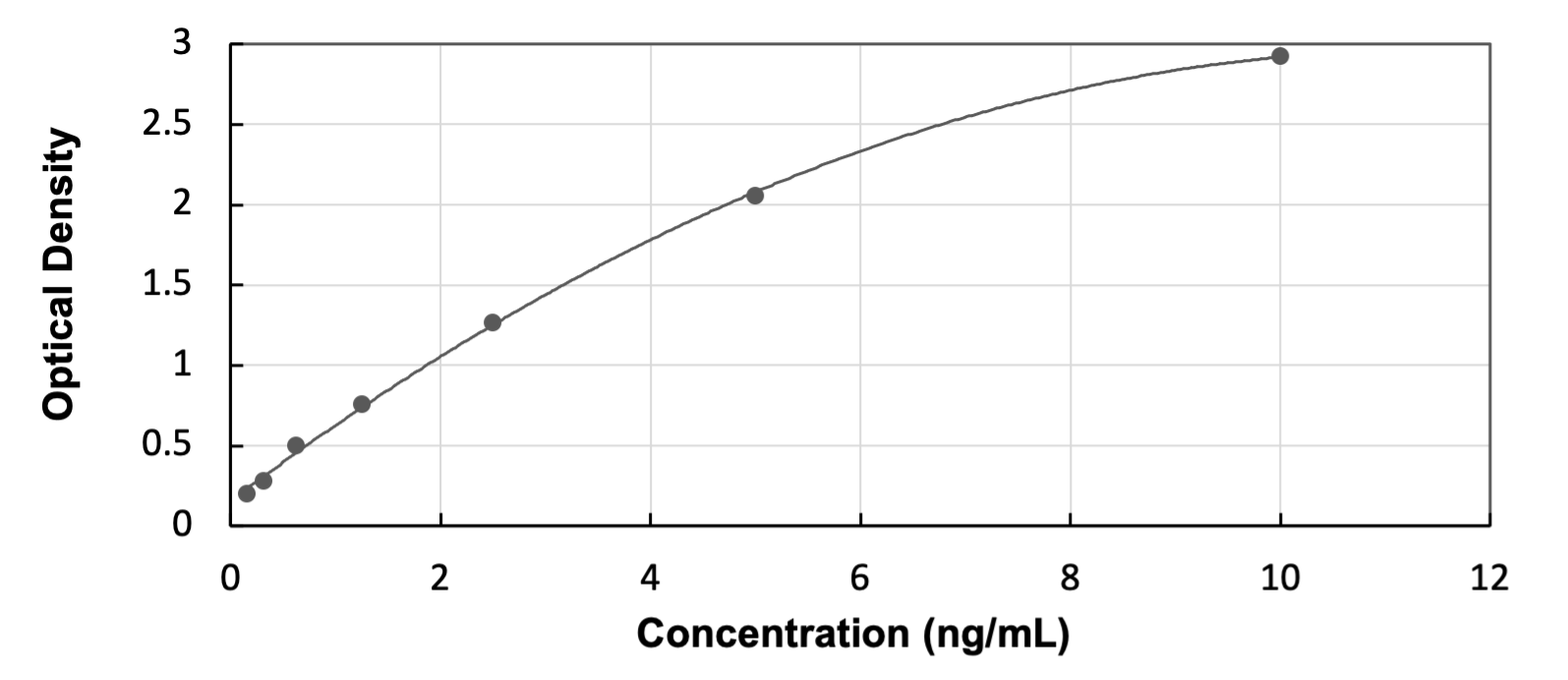
ELISA: Human CCR7 - Ready-To-Use ELISA Kit (Colorimetric) [NBP3-31223] -
ELISA: Human CCR7 - Ready-To-Use ELISA Kit (Colorimetric) [NBP3-31223] - Standard Curve ReferenceKit Contents for Human CCR7 - Ready-To-Use ELISA Kit (Colorimetric)
- Detection Solution A
- Detection Solution B
- Instruction manual
- Plate sealer for 96 wells
- Pre-coated 96T strip plate
- Standard
- Standard Diluent
- Stop Solution
- TMB Substrate
- Wash Buffer (30 x concentrate)
Preparation and Storage
Shipping
The product is shipped with polar packs. Upon receipt, store it immediately at the temperature recommended below.
Stability & Storage
Storage of components varies. See protocol for specific instructions.
Background: CCR7
The primary role of the CCR7/CCL19/CCL21 chemokine signaling axis is homing T cells and DCs to lymph nodes and lymphoid tissues to initiate an immune response (1,2,5,6). In the context of cancer, the CCR7 signaling axis appears to have two opposing roles (2). Downregulation of CCR7 on CD8+ T cells contributes to effector cell migration and anti-cancer activities via cytotoxic tumor-infiltrating lymphocytes (2). However, upregulation of CCR7 by cancer cells can result in cancer cell migration and metastasis (2). Overexpression of CCR7 has been implicated in a variety of cancers including breast, cervical, gastric, head and neck cell carcinoma, and prostate (1,2,7). Studies in breast cancer have found that hypoxia increases CCR7 expression, and this activation can affect cancer cell invasion, extravasation, proliferation, angiogenesis, and metastasis through induction of multiple signaling transduction pathways such as PI3K/AKT, MAPK, and JAK/STAT (5,7).
Given its important role in inflammation and immune response, several strategies have been employed to target the CCR7 signaling axis for cancer immunotherapy (2). Some cancer immunotherapies under investigation include intra-tumoral administration of CCL19 and CCL21, introduction of patient-derived cells transfected to express CCR7 or its ligands, and vaccines (2). Further interrogation of CCR7/CCL19/CCL21 signaling axis is required to develop better therapeutic strategies for cancer treatment.
References:
1. Comerford, I., Harata-Lee, Y., Bunting, M. D., Gregor, C., Kara, E. E., & McColl, S. R. (2013). A myriad of functions and complex regulation of the CCR7/CCL19/CCL21 chemokine axis in the adaptive immune system. Cytokine & growth factor reviews, 24(3), 269-283. https://doi.org/10.1016/j.cytogfr.2013.03.001
2. Salem, A., Alotaibi, M., Mroueh, R., Basheer, H. A., & Afarinkia, K. (2021). CCR7 as a therapeutic target in Cancer. Biochimica et biophysica acta. Reviews on cancer, 1875(1), 188499. https://doi.org/10.1016/j.bbcan.2020.188499
3. Yan, Y., Chen, R., Wang, X., Hu, K., Huang, L., Lu, M., & Hu, Q. (2019). CCL19 and CCR7 Expression, Signaling Pathways, and Adjuvant Functions in Viral Infection and Prevention. Frontiers in cell and developmental biology, 7, 212. https://doi.org/10.3389/fcell.2019.00212
4. Uniprot (P32248)
5. Korbecki, J., Grochans, S., Gutowska, I., Barczak, K., & Baranowska-Bosiacka, I. (2020). CC Chemokines in a Tumor: A Review of Pro-Cancer and Anti-Cancer Properties of Receptors CCR5, CCR6, CCR7, CCR8, CCR9, and CCR10 Ligands. International journal of molecular sciences, 21(20), 7619. https://doi.org/10.3390/ijms21207619
6. Sanchez-Sanchez, N., Riol-Blanco, L., & Rodriguez-Fernandez, J. L. (2006). The multiple personalities of the chemokine receptor CCR7 in dendritic cells. Journal of immunology (Baltimore, Md. : 1950), 176(9), 5153-5159. https://doi.org/10.4049/jimmunol.176.9.5153
7. Rizeq, B., & Malki, M. I. (2020). The Role of CCL21/CCR7 Chemokine Axis in Breast Cancer Progression. Cancers, 12(4), 1036. https://doi.org/10.3390/cancers12041036
Alternate Names
BLR2, CC-CKR-7, CCR7, CD197, CDw197, CMKBR7, EBI1
Gene Symbol
CCR7
Additional CCR7 Products
Product Documents for Human CCR7 - Ready-To-Use ELISA Kit (Colorimetric)
Certificate of Analysis
To download a Certificate of Analysis, please enter a lot or batch number in the search box below.
Product Specific Notices for Human CCR7 - Ready-To-Use ELISA Kit (Colorimetric)
This product is for research use only and is not approved for use in humans or in clinical diagnosis. ELISA Kits are guaranteed for 6 months from date of receipt.
Customer Reviews for Human CCR7 - Ready-To-Use ELISA Kit (Colorimetric)
There are currently no reviews for this product. Be the first to review Human CCR7 - Ready-To-Use ELISA Kit (Colorimetric) and earn rewards!
Have you used Human CCR7 - Ready-To-Use ELISA Kit (Colorimetric)?
Submit a review and receive an Amazon gift card!
$25/€18/£15/$25CAN/¥2500 for a review with an image
$10/€7/£6/$10CAN/¥1110 for a review without an image
Submit a review
Protocols
Find general support by application which include: protocols, troubleshooting, illustrated assays, videos and webinars.
- ELISA Sample Preparation & Collection Guide
- ELISA Troubleshooting Guide
- How to Run an R&D Systems DuoSet ELISA
- How to Run an R&D Systems Quantikine ELISA
- How to Run an R&D Systems Quantikine™ QuicKit™ ELISA
- Quantikine HS ELISA Kit Assay Principle, Alkaline Phosphatase
- Quantikine HS ELISA Kit Principle, Streptavidin-HRP Polymer
- Sandwich ELISA (Colorimetric) – Biotin/Streptavidin Detection Protocol
- Sandwich ELISA (Colorimetric) – Direct Detection Protocol
- Troubleshooting Guide: ELISA
- View all Protocols, Troubleshooting, Illustrated assays and Webinars


