
Rat CD4 Fluorescein‑conjugated Antibody

R&D Systems | Catalog # FAB65771F

R&D Systems
Loading...

Key Product Details

Species Reactivity

Rat

Applications

Flow Cytometry

Label

Fluorescein (Excitation = 488 nm, Emission = 515-545 nm)

Antibody Source

Monoclonal Mouse IgG2B Clone # OX38
Loading...

Product Specifications

Immunogen

MLR generated rat T cells

Specificity

Recognizes the rat CD4 cell surface antigen expressed by T helper cells, monocytes and macrophages. Clone OX38 competes for binding with clone W3/25.

Clonality

Monoclonal

Host

Mouse

Isotype

IgG2B

Scientific Data Images for Rat CD4 Fluorescein‑conjugated Antibody

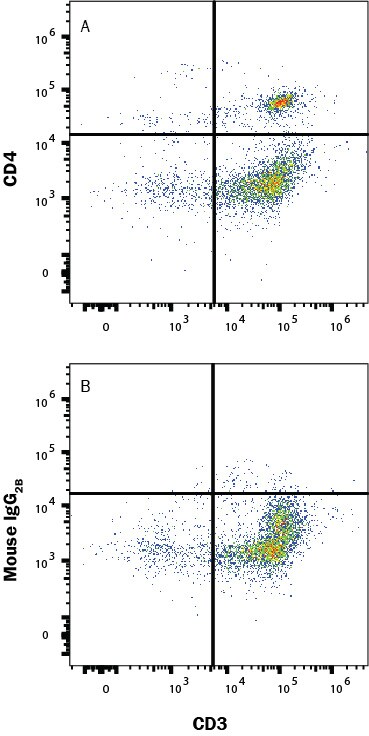
Detection of CD4 in Rat splenocytes cells by Flow Cytometry.

Rat splenocytes were stained with CD3 APC and either (A) Mouse Anti-Rat CD4 Fluorescein‑conjugated Monoclonal Antibody (Catalog # FAB65771F) or (B) Mouse IgG2B Fluorescein Isotype Control (Catalog # IC0041F). View our protocol for Staining Membrane-associated Proteins.

Applications for Rat CD4 Fluorescein‑conjugated Antibody

Application
Recommended Usage

Flow Cytometry

Titration recommended for optimal concentration with starting range of 0.1-1 µg/1 million cells. Sample used for this experiment was Rat splenocytes

Spectra Viewer

Plan Your Experiments

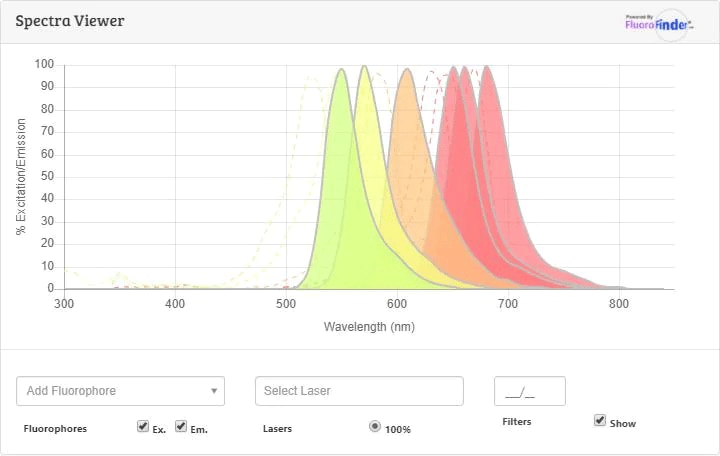
Use our spectra viewer to interactively plan your experiments, assessing multiplexing options. View the excitation and emission spectra for our fluorescent dye range and other commonly used dyes.

Spectra Viewer

Flow Cytometry Panel Builder

Bio-Techne Knows Flow Cytometry

Save time and reduce costly mistakes by quickly finding compatible reagents using the Panel Builder Tool.

Advanced Features

  • Spectra Viewer - Custom analysis of spectra from multiple fluorochromes
  • Spillover Popups - Visualize the spectra of individual fluorochromes
  • Antigen Density Selector - Match fluorochrome brightness with antigen density
Build Your Panel Now

Formulation, Preparation, and Storage

Purification

Protein A or G purified from hybridoma culture supernatant

Formulation

Supplied in a saline solution containing BSA and Sodium Azide.

Shipping

The product is shipped with polar packs. Upon receipt, store it immediately at the temperature recommended below.

Stability & Storage

Protect from light. Do not freeze.
  • 12 months from date of receipt, 2 to 8 °C as supplied.

Background: CD4

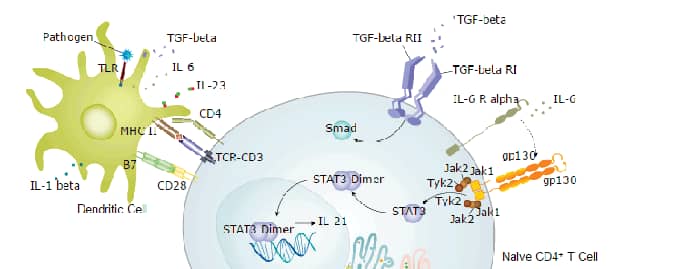
CD4 (cluster of differentiation 4), also known as L3T4 or T4, is a 55 kDa single chain type I transmembrane glycoprotein belonging to the immunoglobin (Ig) superfamily. CD4 is predominantly expressed on most thymocytes, a subset of mature T lymphocytes, and weakly on monocytes, tissue macrophages, dendritic cells, and granulocytes. It is also expressed on neurons and glial cells in the brain (1). CD4 is expressed along with CD8 on double positive T cells during their development in the thymus. Either CD4 or CD8 expression is then lost giving rise to single positive (SP) CD4+ or CD8+ mature T cells. CD4+ SP cells (T helper cells) further differentiate into multiple subsets of CD4+ cells including Th1, Th2, Th17, Tfh, and Treg cells which regulate humoral and cellular immunity (2). The extracellular region of CD4 consists of 372 amino acids (aa) with four immunoglobin-like domains (D1-D4). The structures of D1 and D3 resemble variable (IgV) domains while D2 and D4 resemble constant (IgC) domains (3).

Given its critical role in T cell development, CD4 also has diverse immunology-related functions. CD4 acts as a coreceptor with the T-cell receptor (TCR) during T cell activation and thymic differentiation by binding directly to major histocompatibility complex (MHC) class II antigens and associating with the protein tyrosine kinase, Lck (4). This interaction contributes to the formation of the immunological synapse (5). Defects in antigen presentation cause dysfunction of CD4+ T cells and the almost complete loss of MHC II expression on B cells in peripheral blood, as observed in severe combined immunodeficiency (SCID) (6). CD4 also functions as a receptor for the human immunodeficiency virus (HIV) by binding to gp120, the envelope glycoprotein of HIV‑1. It has been shown that the V-like domains are critical for binding to gp120 (7). In immune mediated and infectious diseases of the central nervous system, CD4 functions as an indirect mediator of neuronal damage (8).

References

  1. Omri, B. Crisanti, P. Alliot, F. Marty, M. Rutin, J. Levallois, C. Pessac, B. (1994). CD4 expression in neurons of the central nervous system. International Immunology, 6(3):377. doi:10.1093/intimm/6.3.377.
  2. Wan, Y.Y. & Flavell, R.A. (2009). How diverse-CD4 effector T cells and their functions. Journal of Molecular Cell Biology, 1(1):20-36. doi:10.1093/jmcb/mjp001.
  3. Wu, H. Myszka, D. G. Tendian, S.W. Brouillette, C.G. Sweet, R.W. Chaiken, I.M. & Hendrickson, W.A. (1996). Kinetic and structural analysis of mutant CD4 receptors that are defective in HIV gp120 binding. Proceedings of the National Academy of Sciences, 93(26):15030. doi:10.1073/pnas.93.26.15030.
  4. Doyle, C. & Strominger, J.L. (1987). Interaction between CD4 and class II MHC molecules mediates cell adhesion. Nature, 330:256. doi:10.1038/330256a0.
  5. Vignali, D.A. (2010). CD4 on the road to coreceptor status. The Journal of Immunology, 184(11):5933-5934. doi:10.4049/jimmunol.1090037.
  6. Tasher, D. & Dalal, I. (2012). The genetic basis of severe combined immunodeficiency and its variants. The Application of Clinical Genetics, 5:67-80. doi:10.2147/tacg.s18693.
  7. Arthos, J. Deen, K.C. Chaikin, M.A. Fornwald, J.A. Sathe, G. Sattentau, Q.J. Sweet, R.W. (1989). Identification of the residues in human CD4 critical for the binding of HIV. Cell, 57(3):469. doi:10.1016/0092-8674(89)90922-7.
  8. Buttini, M. Westland, C.E. Masliah, E. Yafeh, A.M. Wyss-Coray, T. Mucke, L. (1998). Novel role of human cd4 molecule identified in neurodegeneration. Nature Medicine, 4(4):441. doi:10.1038/nm0498-441.

Alternate Names

CD4

Entrez Gene IDs

920 (Human); 12504 (Mouse); 24932 (Rat); 403931 (Canine); 101864991 (Cynomolgus Monkey); 493775 (Feline)

Gene Symbol

CD4

Additional CD4 Products

Product Documents for Rat CD4 Fluorescein‑conjugated Antibody

Certificate of Analysis

To download a Certificate of Analysis, please enter a lot or batch number in the search box below.

Note: Certificate of Analysis not available for kit components.

Product Specific Notices for Rat CD4 Fluorescein‑conjugated Antibody

For research use only

Customer Reviews for Rat CD4 Fluorescein‑conjugated Antibody

There are currently no reviews for this product. Be the first to review Rat CD4 Fluorescein‑conjugated Antibody and earn rewards!

Have you used Rat CD4 Fluorescein‑conjugated Antibody?

Submit a review and receive an Amazon gift card!

$25/€18/£15/$25CAN/¥2500 Yen for a review with an image

$10/€7/£6/$10CAN/¥1110 Yen for a review without an image

Submit a review
Amazon Gift Card

FAQs

No product specific FAQs exist for this product.

View all FAQs for Antibodies