CD8 Antibody (BLR173J)
Novus Biologicals | Catalog # NBP3-14746
Recombinant Monoclonal Antibody

![Western Blot: CD8 Antibody (BLR173J) [NBP3-14746]](https://resources.rndsystems.com/images/products/CD8-Antibody-BLR173J-Western-Blot-NBP3-14746-img0003.jpg "Western Blot: CD8 Antibody (BLR173J) [NBP3-14746]")
Loading...
Key Product Details
Species Reactivity
Mouse
Applications
Immunohistochemistry, Immunohistochemistry-Paraffin, Western Blot, Immunoprecipitation
Label
Unconjugated
Antibody Source
Recombinant Monoclonal Rabbit Clone # BLR173J
Loading...
Product Specifications
Immunogen
residues 28-194 (ECD)
Clonality
Monoclonal
Host
Rabbit
Scientific Data Images for CD8 Antibody (BLR173J)
Western Blot: CD8 Antibody (BLR173J) [NBP3-14746]
Western Blot: CD8 Antibody (BLR173J) [NBP3-14746] - Rabbit anti-CD8 alpha recombinant monoclonal antibodody. Secondary: HRP-conjugated goat anti-rabbit IgG.![Immunohistochemistry: CD8 Antibody (BLR173J) [NBP3-14746]](https://resources.rndsystems.com/images/products/CD8-Antibody-BLR173J-Immunohistochemistry-NBP3-14746-img0002.jpg "Immunohistochemistry: CD8 Antibody (BLR173J) [NBP3-14746]")
Immunohistochemistry: CD8 Antibody (BLR173J) [NBP3-14746]
Immunohistochemistry: CD8 Antibody (BLR173J) [NBP3-14746] - Rabbit anti-CD8 alpha recombinant monoclonal antibody. Secondary HRP-conjugated goat anti-rabbit IgG (A120-501P).![Immunohistochemistry: CD8 Antibody (BLR173J) [NBP3-14746]](https://resources.rndsystems.com/images/products/CD8-Antibody-BLR173J-Immunohistochemistry-NBP3-14746-img0001.jpg "Immunohistochemistry: CD8 Antibody (BLR173J) [NBP3-14746]")
Immunohistochemistry: CD8 Antibody (BLR173J) [NBP3-14746]
Immunohistochemistry: CD8 Antibody (BLR173J) [NBP3-14746] - Rabbit anti-CD8 alpha recombinant monoclonal antibody.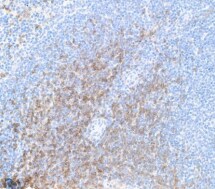
Immunohistochemistry: CD8 Antibody (BLR173J) [NBP3-14746] -
Immunohistochemistry: CD8 Antibody (BLR173J) [NBP3-14746] - Rabbit anti-CD8 alpha recombinantmonoclonal antibody [BLR173J]. Secondary: HRP-conjugated goat anti-rabbit IgG. Substrate: DAB.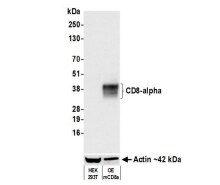
Western Blot: CD8 Antibody (BLR173J) [NBP3-14746] -
Western Blot: CD8 Antibody (BLR173J) [NBP3-14746] - Whole cell lysate (50 µg) from HEK293f and HEK293f overexpressing mouse CD8a cells prepared using NETN lysisbuffer. Antibody: Rabbit anti-CD8-alpha recombinantmonoclonal antibody [BLR173J] used at1:1000. Secondary: HRP-conjugated goat anti-rabbit IgG.Chemiluminescence with an exposure timeof 1 second. Lower Panel: Rabbit anti-Actin recombinantmonoclonal antibody [BLR057F.Applications for CD8 Antibody (BLR173J)
Application
Recommended Usage
Immunohistochemistry
1:100 to 1:500
Immunohistochemistry-Paraffin
1:100 to 1:500
Immunoprecipitation
12 µl/1 mg lysate
Western Blot
1:1000
Application Notes
Epitope retrieval with citrate buffer pH6.0 is recommended for FFPE tissue sections.
Formulation, Preparation, and Storage
Purification
>95%
Formulation
Borate Buffered Saline (BBS) pH 8.2 with 0.1% BSA and
Preservative
0.09% Sodium Azide
Concentration
Please see the vial label for concentration. If unlisted please contact technical services.
Shipping
The product is shipped with polar packs. Upon receipt, store it immediately at the temperature recommended below.
Stability & Storage
Store at 2 - 8 C / 1 year from date of receipt
Background: CD8
Given its role in the immune system, CD8-deficiency in T-cells is a hallmark of many diseases and pathologies (8-10). Specifically, CD8+ T-cell deficiency is prevalent in chronic autoimmune diseases including multiple sclerosis, rheumatoid arthritis, ulcerative colitis, Crohn's disease, type 1 diabetes mellitus, and Graves' disease (8). Furthermore, cancers or chronic infection can lead to CD8 T-cell exhaustion as the continual antigen presentation and inflammatory signals eventually cause the CD8+ T-cells to lose functionality (9, 10). However, animal models and clinical studies have suggested that T-cells are capable of being reinvigorated using inhibitory receptor blockade resulting in better disease outcomes and these exhausted T-cells may be a potential therapeutic target (9, 10).
Alternative names for CD8 includes CD antigen: CD8a, CD8 antigen, alpha polypeptide (p32), CD8a molecule, CD8A, Leu2 T-lymphocyte antigen, LEU2, MAL, OKT8 T-cell antigen, p32, T cell co-receptor, T8 T-cell antigen, T-cell antigen Leu2, T-cell surface glycoprotein CD8 alpha chain, and T-lymphocyte differentiation antigen T8/Leu-2.
References
1. Littman D. R. (1987). The structure of the CD4 and CD8 genes. Annual review of immunology. https://doi.org/10.1146/annurev.iy.05.040187.003021
2. Naeim F. (2008). Chapter 2- Principles of Immunophenotyping. Hematopathology. https://doi.org/10.1016/B978-0-12-370607-2.00002-8.
3. Gao, G. F., & Jakobsen, B. K. (2000). Molecular interactions of coreceptor CD8 and MHC class I: the molecular basis for functional coordination with the T-cell receptor. Immunology today. https://doi.org/10.1016/s0167-5699(00)01750-3
4. UniProt (P01732)
5. UniProt (P01731)
6. Kappes D. J. (2007). CD4 and CD8: hogging all the Lck. Immunity. https://doi.org/10.1016/j.immuni.2007.11.002
7. Gangadharan, D., & Cheroutre, H. (2004). The CD8 isoform CD8alphaalpha is not a functional homologue of the TCR co-receptor CD8alphabeta. Current opinion in immunology. https://doi.org/10.1016/j.coi.2004.03.015
8. Pender M. P. (2012). CD8+ T-Cell Deficiency, Epstein-Barr Virus Infection, Vitamin D Deficiency, and Steps to Autoimmunity: A Unifying Hypothesis. Autoimmune diseases. https://doi.org/10.1155/2012/189096
9. Kurachi M. (2019). CD8+ T cell exhaustion. Seminars in immunopathology. https://doi.org/10.1007/s00281-019-00744-5
10. Hashimoto, M., Kamphorst, A. O., Im, S. J., Kissick, H. T., Pillai, R. N., Ramalingam, S. S., Araki, K., & Ahmed, R. (2018). CD8 T Cell Exhaustion in Chronic Infection and Cancer: Opportunities for Interventions. Annual review of medicine. https://doi.org/10.1146/annurev-med-012017-043208
Alternate Names
CD8, CD8A
Gene Symbol
CD8A
Additional CD8 Products
Product Documents for CD8 Antibody (BLR173J)
Certificate of Analysis
To download a Certificate of Analysis, please enter a lot or batch number in the search box below.
Product Specific Notices for CD8 Antibody (BLR173J)
This product is for research use only and is not approved for use in humans or in clinical diagnosis. Primary Antibodies are guaranteed for 1 year from date of receipt.
Customer Reviews for CD8 Antibody (BLR173J)
There are currently no reviews for this product. Be the first to review CD8 Antibody (BLR173J) and earn rewards!
Have you used CD8 Antibody (BLR173J)?
Submit a review and receive an Amazon gift card!
$25/€18/£15/$25CAN/¥2500 Yen for a review with an image
$10/€7/£6/$10CAN/¥1110 Yen for a review without an image
Submit a review
Protocols
Find general support by application which include: protocols, troubleshooting, illustrated assays, videos and webinars.
- Antigen Retrieval Protocol (PIER)
- Antigen Retrieval for Frozen Sections Protocol
- Appropriate Fixation of IHC/ICC Samples
- Cellular Response to Hypoxia Protocols
- Chromogenic IHC Staining of Formalin-Fixed Paraffin-Embedded (FFPE) Tissue Protocol
- Chromogenic Immunohistochemistry Staining of Frozen Tissue
- ClariTSA™ Fluorophore Kits
- Detection & Visualization of Antibody Binding
- Fluorescent IHC Staining of Frozen Tissue Protocol
- Graphic Protocol for Heat-induced Epitope Retrieval
- Graphic Protocol for the Preparation and Fluorescent IHC Staining of Frozen Tissue Sections
- Graphic Protocol for the Preparation and Fluorescent IHC Staining of Paraffin-embedded Tissue Sections
- Graphic Protocol for the Preparation of Gelatin-coated Slides for Histological Tissue Sections
- IHC Sample Preparation (Frozen sections vs Paraffin)
- Immunofluorescent IHC Staining of Formalin-Fixed Paraffin-Embedded (FFPE) Tissue Protocol
- Immunohistochemistry (IHC) and Immunocytochemistry (ICC) Protocols
- Immunohistochemistry Frozen Troubleshooting
- Immunohistochemistry Paraffin Troubleshooting
- Immunoprecipitation Protocol
- Preparing Samples for IHC/ICC Experiments
- Preventing Non-Specific Staining (Non-Specific Binding)
- Primary Antibody Selection & Optimization
- Protocol for Heat-Induced Epitope Retrieval (HIER)
- Protocol for Making a 4% Formaldehyde Solution in PBS
- Protocol for VisUCyte™ HRP Polymer Detection Reagent
- Protocol for the Preparation & Fixation of Cells on Coverslips
- Protocol for the Preparation and Chromogenic IHC Staining of Frozen Tissue Sections
- Protocol for the Preparation and Chromogenic IHC Staining of Frozen Tissue Sections - Graphic
- Protocol for the Preparation and Chromogenic IHC Staining of Paraffin-embedded Tissue Sections
- Protocol for the Preparation and Chromogenic IHC Staining of Paraffin-embedded Tissue Sections - Graphic
- Protocol for the Preparation and Fluorescent IHC Staining of Frozen Tissue Sections
- Protocol for the Preparation and Fluorescent IHC Staining of Paraffin-embedded Tissue Sections
- Protocol for the Preparation of Gelatin-coated Slides for Histological Tissue Sections
- R&D Systems Quality Control Western Blot Protocol
- TUNEL and Active Caspase-3 Detection by IHC/ICC Protocol
- The Importance of IHC/ICC Controls
- Troubleshooting Guide: Immunohistochemistry
- Troubleshooting Guide: Western Blot Figures
- Western Blot Conditions
- Western Blot Protocol
- Western Blot Protocol for Cell Lysates
- Western Blot Troubleshooting
- Western Blot Troubleshooting Guide
- View all Protocols, Troubleshooting, Illustrated assays and Webinars