
CENPQ Antibody - BSA Free
Novus Biologicals | Catalog # NBP1-42740

![Western Blot: CENPQ Antibody [NBP1-42740]](https://resources.rndsystems.com/images/products/CENPQ-Antibody-Western-Blot-NBP1-42740-img0005.jpg "Western Blot: CENPQ Antibody [NBP1-42740]")
Loading...
Key Product Details
Validated by
Knockout/Knockdown
Species Reactivity
Human
Applications
Western Blot, ELISA, Immunocytochemistry/ Immunofluorescence, Knockdown Validated
Label
Unconjugated
Antibody Source
Polyclonal Rabbit IgG
Format
BSA Free
Loading...
Product Specifications
Immunogen
This protein A purified CENPQ Antibody was prepared from whole rabbit serum produced by repeated immunizations with full-length human CENPQ recombinant protein. (Uniprot: Q7L2Z9)
Reactivity Notes
A BLAST analysis of the full length sequence was used to suggest partial cross-reactivity with CENPQ based on the following percentage homologies: macaque (91%), horse (76%), bovine (74%), dog (73%), swine (71%), mouse (65%) and rat (60%). Cross-reactivity with CENPQ from other sources has not been determined.
Clonality
Polyclonal
Host
Rabbit
Isotype
IgG
Description
This product was protein A purified from monospecific antiserum by immunoaffinity chromatography using protein A coupled to agarose beads
Store vial at -20C prior to opening. Aliquot contents and freeze at -20C or below for extended storage. Avoid cycles of freezing and thawing. Centrifuge product if not completely clear after standing at room temperature. This product is stable for several weeks at 4C as an undiluted liquid. Dilute only prior to immediate use.
Store vial at -20C prior to opening. Aliquot contents and freeze at -20C or below for extended storage. Avoid cycles of freezing and thawing. Centrifuge product if not completely clear after standing at room temperature. This product is stable for several weeks at 4C as an undiluted liquid. Dilute only prior to immediate use.
Scientific Data Images for CENPQ Antibody - BSA Free
Western Blot: CENPQ Antibody [NBP1-42740]
Western Blot: CENPQ Antibody [NBP1-42740] - Lane 1: Lysates from HeLa cells transfected with control sh-virus. Lane 2: Lysates from HeLa cells transfected with Cenp-Q sh-virus.![Immunocytochemistry/ Immunofluorescence: CENPQ Antibody [NBP1-42740]](https://resources.rndsystems.com/images/products/CENPQ-Antibody-Immunocytochemistry-Immunofluorescence-NBP1-42740-img0003.jpg "Immunocytochemistry/ Immunofluorescence: CENPQ Antibody [NBP1-42740]")
Immunocytochemistry/ Immunofluorescence: CENPQ Antibody [NBP1-42740]
Immunocytochemistry/Immunofluorescence: CENPQ Antibody [NBP1-42740] - Analysis of endogenous CENP-Q in HeLa whole cell lysate. Primary antibody was used at 1:100 followed by secondary antibody diluted 1:150. Red punctate anti-CENP-Q signal colocalizes in overlay images with green punctate anti-CREST signals at the kinetochores (attached points of sister chromatids). Visible are colocalized CENP-Q and CREST signal at various stages of the cell cycle as indicated from interphase to the end of mitosis. Nuclei are counter stained with bisbenzimide.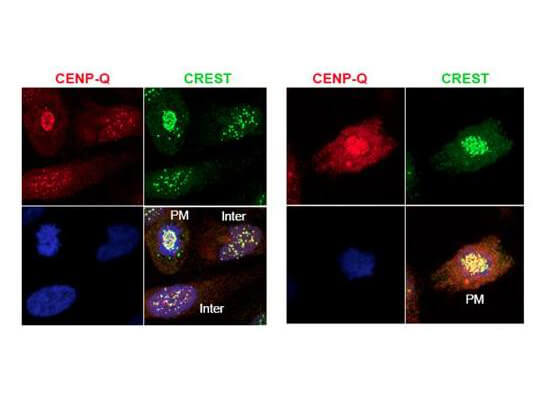
CENPQ Antibody
Immunofluorescence microscopy using protein A purified anti-CENP-Q antibody shows detection of endogenous CENP-Q in HeLa whole cell lysate. Primary antibody was used at 1:100 followed by secondary antibody diluted 1:150. Red punctate anti-CENP-Q signal colocalizes in overlay images with green punctate anti-CREST signals at the kinetochores (attached points of sister chromatids). Visible are colocalized CENP-Q and CREST signal at various stages of the cell cycle as indicated from interphase to the end of mitosis. Nuclei are counter stained with bisbenzimide. Personal Communication, Kyung S. Lee, CCR-NCI, Bethesda, MD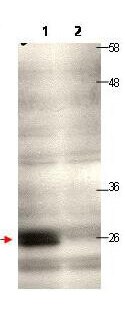
CENPQ Antibody
Western blot using protein A purified anti-CENP-Q antibody shows detection of endogenous CENP-Q in a HeLa whole cell lysate (lane 1, arrowhead). The blot was incubated for 1.5 hours at room temperature using the primary antibody diluted to 0.5ug/mL, followed by washes and incubation with to the secondary antibody. Lane 1: Lysates from HeLa cells transfected with control sh-virus wherein the expression of CENP-Q is expected to not to alter. Lane 2: Lysates from HeLa cells transfected with Cenp-Q sh-virus wherein the expression of CENP-Q is knocked down significantly to a level where it is not being detected at all under the tested condition/WB exposure time. Personal Communication, Kyung S. Lee, CCR-NCI, Bethesda, MD.Applications for CENPQ Antibody - BSA Free
Application
Recommended Usage
ELISA
1:5000-1:20000
Immunocytochemistry/ Immunofluorescence
1:10-1:500
Western Blot
1:100-1:500
Application Notes
This protein A purified antibody has been tested for use in ELISA, immunofluorescence microscopy and western blotting. Specific conditions for reactivity should be optimized by the end user. Expect a band approximately 26-31 kDa in size corresponding to human CENP-Q by western blotting in the appropriate cell lysate or extract.
Formulation, Preparation, and Storage
Purification
Protein A purified
Formulation
0.02 M Potassium Phosphate, 0.15 M Sodium Chloride, pH 7.2
Format
BSA Free
Preservative
0.01% Sodium Azide
Concentration
Please see the vial label for concentration. If unlisted please contact technical services.
Shipping
The product is shipped with polar packs. Upon receipt, store it immediately at the temperature recommended below.
Stability & Storage
Store at -20C short term. Aliquot and store at -80C long term. Avoid freeze-thaw cycles.
Background: CENPQ
Alternate Names
C6orf139, CENP-QFLJ10545, centromere protein Q, chromosome 6 open reading frame 139
Entrez Gene IDs
55166 (Human)
Gene Symbol
CENPQ
UniProt
Additional CENPQ Products
Product Documents for CENPQ Antibody - BSA Free
Certificate of Analysis
To download a Certificate of Analysis, please enter a lot or batch number in the search box below.
Product Specific Notices for CENPQ Antibody - BSA Free
This product is for research use only and is not approved for use in humans or in clinical diagnosis. Primary Antibodies are guaranteed for 1 year from date of receipt.
Customer Reviews for CENPQ Antibody - BSA Free
There are currently no reviews for this product. Be the first to review CENPQ Antibody - BSA Free and earn rewards!
Have you used CENPQ Antibody - BSA Free?
Submit a review and receive an Amazon gift card!
$25/€18/£15/$25CAN/¥2500 Yen for a review with an image
$10/€7/£6/$10CAN/¥1110 Yen for a review without an image
Submit a review
Protocols
Find general support by application which include: protocols, troubleshooting, illustrated assays, videos and webinars.
- Appropriate Fixation of IHC/ICC Samples
- Cellular Response to Hypoxia Protocols
- ClariTSA™ Fluorophore Kits
- Detection & Visualization of Antibody Binding
- ELISA Sample Preparation & Collection Guide
- ELISA Troubleshooting Guide
- How to Run an R&D Systems DuoSet ELISA
- How to Run an R&D Systems Quantikine ELISA
- How to Run an R&D Systems Quantikine™ QuicKit™ ELISA
- ICC Cell Smear Protocol for Suspension Cells
- ICC Immunocytochemistry Protocol Videos
- ICC for Adherent Cells
- Immunocytochemistry (ICC) Protocol
- Immunocytochemistry Troubleshooting
- Immunofluorescence of Organoids Embedded in Cultrex Basement Membrane Extract
- Immunohistochemistry (IHC) and Immunocytochemistry (ICC) Protocols
- Preparing Samples for IHC/ICC Experiments
- Preventing Non-Specific Staining (Non-Specific Binding)
- Primary Antibody Selection & Optimization
- Protocol for VisUCyte™ HRP Polymer Detection Reagent
- Protocol for the Fluorescent ICC Staining of Cell Smears - Graphic
- Protocol for the Fluorescent ICC Staining of Cultured Cells on Coverslips - Graphic
- Protocol for the Preparation and Fluorescent ICC Staining of Cells on Coverslips
- Protocol for the Preparation and Fluorescent ICC Staining of Non-adherent Cells
- Protocol for the Preparation and Fluorescent ICC Staining of Stem Cells on Coverslips
- Protocol for the Preparation of a Cell Smear for Non-adherent Cell ICC - Graphic
- Quantikine HS ELISA Kit Assay Principle, Alkaline Phosphatase
- Quantikine HS ELISA Kit Principle, Streptavidin-HRP Polymer
- R&D Systems Quality Control Western Blot Protocol
- Sandwich ELISA (Colorimetric) – Biotin/Streptavidin Detection Protocol
- Sandwich ELISA (Colorimetric) – Direct Detection Protocol
- TUNEL and Active Caspase-3 Detection by IHC/ICC Protocol
- The Importance of IHC/ICC Controls
- Troubleshooting Guide: ELISA
- Troubleshooting Guide: Western Blot Figures
- Western Blot Conditions
- Western Blot Protocol
- Western Blot Protocol for Cell Lysates
- Western Blot Troubleshooting
- Western Blot Troubleshooting Guide
- View all Protocols, Troubleshooting, Illustrated assays and Webinars
Loading...