
Cre Antibody - BSA Free
Novus Biologicals | Catalog # NB100-56134

![Western Blot: Cre Antibody [NB100-56134]](https://resources.rndsystems.com/images/products/Cre-Antibody-Western-Blot-NB100-56134-img0005.jpg "Western Blot: Cre Antibody [NB100-56134]")
Key Product Details
Species Reactivity
Validated:
Cited:
Applications
Validated:
Cited:
Label
Antibody Source
Format
Product Specifications
Immunogen
Reactivity Notes
Clonality
Host
Isotype
Theoretical MW
Disclaimer note: The observed molecular weight of the protein may vary from the listed predicted molecular weight due to post translational modifications, post translation cleavages, relative charges, and other experimental factors.
Scientific Data Images for Cre Antibody - BSA Free
Western Blot: Cre Antibody [NB100-56134]
Western Blot: Cre Antibody - Unpurified [NB100-56134] - Lane 1: wild-type mouse (negative control). Lanes 2 and 3: brain from 2 types of Cre transgenic mice. Lane 4: recombinant Cre (positive control). Full-length Cre is detected at ~36-38 kDa. The lower molecular weight bands in lane 4 are breakdown products from the recombinant Cre protein.![Immunohistochemistry: Cre Antibody [NB100-56134]](https://resources.rndsystems.com/images/products/Cre-Antibody-Immunohistochemistry-NB100-56134-img0004.jpg "Immunohistochemistry: Cre Antibody [NB100-56134]")
Immunohistochemistry: Cre Antibody [NB100-56134]
Immunohistochemistry: Cre Antibody - Unpurified [NB100-56134] - Cre Antibody [NB100-56134] - Analysis of Cre in a FFPE tissue section from the hippocampus of a Cre transgenic mouse at 1:2000. In this mouse line, Cre is expressed in the brain, predominantly in the nuclei of most types of neurons. Hematoxylin-eosin counterstain. A1 is a higher magnification of A.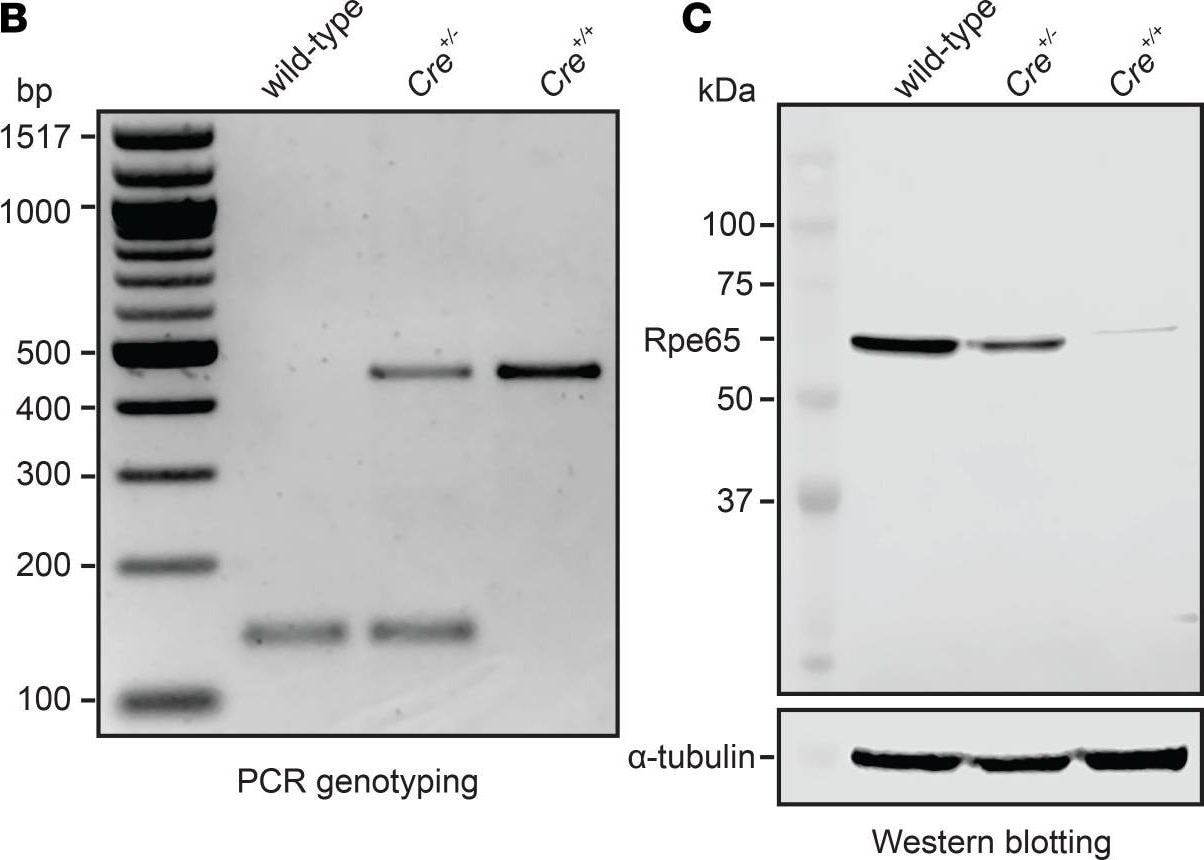
Western Blot: Cre Antibody [NB100-56134] -
Western Blot: Cre Antibody [NB100-56134] - Generation, identification, & Rpe65 expression analysis of Rpe65CreERT2 mice.(A) KI strategy to introduce a P2A-CreERT2 coding sequence in-frame with the final coding exon (exon 14) of the Rpe65 gene. Primer-binding sites & expected PCR product sizes are shown below the wild-type & targeted alleles. The neomycin cassette in the targeting vector was removed during expansion of the embryonic stem cell clone. FLP-recombinase was subsequently bred out by crossing with C57BL/6 mice. The KI allele allows cotranslational expression of RPE65-P2A & CreERT2 as 2 separate polypeptides. The modified RPE65 protein contains an additional G534SGATNFSLLKQAGDVEENPG554 polypeptide sequence at its C-terminus, while CreERT2 contains an additional Pro residue at its N-terminus. (B) Genotyping results from wild-type, Cre+/–, & Cre+/+ animals. (C) Western blot analysis of RPE65 expression. After normalization to the alpha -tubulin loading controls, the RPE65 expression levels in Cre+/– & Cre+/+ mice were estimated to be 59.7% & 1.1% of that for wild-type mice. Image collected & cropped by CiteAb from the following publication (https://pubmed.ncbi.nlm.nih.gov/33784255), licensed under a CC-BY license. Not internally tested by Novus Biologicals.Applications for Cre Antibody - BSA Free
Immunohistochemistry
Immunohistochemistry Free-Floating
Immunohistochemistry-Frozen
Immunohistochemistry-Paraffin
Immunoprecipitation
SDS-PAGE
Western Blot
Reviewed Applications
Read 1 review rated 5 using NB100-56134 in the following applications:
Formulation, Preparation, and Storage
Purification
Formulation
Format
Preservative
Concentration
Shipping
Stability & Storage
Background: Cre
Alternate Names
Additional Cre Products
Product Documents for Cre Antibody - BSA Free
Certificate of Analysis
To download a Certificate of Analysis, please enter a lot or batch number in the search box below.
Product Specific Notices for Cre Antibody - BSA Free
This product is for research use only and is not approved for use in humans or in clinical diagnosis. Primary Antibodies are guaranteed for 1 year from date of receipt.
Citations for Cre Antibody - BSA Free
 Powered by Bioz
Customer Reviews for Cre Antibody - BSA Free (1)
Have you used Cre Antibody - BSA Free?
Submit a review and receive an Amazon gift card!
$25/€18/£15/$25CAN/¥2500 for a review with an image
$10/€7/£6/$10CAN/¥1110 for a review without an image
Submit a review
-
Application: Western BlotSample Tested: BrainSpecies: MouseVerified Customer | Posted 11/15/2011
There are no reviews that match your criteria.
Protocols
Find general support by application which include: protocols, troubleshooting, illustrated assays, videos and webinars.
- Antigen Retrieval Protocol (PIER)
- Antigen Retrieval for Frozen Sections Protocol
- Appropriate Fixation of IHC/ICC Samples
- Cellular Response to Hypoxia Protocols
- Chromogenic IHC Staining of Formalin-Fixed Paraffin-Embedded (FFPE) Tissue Protocol
- Chromogenic Immunohistochemistry Staining of Frozen Tissue
- ClariTSA™ Fluorophore Kits
- Detection & Visualization of Antibody Binding
- Fluorescent IHC Staining of Frozen Tissue Protocol
- Graphic Protocol for Heat-induced Epitope Retrieval
- Graphic Protocol for the Preparation and Fluorescent IHC Staining of Frozen Tissue Sections
- Graphic Protocol for the Preparation and Fluorescent IHC Staining of Paraffin-embedded Tissue Sections
- Graphic Protocol for the Preparation of Gelatin-coated Slides for Histological Tissue Sections
- IHC Sample Preparation (Frozen sections vs Paraffin)
- Immunofluorescent IHC Staining of Formalin-Fixed Paraffin-Embedded (FFPE) Tissue Protocol
- Immunohistochemistry (IHC) and Immunocytochemistry (ICC) Protocols
- Immunohistochemistry Frozen Troubleshooting
- Immunohistochemistry Paraffin Troubleshooting
- Immunoprecipitation Protocol
- Preparing Samples for IHC/ICC Experiments
- Preventing Non-Specific Staining (Non-Specific Binding)
- Primary Antibody Selection & Optimization
- Protocol for Heat-Induced Epitope Retrieval (HIER)
- Protocol for Making a 4% Formaldehyde Solution in PBS
- Protocol for VisUCyte™ HRP Polymer Detection Reagent
- Protocol for the Preparation & Fixation of Cells on Coverslips
- Protocol for the Preparation and Chromogenic IHC Staining of Frozen Tissue Sections
- Protocol for the Preparation and Chromogenic IHC Staining of Frozen Tissue Sections - Graphic
- Protocol for the Preparation and Chromogenic IHC Staining of Paraffin-embedded Tissue Sections
- Protocol for the Preparation and Chromogenic IHC Staining of Paraffin-embedded Tissue Sections - Graphic
- Protocol for the Preparation and Fluorescent IHC Staining of Frozen Tissue Sections
- Protocol for the Preparation and Fluorescent IHC Staining of Paraffin-embedded Tissue Sections
- Protocol for the Preparation of Gelatin-coated Slides for Histological Tissue Sections
- R&D Systems Quality Control Western Blot Protocol
- TUNEL and Active Caspase-3 Detection by IHC/ICC Protocol
- The Importance of IHC/ICC Controls
- Troubleshooting Guide: Immunohistochemistry
- Troubleshooting Guide: Western Blot Figures
- Western Blot Conditions
- Western Blot Protocol
- Western Blot Protocol for Cell Lysates
- Western Blot Troubleshooting
- Western Blot Troubleshooting Guide
- View all Protocols, Troubleshooting, Illustrated assays and Webinars
FAQs for Cre Antibody - BSA Free
-
Q: A customer is looking for a Cre Antibody, raised in either rabbit or goat, suitable for IHC-F. Would you know of a suitable Cre antibody that fits the above criteria and also been published for IHC-Fr? If known, can you also provide details of the publication?
A:
With regards to your customer's inquiry on our Cre antibodies, we do have a wide range of antibodies that would be suitable to use in IHC for frozen sections. NB100-56134 for instance has been tested and validated for IHC-fry and there is one cited PubMed publication on it as well.
-
Q: Do you have a recommended antigen retrieval protocol for NB100-56134?
A: The recommended antigen retrieval for tissues fixed in formalin and paraffin-embedded can be found below (this step is after rehydration and before blocking and primary incubation): Steam slides in 0.01 M sodium citrate buffer, pH 6.0 at 99-100 degrees C - 20 minutes.Remove from heat and let stand at room temperature in buffer - 20 minutes. Rinse in 1X TBS with Tween (TBST) - 1 minute @ RT.
-
Q: A customer is looking for a Cre Antibody, raised in either rabbit or goat, suitable for IHC-F. Would you know of a suitable Cre antibody that fits the above criteria and also been published for IHC-Fr? If known, can you also provide details of the publication?
A:
With regards to your customer's inquiry on our Cre antibodies, we do have a wide range of antibodies that would be suitable to use in IHC for frozen sections. NB100-56134 for instance has been tested and validated for IHC-fry and there is one cited PubMed publication on it as well.
-
Q: Do you have a recommended antigen retrieval protocol for NB100-56134?
A: The recommended antigen retrieval for tissues fixed in formalin and paraffin-embedded can be found below (this step is after rehydration and before blocking and primary incubation): Steam slides in 0.01 M sodium citrate buffer, pH 6.0 at 99-100 degrees C - 20 minutes.Remove from heat and let stand at room temperature in buffer - 20 minutes. Rinse in 1X TBS with Tween (TBST) - 1 minute @ RT.