
DDX19B Antibody
Novus Biologicals | Catalog # NB100-760

![Western Blot: DDX19B Antibody [NB100-760]](https://resources.rndsystems.com/images/products/DDX19B-Antibody-Western-Blot-NB100-760-img0007.jpg "Western Blot: DDX19B Antibody [NB100-760]")
![Western Blot: DDX19B Antibody [NB100-760]](https://resources.rndsystems.com/images/products/DDX19B-Antibody-Western-Blot-NB100-760-img0010.jpg "Western Blot: DDX19B Antibody [NB100-760]")
Loading...
Key Product Details
Validated by
Biological Validation
Species Reactivity
Validated:
Human, Mouse
Cited:
Human, Mouse
Predicted:
Bovine (100%), Guinea Pig (100%), Orangutan (100%), Rat (100%), Xenopus (100%), Zebrafish (100%). Backed by our 100% Guarantee.
Applications
Validated:
Immunohistochemistry, Immunohistochemistry-Paraffin, Western Blot, Immunoprecipitation
Cited:
Western Blot
Label
Unconjugated
Antibody Source
Polyclonal Rabbit IgG
Loading...
Product Specifications
Immunogen
The immunogen recognized by this antibody maps to a region between residue 450 and the C-terminus (residue 479) of human DEAD (Asp-Glu-Ala-Asp) box polypeptide 19B using the numbering given in entry NP_009173.1 (GeneID 11269).
Clonality
Polyclonal
Host
Rabbit
Isotype
IgG
Scientific Data Images for DDX19B Antibody
Western Blot: DDX19B Antibody [NB100-760]
DDX19B-Antibody-Western-Blot-NB100-760-img0010.jpg![Immunohistochemistry: DDX19B Antibody [NB100-760]](https://resources.rndsystems.com/images/products/DDX19B-Antibody-Immunohistochemistry-NB100-760-img0006.jpg "Immunohistochemistry: DDX19B Antibody [NB100-760]")
Immunohistochemistry: DDX19B Antibody [NB100-760]
Immunohistochemistry: DDX19B Antibody [NB100-760] - Sample: FFPE section of human breast carcinoma. Antibody: Affinity purified rabbit anti-DDX19 used at a dilution of 1:200 ( 1ug/ml). Detection: DAB![Western Blot: DDX19B Antibody [NB100-760]](https://resources.rndsystems.com/images/products/DDX19B-Antibody-Western-Blot-NB100-760-img0005.jpg "Western Blot: DDX19B Antibody [NB100-760]")
![Western Blot: DDX19B Antibody [NB100-760]](https://resources.rndsystems.com/images/products/DDX19B-Antibody-Western-Blot-NB100-760-img0008.jpg "Western Blot: DDX19B Antibody [NB100-760]")
Western Blot: DDX19B Antibody [NB100-760]
DDX19B-Antibody-Western-Blot-NB100-760-img0008.jpg![Western Blot: DDX19B Antibody [NB100-760]](https://resources.rndsystems.com/images/products/DDX19B-Antibody-Western-Blot-NB100-760-img0009.jpg "Western Blot: DDX19B Antibody [NB100-760]")
Western Blot: DDX19B Antibody [NB100-760]
DDX19B-Antibody-Western-Blot-NB100-760-img0009.jpg![Western Blot: DDX19B Antibody [NB100-760]](https://resources.rndsystems.com/images/products/DDX19B-Antibody-Western-Blot-NB100-760-img0011.jpg "Western Blot: DDX19B Antibody [NB100-760]")
Western Blot: DDX19B Antibody [NB100-760]
DDX19B-Antibody-Western-Blot-NB100-760-img0011.jpg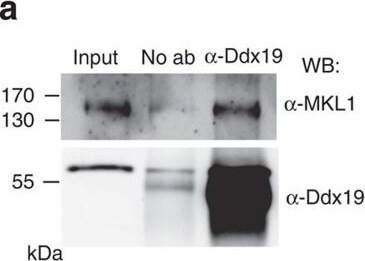
Chromatin Immunoprecipitation: DDX19B Antibody [NB100-760] -
Chromatin Immunoprecipitation: DDX19B Antibody [NB100-760] - MKL1 contains two Ddx19 interaction sites.(a) Co-IPs of endogenous MKL1 with endogenous Ddx19. NIH 3T3 cytoplasmic extract was immunoprecipitated with anti-Ddx19 antibody & the immunoprecipitates were blotted for indicated antibodies. Beads without antibody (no ab) were used as a negative control. (b) HA-tagged MKL1 constructs were immunoprecipitated from NIH 3T3 lysates & their expression was detected by HA-antibody. Co-precipitated endogenous Ddx19 was detected by western blotting (WB). Empty HA was used as a negative control. Image collected & cropped by CiteAb from the following publication (https://www.nature.com/articles/ncomms6978), licensed under a CC-BY license. Not internally tested by Novus Biologicals.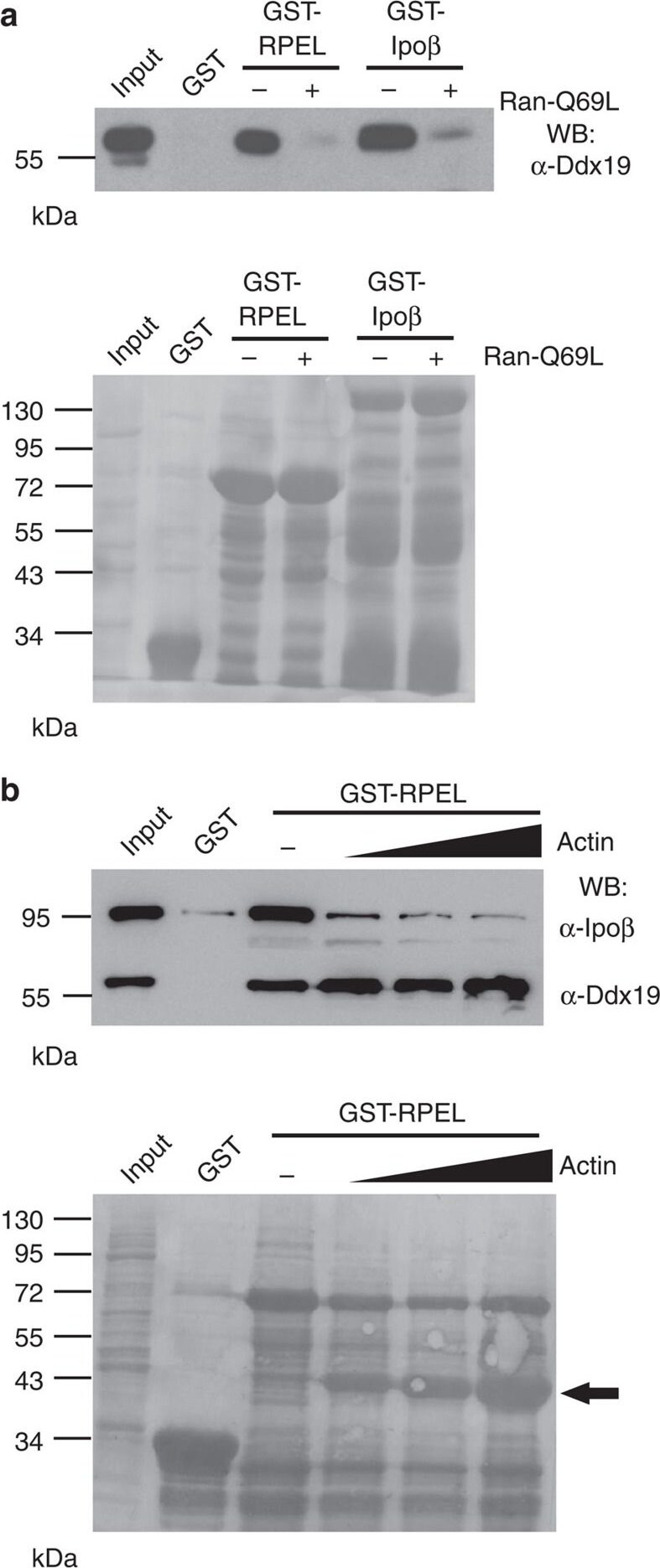
Western Blot: DDX19B Antibody [NB100-760] -
Western Blot: DDX19B Antibody [NB100-760] - Ddx19 interacts with MKL1 RPEL domain & Ipo beta.(a) Ddx19 recruitment from Hela cell lysate by GST-RPEL & GST-Ipo beta (left). WB, western blotting; (−), without Ran-Q69L; (+), with RanQ69L. Corresponding GST baits are stained with Ponceau to ensure the equal loading of the samples (below). Input sample corresponds to 5% of the Hela cell lysate used in the assay. (b) GST-RPEL was used as a bait for pull down of Ddx19 & Ipo beta from the Hela cell lysate in the presence of increasing amounts of LatB-actin (0.25–10 μM) (left). Arrow indicates the increasing amounts of actin in the corresponding Ponceau staining (below). Image collected & cropped by CiteAb from the following publication (https://www.nature.com/articles/ncomms6978), licensed under a CC-BY license. Not internally tested by Novus Biologicals.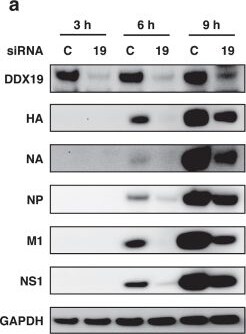
Western Blot: DDX19B Antibody [NB100-760] -
Western Blot: DDX19B Antibody [NB100-760] - The accumulation of viral proteins & RNAs is reduced in DDX19-depleted cells.A549 cells were treated with control (C) or DDX19 (19) siRNAs & infected with WSN (5 pfu/cell). (a) Total extracts were prepared at the indicated times post-infection & analyzed by immunoblots using antibodies directed against the indicated proteins. Results representative of 3 independent experiments are shown. Cropped blots are shown. The corresponding full-length blots are shown in Figure S3. (b–e) The levels of NP or NA mRNAs & vRNAs (b or c & d or e, respectively) were determined at the indicated times post-infection by strand specific RT-qPCR & were normalized to the level of the same RNA species at 3 hpi in cells treated with the control siRNAs. The results are expressed as the mean ± SEM of three independent experiments & the significance was tested with a one-sample t test using GraphPad Prism Software (*p < 0.05; **p < 0.01; ***p < 0.001). Dashed lines were used to indicate that the Y-axes have been segmented. Different scales were used for the mRNA & vRNA graphs. Image collected & cropped by CiteAb from the following publication (https://www.nature.com/articles/srep33763), licensed under a CC-BY license. Not internally tested by Novus Biologicals.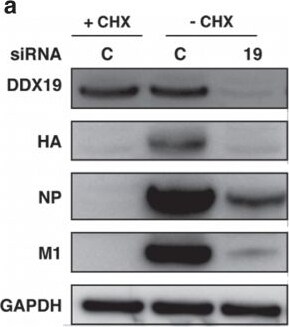
Western Blot: DDX19B Antibody [NB100-760] -
Western Blot: DDX19B Antibody [NB100-760] - The earliest steps of IAV replication are not affected by DDX19 depletion.A549 cells treated with control (C in a & b, dark grey bars in c & d) or DDX19 (19 in a & b, light grey bars in c & d) siRNAs were infected with WSN (5 pfu/cell). (a) Total extracts from control cells treated with CHX (+CHX) or not (−CHX) were prepared at 6 hpi & analyzed by immunoblots using antibodies directed against the indicated proteins. Cropped blots are shown. The corresponding full-length blots are shown in Figure S4. (b) Cytoplasmic & nuclear fractions were prepared at 4 hpi. Aliquots of the indicated subcellular fractions were analyzed by immunoblots with antibodies directed against MEK1/2 kinase (cytoplasmic marker), TBP (nuclear marker) & NP. Alternatively, total RNAs were extracted & the levels of GAPDH pre-mRNA, a nuclear marker, were determined by real-time RT-PCR. Results are expressed as the mean of two determinations of the crossing point value (Cp). Cropped blots are shown. The corresponding full-length blots are shown in Figure S5. (c,d) Infection was carried out for 6 h in the presence of CHX (100 µg/mL). Total RNAs were isolated from cytoplasmic (solid bars) & nuclear (hatched bars) fractions, & the levels of NP & NA vRNAs were determined by strand specific RT-qPCR. The results are expressed as the mean percentages ± SEM of cytoplasmic & nuclear vRNAs levels determined in three independent experiments (c). Total RNAs were extracted & the levels of NP or NA mRNAs & vRNAs were determined by strand specific RT-qPCR. The results are expressed as the mean ratios of mRNA/vRNA ± SEM determined in three independent experiments (d). Image collected & cropped by CiteAb from the following publication (https://www.nature.com/articles/srep33763), licensed under a CC-BY license. Not internally tested by Novus Biologicals.Applications for DDX19B Antibody
Application
Recommended Usage
Immunohistochemistry
1:100-1:500
Immunohistochemistry-Paraffin
1:100-1:500
Immunoprecipitation
2- 5 ug/mg lysate
Western Blot
1:1000-1:10000
Application Notes
Epitope retrieval with Tris-EDTA pH 9.0 is recommended for FFPE tissue sections.
Formulation, Preparation, and Storage
Purification
Immunogen affinity purified
Formulation
TBS and 0.1% BSA
Preservative
0.09% Sodium Azide
Concentration
0.2 mg/ml
Shipping
The product is shipped with polar packs. Upon receipt, store it immediately at the temperature recommended below.
Stability & Storage
Store at 4C. Do not freeze.
Background: DDX19B
Alternate Names
ATP-dependent RNA helicase DDX19, DBP5ATP-dependent RNA helicase DDX19B, DDX19DEAD-box protein 5, DEAD (Asp-Glu-Ala-As) box polypeptide 19, DEAD (Asp-Glu-Ala-As) box polypeptide 19B, DEAD box protein 19B, DEAD box RNA helicase DEAD5, DEAD/H (Asp-Glu-Ala-Asp/His) box polypeptide 19 (Dbp5, yeast, homolog), DEAD-box RNA helicase DEAD5, EC 3.6.1, EC 3.6.4.13, RNAh, yeast Dbp5 homolog
Gene Symbol
DDX19B
UniProt
Additional DDX19B Products
Product Documents for DDX19B Antibody
Certificate of Analysis
To download a Certificate of Analysis, please enter a lot or batch number in the search box below.
Product Specific Notices for DDX19B Antibody
This product is for research use only and is not approved for use in humans or in clinical diagnosis. Primary Antibodies are guaranteed for 1 year from date of receipt.
Citations for DDX19B Antibody
 Powered by Bioz
Customer Reviews for DDX19B Antibody
There are currently no reviews for this product. Be the first to review DDX19B Antibody and earn rewards!
Have you used DDX19B Antibody?
Submit a review and receive an Amazon gift card!
$25/€18/£15/$25CAN/¥2500 Yen for a review with an image
$10/€7/£6/$10CAN/¥1110 Yen for a review without an image
Submit a review
Protocols
Find general support by application which include: protocols, troubleshooting, illustrated assays, videos and webinars.
- Antigen Retrieval Protocol (PIER)
- Antigen Retrieval for Frozen Sections Protocol
- Appropriate Fixation of IHC/ICC Samples
- Cellular Response to Hypoxia Protocols
- Chromogenic IHC Staining of Formalin-Fixed Paraffin-Embedded (FFPE) Tissue Protocol
- Chromogenic Immunohistochemistry Staining of Frozen Tissue
- ClariTSA™ Fluorophore Kits
- Detection & Visualization of Antibody Binding
- Fluorescent IHC Staining of Frozen Tissue Protocol
- Graphic Protocol for Heat-induced Epitope Retrieval
- Graphic Protocol for the Preparation and Fluorescent IHC Staining of Frozen Tissue Sections
- Graphic Protocol for the Preparation and Fluorescent IHC Staining of Paraffin-embedded Tissue Sections
- Graphic Protocol for the Preparation of Gelatin-coated Slides for Histological Tissue Sections
- IHC Sample Preparation (Frozen sections vs Paraffin)
- Immunofluorescent IHC Staining of Formalin-Fixed Paraffin-Embedded (FFPE) Tissue Protocol
- Immunohistochemistry (IHC) and Immunocytochemistry (ICC) Protocols
- Immunohistochemistry Frozen Troubleshooting
- Immunohistochemistry Paraffin Troubleshooting
- Immunoprecipitation Protocol
- Preparing Samples for IHC/ICC Experiments
- Preventing Non-Specific Staining (Non-Specific Binding)
- Primary Antibody Selection & Optimization
- Protocol for Heat-Induced Epitope Retrieval (HIER)
- Protocol for Making a 4% Formaldehyde Solution in PBS
- Protocol for VisUCyte™ HRP Polymer Detection Reagent
- Protocol for the Preparation & Fixation of Cells on Coverslips
- Protocol for the Preparation and Chromogenic IHC Staining of Frozen Tissue Sections
- Protocol for the Preparation and Chromogenic IHC Staining of Frozen Tissue Sections - Graphic
- Protocol for the Preparation and Chromogenic IHC Staining of Paraffin-embedded Tissue Sections
- Protocol for the Preparation and Chromogenic IHC Staining of Paraffin-embedded Tissue Sections - Graphic
- Protocol for the Preparation and Fluorescent IHC Staining of Frozen Tissue Sections
- Protocol for the Preparation and Fluorescent IHC Staining of Paraffin-embedded Tissue Sections
- Protocol for the Preparation of Gelatin-coated Slides for Histological Tissue Sections
- R&D Systems Quality Control Western Blot Protocol
- TUNEL and Active Caspase-3 Detection by IHC/ICC Protocol
- The Importance of IHC/ICC Controls
- Troubleshooting Guide: Immunohistochemistry
- Troubleshooting Guide: Western Blot Figures
- Western Blot Conditions
- Western Blot Protocol
- Western Blot Protocol for Cell Lysates
- Western Blot Troubleshooting
- Western Blot Troubleshooting Guide
- View all Protocols, Troubleshooting, Illustrated assays and Webinars
Loading...