
Dengue Virus NS3 Antibody (GT2811) - Azide and BSA Free
Novus Biologicals | Catalog # NBP3-13491

![Western Blot: Dengue Virus NS3 Antibody (GT2811) [NBP3-13491]](https://resources.rndsystems.com/images/products/Dengue-Virus-NS3-Antibody-GT2811-Western-Blot-NBP3-13491-img0005.jpg "Western Blot: Dengue Virus NS3 Antibody (GT2811) [NBP3-13491]")
Loading...
Key Product Details
Species Reactivity
Virus
Applications
Western Blot, ELISA, Immunocytochemistry/ Immunofluorescence
Label
Unconjugated
Antibody Source
Monoclonal Mouse IgG1 Clone # GT2811
Format
Azide and BSA Free
Loading...
Product Specifications
Immunogen
Carrier-protein conjugated synthetic peptide encompassing a sequence within the C-terminus region of Dengue Virus NS3 (Dengue virus 2 (strain 16681 PDK 53)). The exact sequence is proprietary.
Reactivity Notes
Dengue virus
Clonality
Monoclonal
Host
Mouse
Isotype
IgG1
Theoretical MW
69 kDa.
Disclaimer note: The observed molecular weight of the protein may vary from the listed predicted molecular weight due to post translational modifications, post translation cleavages, relative charges, and other experimental factors.
Disclaimer note: The observed molecular weight of the protein may vary from the listed predicted molecular weight due to post translational modifications, post translation cleavages, relative charges, and other experimental factors.
Description
Centrifuge briefly prior to opening.
Scientific Data Images for Dengue Virus NS3 Antibody (GT2811) - Azide and BSA Free
Western Blot: Dengue Virus NS3 Antibody (GT2811) [NBP3-13491]
Western Blot: Dengue Virus NS3 Antibody (GT2811) [NBP3-13491] - Non-infected (-) and infected (+) C6/36 whole cell extracts (15 ug) were separated by 7.5% SDS-PAGE, and the membrane was blotted with Dengue Virus NS3 antibody [GT2811] (NBP3-13491) diluted at 1:5000. The HRP-conjugated anti-mouse IgG antibody (NBP2-19382) was used to detect the primary antibody.![Immunocytochemistry/ Immunofluorescence: Dengue Virus NS3 Antibody (GT2811) [NBP3-13491]](https://resources.rndsystems.com/images/products/Dengue-Virus-NS3-Antibody-GT2811-Immunocytochemistry-Immunofluorescence-NBP3-13491-img0002.jpg "Immunocytochemistry/ Immunofluorescence: Dengue Virus NS3 Antibody (GT2811) [NBP3-13491]")
Immunocytochemistry/ Immunofluorescence: Dengue Virus NS3 Antibody (GT2811) [NBP3-13491]
Immunocytochemistry/Immunofluorescence: Dengue Virus NS3 Antibody (GT2811) [NBP3-13491] - NS3 (Dengue virus) antibody [GT2811] detects NS3 (Dengue virus) protein at cytoplasm by immunofluorescent analysis. Samples: BHK-21 cells mock (left) and infected with Dengue virus 3 (right) were fixed in paraformaldehyde. Green: NS3 (Dengue virus) protein stained by NS3 (Dengue virus) antibody [GT2811] (NBP3-13491) diluted at 1:2000. Blue: Hoechst 33342 staining.![Western Blot: Dengue Virus NS3 Antibody (GT2811) [NBP3-13491]](https://resources.rndsystems.com/images/products/Dengue-Virus-NS3-Antibody-GT2811-Western-Blot-NBP3-13491-img0003.jpg "Western Blot: Dengue Virus NS3 Antibody (GT2811) [NBP3-13491]")
Western Blot: Dengue Virus NS3 Antibody (GT2811) [NBP3-13491]
Western Blot: Dengue Virus NS3 Antibody (GT2811) [NBP3-13491] - NS3 (Dengue Virus 2) antibody [GT2811] detects NS3 protein by western blot analysis. A. 30 ug BHK21 whole cell lysate/extract B. 30 ug whole cell lysate/extract of Dengue virus 2 infected BHK21 cells C. 30 ug whole cell lysate/extract of Japanese encephalitis virus infected BHK21 cells 7.5% SDS-PAGE NS3 (Dengue Virus 2) antibody [GT2811] (NBP3-13491) dilution: 1:5000 The HRP-conjugated anti-mouse IgG antibody (NBP2-19382) was used to detect the primary antibody.![Western Blot: Dengue Virus NS3 Antibody (GT2811) [NBP3-13491]](https://resources.rndsystems.com/images/products/Dengue-Virus-NS3-Antibody-GT2811-Western-Blot-NBP3-13491-img0004.jpg "Western Blot: Dengue Virus NS3 Antibody (GT2811) [NBP3-13491]")
Western Blot: Dengue Virus NS3 Antibody (GT2811) [NBP3-13491]
Western Blot: Dengue Virus NS3 Antibody (GT2811) [NBP3-13491] - NS3 (Dengue virus) antibody [GT2811] detects NS3 (Dengue virus) protein by western blot analysis. A. 66 ug BHK-21 whole cell extract B. 20 ug whole cell extract of Dengue virus type 2 infected BHK-21 cells C. 10 ug whole cell extract of Dengue virus type 3 infected BHK-21 cells 10% SDS-PAGE NS3 (Dengue virus) antibody [GT2811] (NBP3-13491) dilution: 1:5000 The HRP-conjugated anti-mouse IgG antibody (NBP2-19382) was used to detect the primary antibody.![Immunocytochemistry/ Immunofluorescence: Dengue Virus NS3 Antibody (GT2811) [NBP3-13491]](https://resources.rndsystems.com/images/products/Dengue-Virus-NS3-Antibody-GT2811-Immunocytochemistry-Immunofluorescence-NBP3-13491-img0001.jpg "Immunocytochemistry/ Immunofluorescence: Dengue Virus NS3 Antibody (GT2811) [NBP3-13491]")
Immunocytochemistry/ Immunofluorescence: Dengue Virus NS3 Antibody (GT2811) [NBP3-13491]
Immunocytochemistry/Immunofluorescence: Dengue Virus NS3 Antibody (GT2811) [NBP3-13491] - NS3 (Dengue virus) antibody [GT2811] detects NS3 (Dengue virus) protein at cytoplasm by immunofluorescent analysis. Samples: BHK-21 cells mock (left) and infected with Dengue virus 2 (right) were fixed in paraformaldehyde. Green: NS3 (Dengue virus) protein stained by NS3 (Dengue virus) antibody [GT2811] (NBP3-13491) diluted at 1:2000. Blue: Hoechst 33342 staining.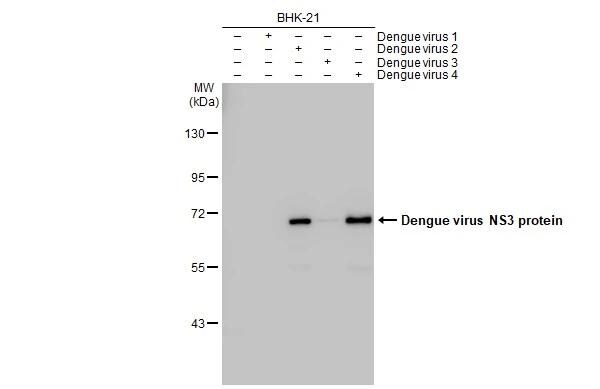
Western Blot: Dengue Virus NS3 Antibody (GT2811) [NBP3-13491] -
Non-infected (-) and infected (+) BHK-21 whole cell extracts were separated by 7.5% SDS-PAGE, and the membrane was blotted with Dengue virus NS3 protein antibody [GT2811] (NBP3-13491) diluted at 1:5000. The HRP-conjugated anti-mouse IgG antibody was used to detect the primary antibody.Applications for Dengue Virus NS3 Antibody (GT2811) - Azide and BSA Free
Application
Recommended Usage
ELISA
Assay dependent
Immunocytochemistry/ Immunofluorescence
1:100-1:2000
Western Blot
1:1000-1:10000
Formulation, Preparation, and Storage
Purification
Protein G purified
Formulation
PBS, 20% Glycerol
Format
Azide and BSA Free
Preservative
No Preservative
Concentration
Concentrations vary lot to lot. See vial label for concentration. If unlisted please contact technical services.
Shipping
The product is shipped with polar packs. Upon receipt, store it immediately at the temperature recommended below.
Stability & Storage
Store at 4C short term. Aliquot and store at -20C long term. Avoid freeze-thaw cycles.
Background: Dengue Virus NS3
Dengue virus entry into host cells occurs via receptor-mediated endocytosis by receptor molecules including the mannose receptor, heparan sulfate, glycosaminoglycans, and DC-SIGN (1,3). Following attachment, the virus is endocytosed in clathrin-coated vesicles (1,3). Following internalization, clathrin disassembles and endosomal processing occurs, allowing viral fusion, disassembly, and release of viral RNA (1,3). This release results in viral translation and replication, virus assembly and maturation, and eventual exocytosis of the mature virus (1,3). Infection can result in a wide range of clinical symptoms including mild disease such as Dengue fever which is characterized by fever, headache, joint pain, rash, and retro-orbital pain, or severe, life-threatening conditions like Dengue hemorrhagic fever or Dengue shock syndrome which involves vascular permeability and leakage (1-3). Host immune response against infection includes innate immune response via interferon secretion and pro-inflammatory cytokine production, as well as adaptive immune response involving cellular and humoral components like T cell activation and B-cell mediated antibody production (1-3). As far as treatment for Dengue virus infection, there no commercial antiviral agents, though some anti-pyretics and certain phenolic compounds do show promise in treating infection (1-3). However, Resveratol, an antiviral for other Flavivirus, has been shown to directly attack the Dengue virus genome (1). While more work needs to be done, there are some live-attenuated tetravalent Dengue virus vaccine candidates in clinal trials including DENVax and TV003/TV005 (1-3).
References
1. Nanaware N, Banerjee A, Mullick Bagchi S, Bagchi P, Mukherjee A. Dengue Virus Infection: A Tale of Viral Exploitations and Host Responses. Viruses. 2021;13(10):1967. Published 2021 Sep 30. https://doi.org/10.3390/v13101967
2. Harapan H, Michie A, Sasmono RT, Imrie A. Dengue: A Minireview. Viruses. 2020;12(8):829. Published 2020 Jul 30. https://doi.org/10.3390/v12080829
3. Roy SK, Bhattacharjee S. Dengue virus: epidemiology, biology, and disease aetiology. Can J Microbiol. 2021;67(10):687-702. https://doi.org/10.1139/cjm-2020-0572
Alternate Names
polyprotein gene
Gene Symbol
POLY
Additional Dengue Virus NS3 Products
Product Documents for Dengue Virus NS3 Antibody (GT2811) - Azide and BSA Free
Certificate of Analysis
To download a Certificate of Analysis, please enter a lot or batch number in the search box below.
Product Specific Notices for Dengue Virus NS3 Antibody (GT2811) - Azide and BSA Free
This product is for research use only and is not approved for use in humans or in clinical diagnosis. Primary Antibodies are guaranteed for 1 year from date of receipt.
Customer Reviews for Dengue Virus NS3 Antibody (GT2811) - Azide and BSA Free
There are currently no reviews for this product. Be the first to review Dengue Virus NS3 Antibody (GT2811) - Azide and BSA Free and earn rewards!
Have you used Dengue Virus NS3 Antibody (GT2811) - Azide and BSA Free?
Submit a review and receive an Amazon gift card!
$25/€18/£15/$25CAN/¥2500 for a review with an image
$10/€7/£6/$10CAN/¥1110 for a review without an image
Submit a review
Protocols
Find general support by application which include: protocols, troubleshooting, illustrated assays, videos and webinars.
- Appropriate Fixation of IHC/ICC Samples
- Cellular Response to Hypoxia Protocols
- ClariTSA™ Fluorophore Kits
- Detection & Visualization of Antibody Binding
- ELISA Sample Preparation & Collection Guide
- ELISA Troubleshooting Guide
- How to Run an R&D Systems DuoSet ELISA
- How to Run an R&D Systems Quantikine ELISA
- How to Run an R&D Systems Quantikine™ QuicKit™ ELISA
- ICC Cell Smear Protocol for Suspension Cells
- ICC Immunocytochemistry Protocol Videos
- ICC for Adherent Cells
- Immunocytochemistry (ICC) Protocol
- Immunocytochemistry Troubleshooting
- Immunofluorescence of Organoids Embedded in Cultrex Basement Membrane Extract
- Immunohistochemistry (IHC) and Immunocytochemistry (ICC) Protocols
- Preparing Samples for IHC/ICC Experiments
- Preventing Non-Specific Staining (Non-Specific Binding)
- Primary Antibody Selection & Optimization
- Protocol for VisUCyte™ HRP Polymer Detection Reagent
- Protocol for the Fluorescent ICC Staining of Cell Smears - Graphic
- Protocol for the Fluorescent ICC Staining of Cultured Cells on Coverslips - Graphic
- Protocol for the Preparation and Fluorescent ICC Staining of Cells on Coverslips
- Protocol for the Preparation and Fluorescent ICC Staining of Non-adherent Cells
- Protocol for the Preparation and Fluorescent ICC Staining of Stem Cells on Coverslips
- Protocol for the Preparation of a Cell Smear for Non-adherent Cell ICC - Graphic
- Quantikine HS ELISA Kit Assay Principle, Alkaline Phosphatase
- Quantikine HS ELISA Kit Principle, Streptavidin-HRP Polymer
- R&D Systems Quality Control Western Blot Protocol
- Sandwich ELISA (Colorimetric) – Biotin/Streptavidin Detection Protocol
- Sandwich ELISA (Colorimetric) – Direct Detection Protocol
- TUNEL and Active Caspase-3 Detection by IHC/ICC Protocol
- The Importance of IHC/ICC Controls
- Troubleshooting Guide: ELISA
- Troubleshooting Guide: Western Blot Figures
- Western Blot Conditions
- Western Blot Protocol
- Western Blot Protocol for Cell Lysates
- Western Blot Troubleshooting
- Western Blot Troubleshooting Guide
- View all Protocols, Troubleshooting, Illustrated assays and Webinars
Loading...