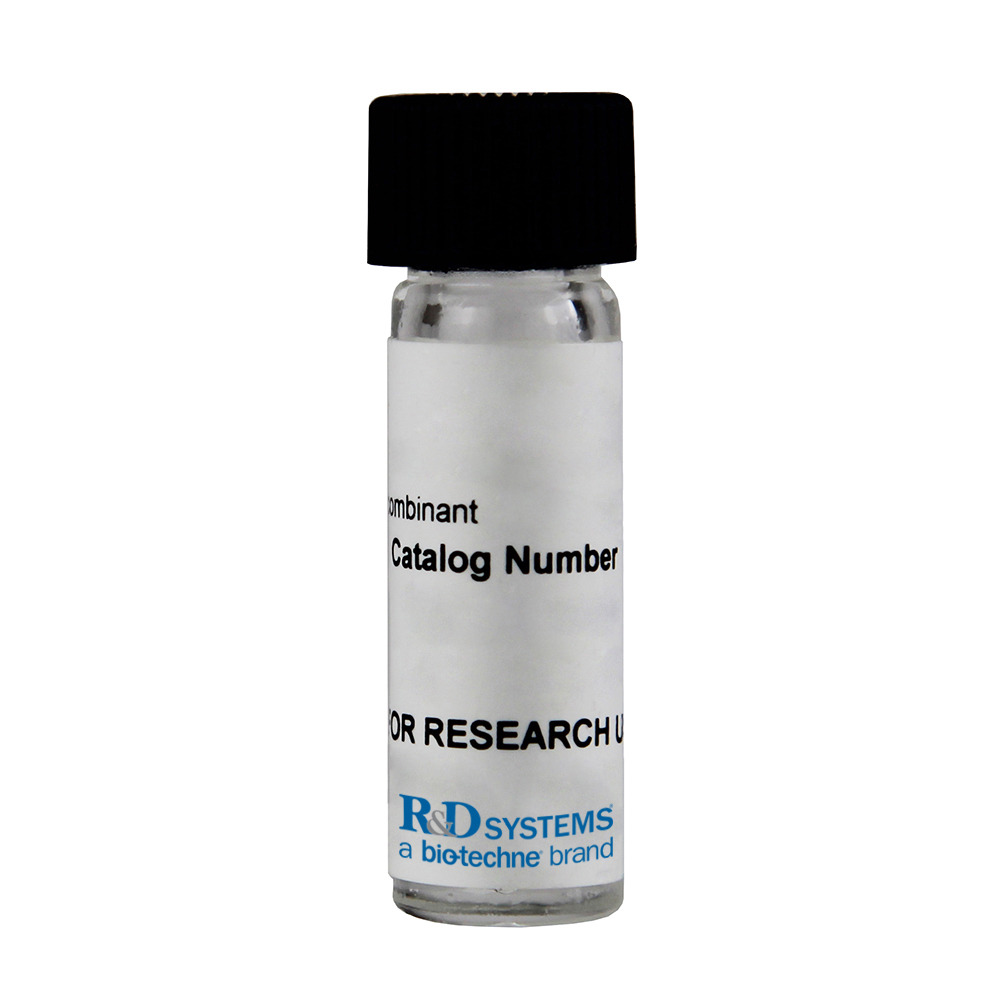
Di-Ubiquitin/Ub2 (K6-linked) Protein, CF Summary
Product Specifications
Product Datasheets
Carrier Free
CF stands for Carrier Free (CF). We typically add Bovine Serum Albumin (BSA) as a carrier protein to our recombinant proteins. Adding a carrier protein enhances protein stability, increases shelf-life, and allows the recombinant protein to be stored at a more dilute concentration. The carrier free version does not contain BSA.
In general, we advise purchasing the recombinant protein with BSA for use in cell or tissue culture, or as an ELISA standard. In contrast, the carrier free protein is recommended for applications, in which the presence of BSA could interfere.
UC-11
| Formulation | Lyophilized from a solution in deionized water. |
| Reconstitution | Reconstitute at 2 mg/mL in an aqueous solution. |
| Shipping | The product is shipped at ambient temperature. Upon receipt, store it immediately at the temperature recommended below. |
| Stability & Storage: | Use a manual defrost freezer and avoid repeated freeze-thaw cycles.
|
Reconstitution Calculator
Background: Di-Ubiquitin
With a predicted molecular weight of 17 kDa, Di-Ubiquitin is composed of two Ubiquitin monomers that are covalently linked through an isopeptide bond, which typically form between a lysine residue of one Ubiquitin molecule and the C-terminal glycine residue of another Ubiquitin molecule (1). Each human Ubiquitin monomer is 76 amino acids (aa) in length and shares 96% and 100% aa identity with yeast and mouse Ubiquitin, respectively (2). Ubiquitin has seven lysine residues that can participate in the formation of poly-Ubiquitin chains. The specific lysine residue used in Ubiquitin conjugation is thought to determine the function of poly-ubiquitination in cellular processes such as protein degradation, signaling, and trafficking (3-8).
Linkage specific di-Ubiquitin is a substrate for enzymes that cleave the isopeptide linkage between two Ubiquitin molecules. It can also be used to investigate the mechanism of binding and recognition by Ubiquitin-activating (E1) or Ubiquitin-conjugating (E2) enzymes, deubiquitinating enzymes, Ubiquitin ligases (E3), or other proteins that contain Ubiquitin-associated domains (UBAs) or Ubiquitin-interacting motifs (UIMs).
- Scheffner, M. et al. (1995) Nature 373:81.
- Sharp, P.M. & W.-H. Li (1987) Trends Ecol. Evol. 2:328.
- Behrends, C. & J.W. Harper (2011) Nat. Struct. Mol. Biol. 18:520.
- Greene, W. et al. (2012) PLoS Pathog. 8:e1002703.
- Henry, A.G. et al. (2012) Dev. Cell 23:519.
- Tong, X. et al. (2012) J. Biol. Chem. 287:25280.
- Wei, W. et al. (2004) Nature 428:194.
- Zhang, J. et al. (2012) J. Biol. Chem. 287:28646.
- Buchberger A., et al. (2002) Trends. Cell. Biol. 12:216-221.
- Cook W.J., et al. (1992) J. Biol. Chem. 267:16467-16471.
- El Oualid, F., et al. (2010) Angewandte Chemie. 49: 10149-10153.
- Fischer R.D., et al. (2003) J. Biol. Chem. 278:28976-28984.
- Tenno T., et al. (2004) Genes to Cells. 9:865-875.
- Varadan R., et al. (2002) J. Mol. Biol. 324:637-647.
- Varadan R., et al. (2004) J. Biol. Chem. 279:7055-7063.
Citations for Di-Ubiquitin/Ub2 (K6-linked) Protein, CF
R&D Systems personnel manually curate a database that contains references using R&D Systems products. The data collected includes not only links to publications in PubMed, but also provides information about sample types, species, and experimental conditions.
3
Citations: Showing 1 - 3
Filter your results:
Filter by:
-
USP45 deubiquitylase controls ERCC1-XPF endonuclease-mediated DNA damage responses.
Authors: Perez-Oliva A, Lachaud C, Szyniarowski P, Munoz I, Macartney T, Hickson I, Rouse J, Alessi D
EMBO J, 2014-12-23;34(3):326-43.
-
The vOTU domain of highly-pathogenic porcine reproductive and respiratory syndrome virus displays a differential substrate preference.
Authors: Deaton M, Spear A, Faaberg K, Pegan S
Virology, 2014-03-15;454(0):247-53.
-
Specific recognition of linear polyubiquitin by A20 zinc finger 7 is involved in NF-kappaB regulation.
EMBO J., 2012-08-28;31(19):3856-70.
Species: Human
Sample Types: Recombinant Protein
Applications: Binding Assay
FAQs
No product specific FAQs exist for this product, however you may
View all Proteins and Enzyme FAQsReviews for Di-Ubiquitin/Ub2 (K6-linked) Protein, CF
There are currently no reviews for this product. Be the first to review Di-Ubiquitin/Ub2 (K6-linked) Protein, CF and earn rewards!
Have you used Di-Ubiquitin/Ub2 (K6-linked) Protein, CF?
Submit a review and receive an Amazon gift card.
$25/€18/£15/$25CAN/¥75 Yuan/¥2500 Yen for a review with an image
$10/€7/£6/$10 CAD/¥70 Yuan/¥1110 Yen for a review without an image
