
EPLIN Antibody - BSA Free
Novus Biologicals | Catalog # NB100-2305

![Western Blot: EPLIN Antibody [NB100-2305]](https://resources.rndsystems.com/images/products/EPLIN-Antibody-Western-Blot-NB100-2305-img0005.jpg "Western Blot: EPLIN Antibody [NB100-2305]")
Key Product Details
Validated by
Species Reactivity
Validated:
Cited:
Predicted:
Applications
Validated:
Cited:
Label
Antibody Source
Format
Product Specifications
Immunogen
Reactivity Notes
Clonality
Host
Isotype
Scientific Data Images for EPLIN Antibody - BSA Free
Western Blot: EPLIN Antibody [NB100-2305]
Western Blot: EPLIN Antibody [NB100-2305] - Whole cell lysate from MCF7 (5, 15 and 50 ug) cells prepared using NETN lysis buffer. Antibody: Affinity purified rabbit anti-EPLIN antibody used for WB at 0.4 ug/ml. Detection: Chemiluminescence with an exposure time of 30 seconds.![Immunocytochemistry/ Immunofluorescence: EPLIN Antibody [NB100-2305]](https://resources.rndsystems.com/images/products/EPLIN-Antibody-Immunocytochemistry-Immunofluorescence-NB100-2305-img0007.jpg "Immunocytochemistry/ Immunofluorescence: EPLIN Antibody [NB100-2305]")
Immunocytochemistry/ Immunofluorescence: EPLIN Antibody [NB100-2305]
EPLIN-Antibody-Immunocytochemistry-Immunofluorescence-NB100-2305-img0007.jpg![Immunoprecipitation: EPLIN Antibody [NB100-2305]](https://resources.rndsystems.com/images/products/EPLIN-Antibody-Immunoprecipitation-NB100-2305-img0006.jpg "Immunoprecipitation: EPLIN Antibody [NB100-2305]")
Immunoprecipitation: EPLIN Antibody [NB100-2305]
Immunoprecipitation: EPLIN Antibody [NB100-2305] - Detection of human EPLIN by western blot of immunoprecipitates. Samples: Whole cell lysate (0.5 or 1.0 mg per IP reaction; 20% of IP loaded) from MCF-7 cells prepared using NETN lysis buffer. Antibodies: Affinity purified rabbit anti-EPLIN antibody NB100-2305 (lot NB100-2305-4) used for IP at 6 ug per reaction. EPLIN was also immunoprecipitated by rabbit anti-EPLIN antibody NB100-320. For blotting immunoprecipitated EPLIN, NB100-2305 was used at 1 ug/ml. Detection: Chemiluminescence with an exposure time of 75 seconds.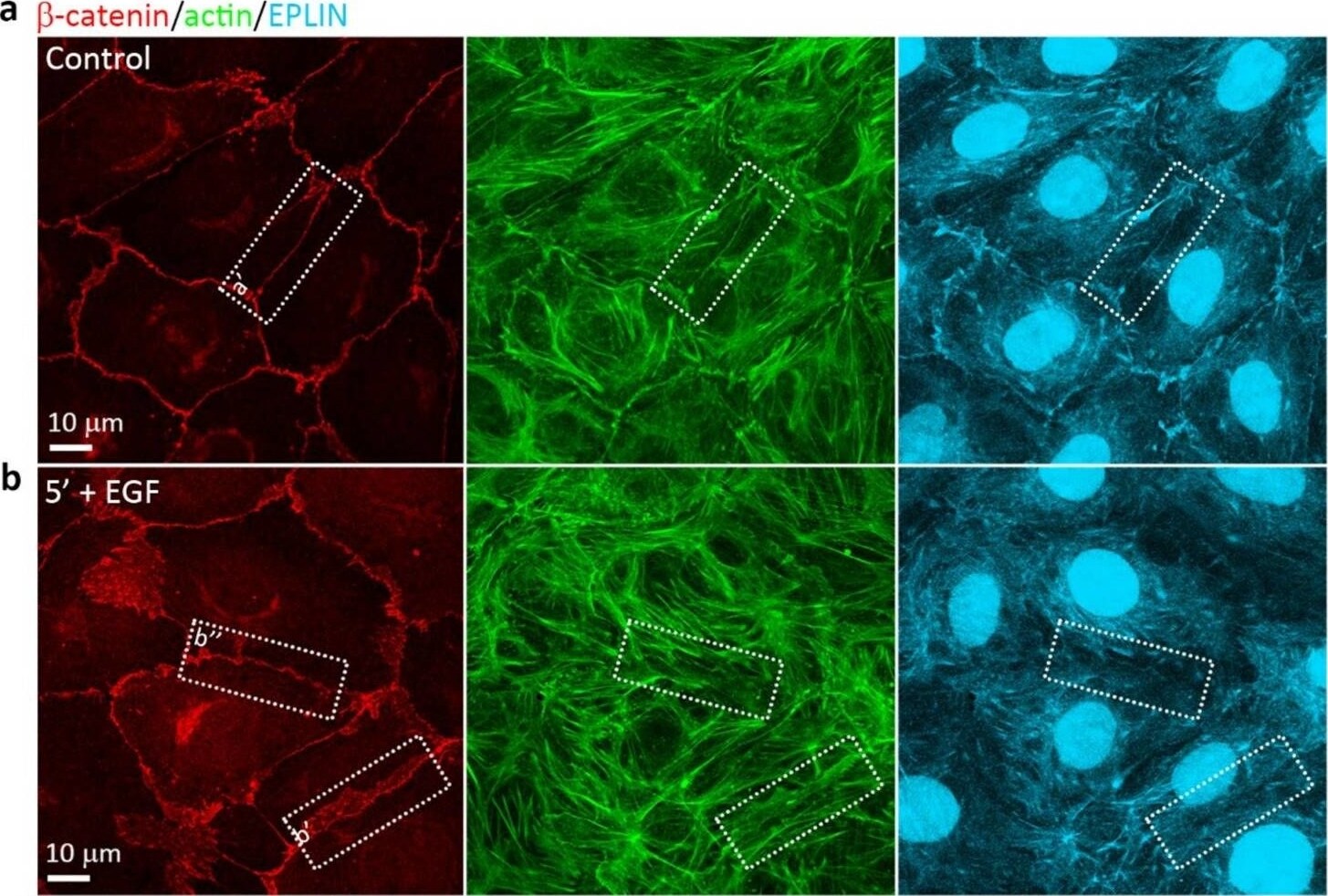
Immunocytochemistry/ Immunofluorescence: EPLIN Antibody [NB100-2305] -
Immunocytochemistry/ Immunofluorescence: EPLIN Antibody [NB100-2305] - Effects of EGF on EPLIN in IAR-20 cells. (a), (a’) In control IAR-20 cells, EPLIN colocalizes with the circumferential actin bundles at cell-cell boundaries. (b) Addition of EGF leads to release of EPLIN from the zones of disorganization or disappearance of the circumferential bundles (Figure 8b’,b’’). EPLIN colocalizes with the remaining intact circumferential bundle (Figure 8b’’, asterisk). (c) EPLIN fluorescence intensity at the cell-cell boundaries in control & EGF-treated cells. Circles & squares represent individual cells, N = 35, * p < 0.001. (d) Western blot analysis of EPLIN phosphorylation (5% PAAG). Arrows indicate up-shifted bands of phosphorylated EPLIN in the cells treated with EGF. beta -actin was used as loading control. Densitometry results are averaged across three independent experiments. Data are presented as mean ± SEM. (e) MEK inhibitor CI-1040 (4 µM), which inhibits phosphorylation of ERK (p-ERK), significantly decreases the levels of phosphorylated EPLIN at 10 min & 15 min after the addition of EGF. alpha -tubulin was used as a loading control. Image collected & cropped by CiteAb from the following publication (https://pubmed.ncbi.nlm.nih.gov/32121325), licensed under a CC-BY license. Not internally tested by Novus Biologicals.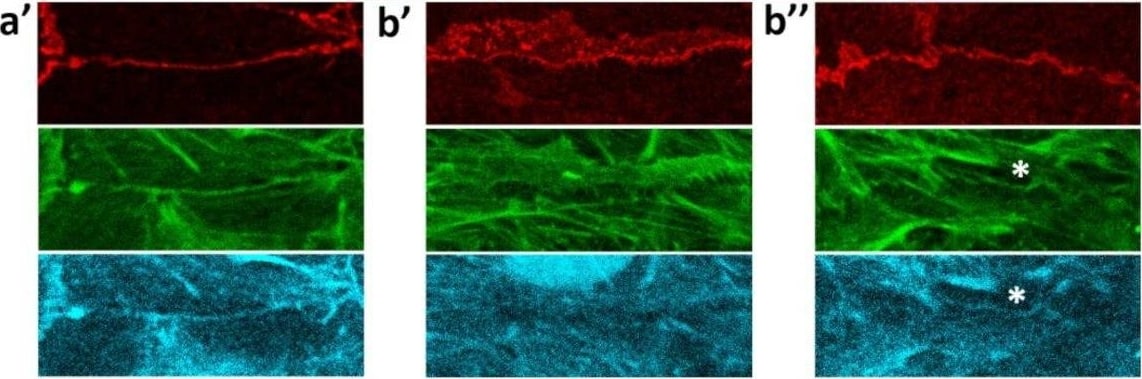
Immunocytochemistry/ Immunofluorescence: EPLIN Antibody [NB100-2305] -
Immunocytochemistry/ Immunofluorescence: EPLIN Antibody [NB100-2305] - Effects of EGF on EPLIN in IAR-20 cells. (a), (a’) In control IAR-20 cells, EPLIN colocalizes with the circumferential actin bundles at cell-cell boundaries. (b) Addition of EGF leads to release of EPLIN from the zones of disorganization or disappearance of the circumferential bundles (Figure 8b’,b’’). EPLIN colocalizes with the remaining intact circumferential bundle (Figure 8b’’, asterisk). (c) EPLIN fluorescence intensity at the cell-cell boundaries in control & EGF-treated cells. Circles & squares represent individual cells, N = 35, * p < 0.001. (d) Western blot analysis of EPLIN phosphorylation (5% PAAG). Arrows indicate up-shifted bands of phosphorylated EPLIN in the cells treated with EGF. beta -actin was used as loading control. Densitometry results are averaged across three independent experiments. Data are presented as mean ± SEM. (e) MEK inhibitor CI-1040 (4 µM), which inhibits phosphorylation of ERK (p-ERK), significantly decreases the levels of phosphorylated EPLIN at 10 min & 15 min after the addition of EGF. alpha -tubulin was used as a loading control. Image collected & cropped by CiteAb from the following publication (https://pubmed.ncbi.nlm.nih.gov/32121325), licensed under a CC-BY license. Not internally tested by Novus Biologicals.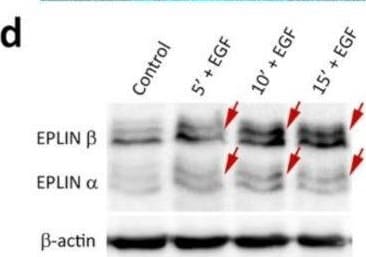
Western Blot: EPLIN Antibody - BSA Free [NB100-2305] -
Effects of EGF on EPLIN in IAR-20 cells. (a), (a’) In control IAR-20 cells, EPLIN colocalizes with the circumferential actin bundles at cell-cell boundaries. (b) Addition of EGF leads to release of EPLIN from the zones of disorganization or disappearance of the circumferential bundles (Figure 8b’,b’’). EPLIN colocalizes with the remaining intact circumferential bundle (Figure 8b’’, asterisk). (c) EPLIN fluorescence intensity at the cell-cell boundaries in control and EGF-treated cells. Circles and squares represent individual cells, N = 35, * p < 0.001. (d) Western blot analysis of EPLIN phosphorylation (5% PAAG). Arrows indicate up-shifted bands of phosphorylated EPLIN in the cells treated with EGF. beta -actin was used as loading control. Densitometry results are averaged across three independent experiments. Data are presented as mean +/- SEM. (e) MEK inhibitor CI-1040 (4 uM), which inhibits phosphorylation of ERK (p-ERK), significantly decreases the levels of phosphorylated EPLIN at 10 min and 15 min after the addition of EGF. alpha -tubulin was used as a loading control. Image collected and cropped by CiteAb from the following open publication (https://pubmed.ncbi.nlm.nih.gov/32121325), licensed under a CC-BY license. Not internally tested by Novus Biologicals.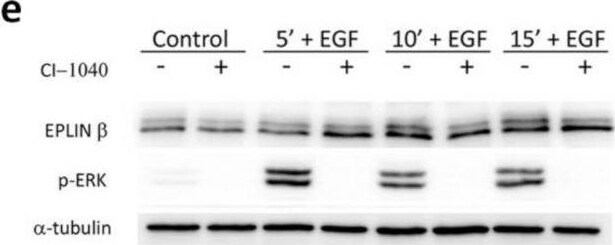
Western Blot: EPLIN Antibody - BSA Free [NB100-2305] -
Effects of EGF on EPLIN in IAR-20 cells. (a), (a’) In control IAR-20 cells, EPLIN colocalizes with the circumferential actin bundles at cell-cell boundaries. (b) Addition of EGF leads to release of EPLIN from the zones of disorganization or disappearance of the circumferential bundles (Figure 8b’,b’’). EPLIN colocalizes with the remaining intact circumferential bundle (Figure 8b’’, asterisk). (c) EPLIN fluorescence intensity at the cell-cell boundaries in control and EGF-treated cells. Circles and squares represent individual cells, N = 35, * p < 0.001. (d) Western blot analysis of EPLIN phosphorylation (5% PAAG). Arrows indicate up-shifted bands of phosphorylated EPLIN in the cells treated with EGF. beta -actin was used as loading control. Densitometry results are averaged across three independent experiments. Data are presented as mean +/- SEM. (e) MEK inhibitor CI-1040 (4 uM), which inhibits phosphorylation of ERK (p-ERK), significantly decreases the levels of phosphorylated EPLIN at 10 min and 15 min after the addition of EGF. alpha -tubulin was used as a loading control. Image collected and cropped by CiteAb from the following open publication (https://pubmed.ncbi.nlm.nih.gov/32121325), licensed under a CC-BY license. Not internally tested by Novus Biologicals.Applications for EPLIN Antibody - BSA Free
Immunohistochemistry
Immunoprecipitation
Western Blot
Formulation, Preparation, and Storage
Purification
Formulation
Format
Preservative
Concentration
Shipping
Stability & Storage
Background: EPLIN
Alternate Names
Gene Symbol
UniProt
Additional EPLIN Products
Product Documents for EPLIN Antibody - BSA Free
Certificate of Analysis
To download a Certificate of Analysis, please enter a lot or batch number in the search box below.
Product Specific Notices for EPLIN Antibody - BSA Free
This product is for research use only and is not approved for use in humans or in clinical diagnosis. Primary Antibodies are guaranteed for 1 year from date of receipt.
Citations for EPLIN Antibody - BSA Free
 Powered by Bioz
Customer Reviews for EPLIN Antibody - BSA Free
There are currently no reviews for this product. Be the first to review EPLIN Antibody - BSA Free and earn rewards!
Have you used EPLIN Antibody - BSA Free?
Submit a review and receive an Amazon gift card!
$25/€18/£15/$25CAN/¥2500 for a review with an image
$10/€7/£6/$10CAN/¥1110 for a review without an image
Submit a review
Protocols
Find general support by application which include: protocols, troubleshooting, illustrated assays, videos and webinars.
- Antigen Retrieval Protocol (PIER)
- Antigen Retrieval for Frozen Sections Protocol
- Appropriate Fixation of IHC/ICC Samples
- Cellular Response to Hypoxia Protocols
- Chromogenic IHC Staining of Formalin-Fixed Paraffin-Embedded (FFPE) Tissue Protocol
- Chromogenic Immunohistochemistry Staining of Frozen Tissue
- ClariTSA™ Fluorophore Kits
- Detection & Visualization of Antibody Binding
- Fluorescent IHC Staining of Frozen Tissue Protocol
- Graphic Protocol for Heat-induced Epitope Retrieval
- Graphic Protocol for the Preparation and Fluorescent IHC Staining of Frozen Tissue Sections
- Graphic Protocol for the Preparation and Fluorescent IHC Staining of Paraffin-embedded Tissue Sections
- Graphic Protocol for the Preparation of Gelatin-coated Slides for Histological Tissue Sections
- ICC Cell Smear Protocol for Suspension Cells
- ICC Immunocytochemistry Protocol Videos
- ICC for Adherent Cells
- IHC Sample Preparation (Frozen sections vs Paraffin)
- Immunocytochemistry (ICC) Protocol
- Immunocytochemistry Troubleshooting
- Immunofluorescence of Organoids Embedded in Cultrex Basement Membrane Extract
- Immunofluorescent IHC Staining of Formalin-Fixed Paraffin-Embedded (FFPE) Tissue Protocol
- Immunohistochemistry (IHC) and Immunocytochemistry (ICC) Protocols
- Immunohistochemistry Frozen Troubleshooting
- Immunohistochemistry Paraffin Troubleshooting
- Immunoprecipitation Protocol
- Preparing Samples for IHC/ICC Experiments
- Preventing Non-Specific Staining (Non-Specific Binding)
- Primary Antibody Selection & Optimization
- Protocol for Heat-Induced Epitope Retrieval (HIER)
- Protocol for Making a 4% Formaldehyde Solution in PBS
- Protocol for VisUCyte™ HRP Polymer Detection Reagent
- Protocol for the Fluorescent ICC Staining of Cell Smears - Graphic
- Protocol for the Fluorescent ICC Staining of Cultured Cells on Coverslips - Graphic
- Protocol for the Preparation & Fixation of Cells on Coverslips
- Protocol for the Preparation and Chromogenic IHC Staining of Frozen Tissue Sections
- Protocol for the Preparation and Chromogenic IHC Staining of Frozen Tissue Sections - Graphic
- Protocol for the Preparation and Chromogenic IHC Staining of Paraffin-embedded Tissue Sections
- Protocol for the Preparation and Chromogenic IHC Staining of Paraffin-embedded Tissue Sections - Graphic
- Protocol for the Preparation and Fluorescent ICC Staining of Cells on Coverslips
- Protocol for the Preparation and Fluorescent ICC Staining of Non-adherent Cells
- Protocol for the Preparation and Fluorescent ICC Staining of Stem Cells on Coverslips
- Protocol for the Preparation and Fluorescent IHC Staining of Frozen Tissue Sections
- Protocol for the Preparation and Fluorescent IHC Staining of Paraffin-embedded Tissue Sections
- Protocol for the Preparation of Gelatin-coated Slides for Histological Tissue Sections
- Protocol for the Preparation of a Cell Smear for Non-adherent Cell ICC - Graphic
- R&D Systems Quality Control Western Blot Protocol
- TUNEL and Active Caspase-3 Detection by IHC/ICC Protocol
- The Importance of IHC/ICC Controls
- Troubleshooting Guide: Immunohistochemistry
- Troubleshooting Guide: Western Blot Figures
- Western Blot Conditions
- Western Blot Protocol
- Western Blot Protocol for Cell Lysates
- Western Blot Troubleshooting
- Western Blot Troubleshooting Guide
- View all Protocols, Troubleshooting, Illustrated assays and Webinars
FAQs for EPLIN Antibody - BSA Free
-
Q: What's the epitope and where does it bind on EPLIN? Does NB100-2305 recognize only the alpha and the beta forms, and not other isoforms(there are 4 in total)? I get multiple bands (more than 2) and just want to make sure which band corresponds to which isoforms.
A: Our EPLIN antibody with catalogue number NB100-2305 was raised against an immunogen derived from amino acids 700-759 of human EPLIN (NP_057441.1). Unfortunately we do not epitope map our antibodies and so I am unable to provide you with any further information regarding the specific binding of NB100-2305 to its target. Our Western blot data, as you rightly point out, shows the antibody to bind to EPLIN alpha and EPLIN beta in lysates from DU145 and SKBR3 cells. We have not yet tested its binding to the other two EPLIN isoforms. According to the Uniprot listing, the theoretical molecular weight of isoform beta is 85kDa. isoform alpha is 67kDa, isoform 3 is 51kDa and isoform 4 is 85kDa. The EPLIN protein has multiple phosphorylation sites, so the phosphorylation status may also have an impact on the size at which your bands are running.