
EWSR1 Antibody - BSA Free
Novus Biologicals | Catalog # NB200-182

![Western Blot: EWSR1 Antibody [NB200-182]](https://resources.rndsystems.com/images/products/EWSR1-Antibody-Western-Blot-NB200-182-img0018.jpg "Western Blot: EWSR1 Antibody [NB200-182]")
Scientific images may be resized, cropped, or adjusted for brightness or contrast for presentation purposes. These updates are limited to presentation and do not affect the underlying scientific interpretation of the data. Where available, additional source data may be provided upon request.
Key Product Details
Species Reactivity
Applications
Label
Antibody Source
Format
Product Specifications
Immunogen
Clonality
Host
Isotype
Scientific Data Images for EWSR1 Antibody - BSA Free
Western Blot: EWSR1 Antibody [NB200-182]
Western Blot: EWSR1 Antibody [NB200-182] - Image shows a specific band for EWSR1 (observed molecular weight ~95 kDa) in HEK293T lysate.![Immunohistochemistry-Paraffin: EWSR1 Antibody [NB200-182]](https://resources.rndsystems.com/images/products/EWSR1-Antibody-Immunohistochemistry-NB200-182-img0014.jpg "Immunohistochemistry-Paraffin: EWSR1 Antibody [NB200-182]")
Immunohistochemistry-Paraffin: EWSR1 Antibody [NB200-182]
Immunohistochemistry-Paraffin: EWSR1 Antibody [NB200-182] - Detection of human EWS by immunohistochemistry. Sample: FFPE section of human breast carcinoma. Antibody: Affinity purified rabbit anti-EWS (NB200-182). Detection: DAB![Western Blot: EWSR1 Antibody [NB200-182]](https://resources.rndsystems.com/images/products/EWSR1-Antibody-Western-Blot-NB200-182-img0016.jpg "Western Blot: EWSR1 Antibody [NB200-182]")
Western Blot: EWSR1 Antibody [NB200-182]
Western Blot: EWSR1 Antibody [NB200-182] - Detection of human and mouse EWS by western blot. Samples: Whole cell lysate (5 ug) from HeLa, HEK293T, Jurkat, mouse TCMK-1, and mouse NIH 3T3 cells prepared using NETN lysis buffer. Antibody: Affinity purified rabbit anti-EWS antibody NB200-182 used for WB at 0.04 ug/ml. Detection: Chemiluminescence with an exposure time of 1 second.![Immunoprecipitation: EWSR1 Antibody [NB200-182]](https://resources.rndsystems.com/images/products/EWSR1-Antibody-Immunoprecipitation-NB200-182-img0015.jpg "Immunoprecipitation: EWSR1 Antibody [NB200-182]")
Immunoprecipitation: EWSR1 Antibody [NB200-182]
Immunoprecipitation: EWSR1 Antibody [NB200-182] - Detection of human EWS by western blot of immunoprecipitates. Samples: Whole cell lysate (1.0 mg per IP reaction; 20% of IP loaded) from HeLa cells prepared using NETN lysis buffer. Antibodies: Affinity purified rabbit anti-EWS antibody NB200-182 (lot NB200-182-2) used for IP at 3 ug per reaction. EWS was also immunoprecipitated by a previous lot of this antibody (lot NB200-182-1). For blotting immunoprecipitated EWS, NB200-182 was used at 0.1 ug/ml. Detection: Chemiluminescence with an exposure time of 3 seconds.![Simple Western: EWSR1 Antibody [NB200-182]](https://resources.rndsystems.com/images/products/EWSR1-Antibody-Simple-Western-NB200-182-img0017.jpg "Simple Western: EWSR1 Antibody [NB200-182]")
Simple Western: EWSR1 Antibody [NB200-182]
Simple Western: EWSR1 Antibody [NB200-182] - Simple Western lane view shows HeLa, HEK293T, and HepG2 whole cell lysate (WCL). A specific band was detected for EWSR1 antibody (NBP1-49701) at approximately 116-140 kDa (as indicated) using 10 ug/mL of EWSR1 antibody. This experiment was conducted under reducing conditions and using the 12-230 kDa separation system.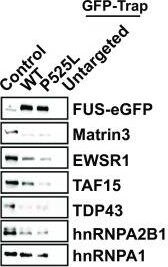
Simple Western: EWSR1 Antibody [NB200-182] -
The cytoplasmic mislocalization induced by P525L causes reduced FUS binding to several ALS-associated RBPs, promoting aggregation. a, b Western blot analysis of FUS protein interactors in a LL & b SL neurons after FUS-eGFP immunoprecipitation reveals differential interactions with several ALS-associated partners. n = 4. Error bars indicate SEM. *, **, & *** Correspond to p < 0.05, 0.01, & 0.001, respectively. c In vitro phase separation assay showing fibrillization of purified P525L LL FUS-eGFP protein in the presence or absence of distinct RBPs. Investigated RBPs effectively prevent FUS fibril formation. d Fluorescence recovery after photobleaching (FRAP) was used to assess the dynamics of P525L LL FUS at the tested conditions for the indicated time points. RBPs promote the maintenance of a liquid-like behavior. e Co-localization of P525L LL FUS with the reported RBPs. Scale bar 5 µm Image collected & cropped by CiteAb from the following publication (https://pubmed.ncbi.nlm.nih.gov/30937520), licensed under a CC-BY license. Not internally tested by Novus Biologicals.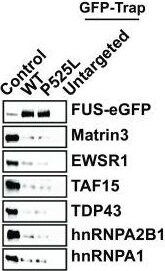
Simple Western: EWSR1 Antibody [NB200-182] -
The cytoplasmic mislocalization induced by P525L causes reduced FUS binding to several ALS-associated RBPs, promoting aggregation. a, b Western blot analysis of FUS protein interactors in a LL & b SL neurons after FUS-eGFP immunoprecipitation reveals differential interactions with several ALS-associated partners. n = 4. Error bars indicate SEM. *, **, & *** Correspond to p < 0.05, 0.01, & 0.001, respectively. c In vitro phase separation assay showing fibrillization of purified P525L LL FUS-eGFP protein in the presence or absence of distinct RBPs. Investigated RBPs effectively prevent FUS fibril formation. d Fluorescence recovery after photobleaching (FRAP) was used to assess the dynamics of P525L LL FUS at the tested conditions for the indicated time points. RBPs promote the maintenance of a liquid-like behavior. e Co-localization of P525L LL FUS with the reported RBPs. Scale bar 5 µm Image collected & cropped by CiteAb from the following publication (https://pubmed.ncbi.nlm.nih.gov/30937520), licensed under a CC-BY license. Not internally tested by Novus Biologicals.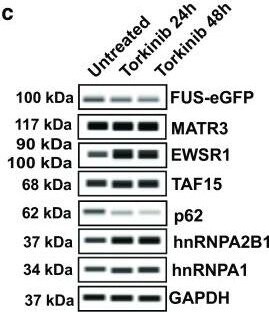
Simple Western: EWSR1 Antibody [NB200-182] -
Autophagic clearance of aberrantly accumulated cytoplasmic FUS restores protein homeostasis & ameliorates survival of SL P525L iPSC-derived neurons. a Confocal micrographs showing FUS-eGFP distribution before & after Torkinib treatment (above). Arrowhead indicates FUS-eGFP cytoplasmic accumulation in untreated neurites; arrow shows reduced FUS-eGFP cytoplasmic signal following torkinib treatment. Quantification of cytoplasmic FUS-eGFP signal intensity in acquired images (below) confirms clearance of mislocalized FUS-eGFP protein. Scale bar = 10 µm. b FRAP analysis performed on untreated versus torkinib-treated neurons shows comparable dynamics of FUS-eGFP recovery. n = 3. Error bars indicate SEM. CHX = cycloheximide. c WES capillary electrophoresis & d corresponding quantification of the indicated proteins in P525L SL neurons before & after torkinib treatment. Autophagy stimulation restores physiological levels. n = 4. Error bars indicate SEM. * & ** Correspond to p < 0.05 & 0.01, respectively. e 6 h of torkinib reduces apoptotic cell death identified by cleaved Caspase 3 staining. Scale bar = 50 µm Image collected & cropped by CiteAb from the following publication (https://pubmed.ncbi.nlm.nih.gov/30937520), licensed under a CC-BY license. Not internally tested by Novus Biologicals.Applications for EWSR1 Antibody - BSA Free
Immunohistochemistry
Immunohistochemistry-Paraffin
Immunoprecipitation
Western Blot
See Simple Western Antibody Database for Simple Western validation
Formulation, Preparation, and Storage
Purification
Formulation
Format
Preservative
Concentration
Shipping
Stability & Storage
Background: EWSR1
Long Name
Alternate Names
Entrez Gene IDs
Gene Symbol
UniProt
Additional EWSR1 Products
Product Documents for EWSR1 Antibody - BSA Free
Certificate of Analysis
To download a Certificate of Analysis, please enter a lot or batch number in the search box below.
Product Specific Notices for EWSR1 Antibody - BSA Free
This product is for research use only and is not approved for use in humans or in clinical diagnosis. Primary Antibodies are guaranteed for 1 year from date of receipt.
Citations for EWSR1 Antibody - BSA Free
 Powered by Bioz
Customer Reviews for EWSR1 Antibody - BSA Free
There are currently no reviews for this product. Be the first to review EWSR1 Antibody - BSA Free and earn rewards!
Have you used EWSR1 Antibody - BSA Free?
Submit a review and receive an Amazon gift card!
$25/€18/£15/$25CAN/¥2500 for a review with an image
$10/€7/£6/$10CAN/¥1110 for a review without an image
Submit a review
Protocols
Find general support by application which include: protocols, troubleshooting, illustrated assays, videos and webinars.
- Antigen Retrieval Protocol (PIER)
- Antigen Retrieval for Frozen Sections Protocol
- Appropriate Fixation of IHC/ICC Samples
- Cellular Response to Hypoxia Protocols
- Chromogenic IHC Staining of Formalin-Fixed Paraffin-Embedded (FFPE) Tissue Protocol
- Chromogenic Immunohistochemistry Staining of Frozen Tissue
- ClariTSA™ Fluorophore Kits
- Detection & Visualization of Antibody Binding
- Fluorescent IHC Staining of Frozen Tissue Protocol
- Graphic Protocol for Heat-induced Epitope Retrieval
- Graphic Protocol for the Preparation and Fluorescent IHC Staining of Frozen Tissue Sections
- Graphic Protocol for the Preparation and Fluorescent IHC Staining of Paraffin-embedded Tissue Sections
- Graphic Protocol for the Preparation of Gelatin-coated Slides for Histological Tissue Sections
- IHC Sample Preparation (Frozen sections vs Paraffin)
- Immunofluorescent IHC Staining of Formalin-Fixed Paraffin-Embedded (FFPE) Tissue Protocol
- Immunohistochemistry (IHC) and Immunocytochemistry (ICC) Protocols
- Immunohistochemistry Frozen Troubleshooting
- Immunohistochemistry Paraffin Troubleshooting
- Immunoprecipitation Protocol
- Preparing Samples for IHC/ICC Experiments
- Preventing Non-Specific Staining (Non-Specific Binding)
- Primary Antibody Selection & Optimization
- Protocol for Heat-Induced Epitope Retrieval (HIER)
- Protocol for Making a 4% Formaldehyde Solution in PBS
- Protocol for VisUCyte™ HRP Polymer Detection Reagent
- Protocol for the Preparation & Fixation of Cells on Coverslips
- Protocol for the Preparation and Chromogenic IHC Staining of Frozen Tissue Sections
- Protocol for the Preparation and Chromogenic IHC Staining of Frozen Tissue Sections - Graphic
- Protocol for the Preparation and Chromogenic IHC Staining of Paraffin-embedded Tissue Sections
- Protocol for the Preparation and Chromogenic IHC Staining of Paraffin-embedded Tissue Sections - Graphic
- Protocol for the Preparation and Fluorescent IHC Staining of Frozen Tissue Sections
- Protocol for the Preparation and Fluorescent IHC Staining of Paraffin-embedded Tissue Sections
- Protocol for the Preparation of Gelatin-coated Slides for Histological Tissue Sections
- R&D Systems Quality Control Western Blot Protocol
- TUNEL and Active Caspase-3 Detection by IHC/ICC Protocol
- The Importance of IHC/ICC Controls
- Troubleshooting Guide: Immunohistochemistry
- Troubleshooting Guide: Western Blot Figures
- Western Blot Conditions
- Western Blot Protocol
- Western Blot Protocol for Cell Lysates
- Western Blot Troubleshooting
- Western Blot Troubleshooting Guide
- View all Protocols, Troubleshooting, Illustrated assays and Webinars