
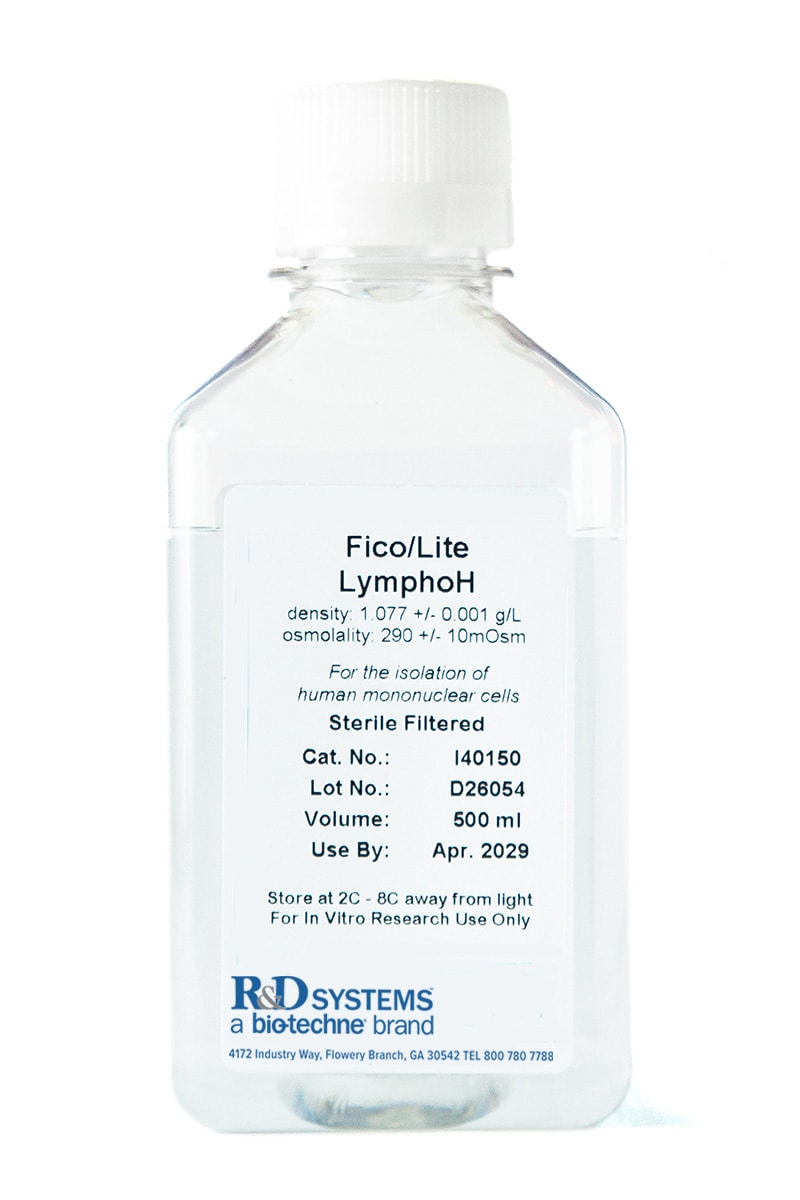
Fico/Lite-LymphoH™
R&D Systems | Catalog # I40150
Atlanta Biologicals cell culture products are now sold under the R&D Systems brand.

Discontinued Product
I40150 has been discontinued.
View all Cell Culture Media products.
Key Product Details
Features
Fico/Lite-LymphoH is recommended for the isolation of viable mononuclear cells from human peripheral blood.
Species
Human
Applications
Cell Culture
Product Summary for Fico/Lite-LymphoH™
What is Fico/Lite-LymphoH?
Ficoll-based cell separation media is for the isolation of blood cells from human and animal species. Fico/Lite ionic density gradient media are supplied as ready-to-use sterile solutions. These media allow a rapid, simple and reliable separation of cell populations in one centrifugation step. Each lot of product is carefully manufactured and quality controlled to ensure lot-to-lot consistency and reliability. Fico/Lite-LymphoH is suitable for the isolation of viable mononuclear cells from human peripheral blood. The Fico/Lite-LymphoH is supplied with a density of 1.077 0.001 g/mL @ 20 °C and an Osmolality of 290 10 mOs/kg H2O. This cell separation product is an ionic density gradient medium widely used for efficient purification of cells without subjecting the cells to the damaging effects of high osmotic pressure.
Loading...
Product Specifications
Osmolality
290 10 mOs/kg H2O
Sterility Testing
Pass
Formulation, Preparation, and Storage
Shipping
Ambient
Storage
2 - 8 °C, protected from light
Product Documents for Fico/Lite-LymphoH™
Certificate of Analysis
To download a Certificate of Analysis, please enter a lot or batch number in the search box below.
Note: Certificate of Analysis not available for kit components.
Customer Reviews for Fico/Lite-LymphoH™
There are currently no reviews for this product. Be the first to review Fico/Lite-LymphoH™ and earn rewards!
Have you used Fico/Lite-LymphoH™?
Submit a review and receive an Amazon gift card!
$25/€18/£15/$25CAN/¥2500 Yen for a review with an image
$10/€7/£6/$10CAN/¥1110 Yen for a review without an image
Submit a review
Protocols
Find general support by application which include: protocols, troubleshooting, illustrated assays, videos and webinars.
- A Guide to the Colony Forming Cell Assay: Methods and Tips
- Cultrex UltiMatrix BME Protocol
- Culture of Mouse Enteric Organoids using Cultrex Basement Membrane Extract
- Culturing BG01V Human Embryonic Stem Cells with Mouse Embryonic Fibroblast (MEF)-Conditioned Media
- Culturing Mouse Cortical Stem Cells: Expansion using the Neurosphere System
- Culturing Rat Cortical Stem Cells: Expansion using the Monolayer System
- Culturing Rat Cortical Stem Cells: Expansion using the Neurosphere System
- Definitive Endoderm Differentiation of BG01V Human Embryonic Stem Cells
- General Support Buffers
- Immunofluorescence of Organoids Embedded in Cultrex Basement Membrane Extract
- Protocol for CEPT Cocktail Kit
- Protocol for Cell Counting Kit-8
- Protocol for Culturing Embryonic Chick Dorsal Root Ganglion Neurons
- Protocol for Culturing Embryonic Rat Spinal Motor Neurons
- Protocol for Culturing Rat Hippocampal Neurons
- Protocol for Culturing Rat Microglia
- Protocol for MortaLIVE™ Non-Toxic Dye
- Protocol for the Differentiation and Characterization of Human Th1 Cells
- Rat Cortical Stem Cell Culture Expansion Protocol
- The Human Colony Forming Cell (CFC) Assay using Methylcellulose-based Media
- The Mouse Colony Forming Cell (CFC) Assay using Methylcellulose-based Media
- The Mouse Pre-B Colony Forming Cell (CFC) Assay Using Methylcellulose-based Media
- Use of Cultrex Basement Membrane Extract to Improve Take and Growth of Xenografts in Mice
- View all Protocols, Troubleshooting, Illustrated assays and Webinars
Loading...