


Key Product Details
Applications
Product Specifications
Specificity
Application Notes
Protocol Recommendations
1. Mounting Procedure: Remove red tip from the bottle and cut thetip off with a sharp razor or scissors. This will help achieve asmooth flow of Fluoromount and prevent formation of tinybubbles.
2. Place the bottle upside down in a container before use. This will also help clear Fluoromount of bubbles.
3. Blot excess water from the slide without letting tissue specimendry. Make sure tissue is wet prior to mounting.
4. Apply 2-3 drops of Fluoromount on the tissue section. Gentlyrotate the slide to make a thin. Make sure the tissue is completely covered.
5. Allow Fluoromount to dry for 30-45 minutes at room temperature.
6. Seal coverslip edges with nail polish for long term storage.
7. Removal of Fluoromount: Fluoromount is an aqueous-based mounting medium that can easily be removed by soaking theslides in de-ionized water.
8. Place the slide in a beaker full of de-ionized water on a magnetic stirrer.
9. Leave the slide for few hours or overnight with gentle stirring for complete removal of dry Fluoromount.
Formulation, Preparation, and Storage
Preservative
Concentration
Shipping
Storage
Background: Fluoromount
Additional Fluoromount Products
Product Documents for Fluoromount
Certificate of Analysis
To download a Certificate of Analysis, please enter a lot or batch number in the search box below.
Product Specific Notices for Fluoromount
This product is for research use only and is not approved for use in humans or in clinical diagnosis. Support products are guaranteed for 6 months from date of receipt.
Citations for Fluoromount
 Powered by Bioz
Customer Reviews for Fluoromount (1)
Have you used Fluoromount?
Submit a review and receive an Amazon gift card!
$25/€18/£15/$25CAN/¥2500 for a review with an image
$10/€7/£6/$10CAN/¥1110 for a review without an image
Submit a review
Customer Images
-
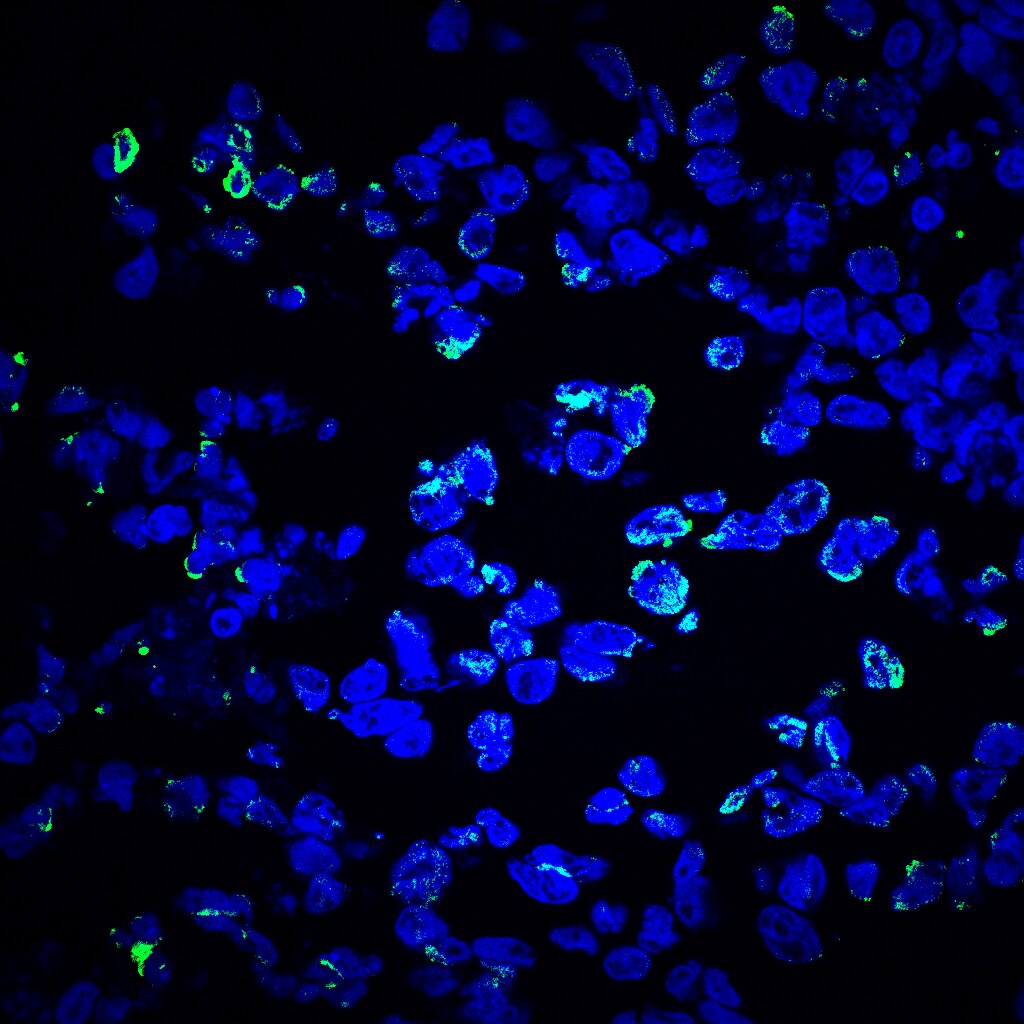
Verified Customer | Posted 12/05/2016Fluoromount was used to mount and coverslip. The solution was works excellent, as there is no photobleaching effect and the sample looks great. This is CD38 staining of lung cancer cells.We add a small drop of the solution onto the slide before adding the coverslip.

There are no reviews that match your criteria.
Protocols
View specific protocols for Fluoromount (NB900-66726):
1. Remove the red tip from the bottle and cut the tip off with a sharp razor or scissors. This will help achieve smooth flow of Fluoromount and prevent formation of tiny bubbles.
2. Place the bottle upside down in a container before using. This will help clear Fluoromount of tiny bubbles.
3. Blot excess water from the slide without letting tissue dry. Make sure the tissue is wet prior to mounting.
4. Apply 2-3 drops of Fluoromount on the tissue section and gently apply a cover slip. Allow to dry for 30-45 minutes at room temperature. Seal edges of the coverslip with nail polish for long term storage.
Find general support by application which include: protocols, troubleshooting, illustrated assays, videos and webinars.
- Antigen Retrieval Protocol (PIER)
- Antigen Retrieval for Frozen Sections Protocol
- Appropriate Fixation of IHC/ICC Samples
- Cellular Response to Hypoxia Protocols
- Chromogenic IHC Staining of Formalin-Fixed Paraffin-Embedded (FFPE) Tissue Protocol
- Chromogenic Immunohistochemistry Staining of Frozen Tissue
- ClariTSA™ Fluorophore Kits
- Detection & Visualization of Antibody Binding
- Fluorescent IHC Staining of Frozen Tissue Protocol
- Graphic Protocol for Heat-induced Epitope Retrieval
- Graphic Protocol for the Preparation and Fluorescent IHC Staining of Frozen Tissue Sections
- Graphic Protocol for the Preparation and Fluorescent IHC Staining of Paraffin-embedded Tissue Sections
- Graphic Protocol for the Preparation of Gelatin-coated Slides for Histological Tissue Sections
- ICC Cell Smear Protocol for Suspension Cells
- ICC Immunocytochemistry Protocol Videos
- ICC for Adherent Cells
- IHC Sample Preparation (Frozen sections vs Paraffin)
- Immunocytochemistry (ICC) Protocol
- Immunocytochemistry Troubleshooting
- Immunofluorescence of Organoids Embedded in Cultrex Basement Membrane Extract
- Immunofluorescent IHC Staining of Formalin-Fixed Paraffin-Embedded (FFPE) Tissue Protocol
- Immunohistochemistry (IHC) and Immunocytochemistry (ICC) Protocols
- Immunohistochemistry Frozen Troubleshooting
- Immunohistochemistry Paraffin Troubleshooting
- Preparing Samples for IHC/ICC Experiments
- Preventing Non-Specific Staining (Non-Specific Binding)
- Primary Antibody Selection & Optimization
- Protocol for Heat-Induced Epitope Retrieval (HIER)
- Protocol for Making a 4% Formaldehyde Solution in PBS
- Protocol for VisUCyte™ HRP Polymer Detection Reagent
- Protocol for the Fluorescent ICC Staining of Cell Smears - Graphic
- Protocol for the Fluorescent ICC Staining of Cultured Cells on Coverslips - Graphic
- Protocol for the Preparation & Fixation of Cells on Coverslips
- Protocol for the Preparation and Chromogenic IHC Staining of Frozen Tissue Sections
- Protocol for the Preparation and Chromogenic IHC Staining of Frozen Tissue Sections - Graphic
- Protocol for the Preparation and Chromogenic IHC Staining of Paraffin-embedded Tissue Sections
- Protocol for the Preparation and Chromogenic IHC Staining of Paraffin-embedded Tissue Sections - Graphic
- Protocol for the Preparation and Fluorescent ICC Staining of Cells on Coverslips
- Protocol for the Preparation and Fluorescent ICC Staining of Non-adherent Cells
- Protocol for the Preparation and Fluorescent ICC Staining of Stem Cells on Coverslips
- Protocol for the Preparation and Fluorescent IHC Staining of Frozen Tissue Sections
- Protocol for the Preparation and Fluorescent IHC Staining of Paraffin-embedded Tissue Sections
- Protocol for the Preparation of Gelatin-coated Slides for Histological Tissue Sections
- Protocol for the Preparation of a Cell Smear for Non-adherent Cell ICC - Graphic
- TUNEL and Active Caspase-3 Detection by IHC/ICC Protocol
- The Importance of IHC/ICC Controls
- Troubleshooting Guide: Immunohistochemistry
- View all Protocols, Troubleshooting, Illustrated assays and Webinars
FAQs for Fluoromount
-
Q: Does NB900-66726 contains glycerol?
A: No, Fluoromount does not contain any glycerol.
-
Q: Will NB900-66726 solidify after application?
A: NB900-66726 is an aqueous mounting, and it won't really harden. For long-term storage, you should seal the edges of the cover slip with clear nail polish.
-
Q: Does NB900-66726 contains glycerol?
A: No, Fluoromount does not contain any glycerol.
-
Q: Will NB900-66726 solidify after application?
A: NB900-66726 is an aqueous mounting, and it won't really harden. For long-term storage, you should seal the edges of the cover slip with clear nail polish.