
HLA G Antibody (MEM-G/1) [FITC]
Novus Biologicals | Catalog # NB500-302F

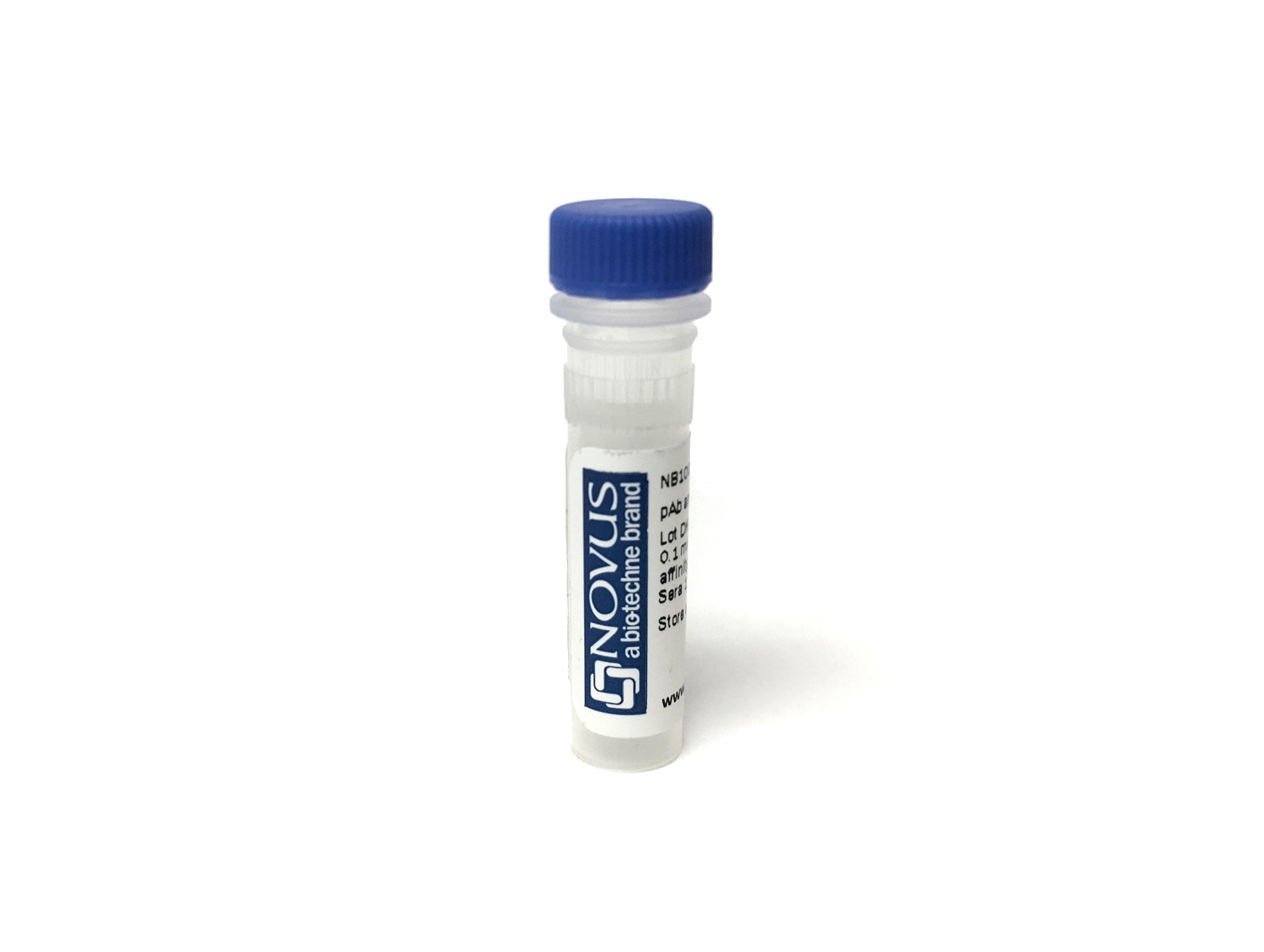
Key Product Details
Species Reactivity
Human
Applications
Immunohistochemistry, Immunohistochemistry-Paraffin, Immunohistochemistry-Frozen, Western Blot, Immunocytochemistry/ Immunofluorescence
Label
FITC (Excitation = 495 nm, Emission = 519 nm)
Antibody Source
Monoclonal Mouse IgG1 Clone # MEM-G/1
Loading...
Product Specifications
Immunogen
HLA-A2.1/human beta2-microglobulin double transgenic mice were immunized with murine L cells transfected with both human beta2-microglobulin and HLA G Antibody (G233)
Reactivity Notes
Mouse reactivity reported in scientific literature (PMID: 27849611).
Localization
Cell Membrane
Specificity
The antibody MEM-G/1 reacts with denaturated HLA-G heavy chain. HLA-G belongs to the MHC Class I molecules (MHC Class Ib; nonclassical) and it is expressed on the surface of trophoblast cells.
Clonality
Monoclonal
Host
Mouse
Isotype
IgG1
Description
This conjugate is made on demand and is not held in inventory. Each order represents a unique lot. All conjugates are generated using validated conjugation protocols and meet strict degree of labeling (F/P) specifications; additional information is available upon request. The antibody concentration is provided on the individual product label.
For specialized conjugation needs, like large quantities, specific concentrations, and defined F/P ratios, bulk and custom antibody conjugation services are available.
For specialized conjugation needs, like large quantities, specific concentrations, and defined F/P ratios, bulk and custom antibody conjugation services are available.
Applications for HLA G Antibody (MEM-G/1) [FITC]
Application
Recommended Usage
Immunocytochemistry/ Immunofluorescence
Optimal dilutions of this antibody should be experimentally determined.
Immunohistochemistry
Optimal dilutions of this antibody should be experimentally determined.
Immunohistochemistry-Frozen
Optimal dilutions of this antibody should be experimentally determined.
Immunohistochemistry-Paraffin
Optimal dilutions of this antibody should be experimentally determined.
Western Blot
Optimal dilutions of this antibody should be experimentally determined.
Application Notes
Recommended applications are based on validated applications from the unconjugated base product NB500-302. This conjugated antibody is not kept in inventory and is made to order using validated conjugation protocols.
Formulation, Preparation, and Storage
Purification
Protein A purified
Formulation
PBS
Preservative
0.05% Sodium Azide
Concentration
Please see the vial label for concentration. If unlisted please contact technical services.
Shipping
The product is shipped with polar packs. Upon receipt, store it immediately at the temperature recommended below.
Stability & Storage
Store at 4C in the dark.
Background: HLA-G
Discovered in cytotrophoblasts, HLA-G is involved in fetal maternal immune tolerance and some studies have linked its downregulation with severe preeclampsia (3). HLA-G mediated immune suppression works by impeding cell proliferation, differentiation, cytotoxicity, cytokine secretion and chemotaxis; and activation of regulatory cells and MDSCs or M2 type macrophage. HLA-G is constitutively expressed in immune-privileged sites such as pancreatic islets, mesenchymal stem cells (MSCs) and the cornea. Upregulation of HLA-G occurs in pathological states including cancer, allo-transplantations, viral infections, autoimmune and inflammatory diseases (4). In cancer, HLA-G expression is induced by hypoxia and has been correlated with advanced tumor stage, tumor metastasis, and poor therapeutic response and survival. HLA-G is an attractive tumor associated-antigen (TAA) for immunotherapy and is considered a major immune checkpoint (ICP).
References
1. Loustau, M., Anna, F., Drean, R., Lecomte, M., Langlade-Demoyen, P., & Caumartin, J. (2020). HLA-G Neo-Expression on Tumors. Front Immunol, 11:1685. PMID: 32922387
2. Lin A, Yan WH. (2018) Heterogeneity of HLA-G Expression in Cancers: Facing the Challenges. Front Immunol. 9:2164. PMID: 30319626
3. Djurisic S, Hviid TV. (2014) HLA Class Ib Molecules and Immune Cells in Pregnancy and Preeclampsia. Front Immunol. 5:652. PMID: 25566263
4. Lila N, Rouas-Freiss N, Dausset J, Carpentier A, Carosella ED. (2001) Soluble HLA-G protein secreted by allo-specific CD4+ T cells suppresses the allo-proliferative response: a CD4+ T cell regulatory mechanism. Proc Natl Acad Sci U S A. 98(21):12150-12155. PMID: 11572934
Long Name
Major Histocompatibility Complex, Class I, G
Alternate Names
HLA G, HLA-6.0, HLAG, MHC Class I Antigen G, MHC-G
Gene Symbol
HLA-G
Additional HLA-G Products
Product Documents for HLA G Antibody (MEM-G/1) [FITC]
Certificate of Analysis
To download a Certificate of Analysis, please enter a lot or batch number in the search box below.
Product Specific Notices for HLA G Antibody (MEM-G/1) [FITC]
This product is for research use only and is not approved for use in humans or in clinical diagnosis. Primary Antibodies are guaranteed for 1 year from date of receipt.
Related Research Areas
Customer Reviews for HLA G Antibody (MEM-G/1) [FITC]
There are currently no reviews for this product. Be the first to review HLA G Antibody (MEM-G/1) [FITC] and earn rewards!
Have you used HLA G Antibody (MEM-G/1) [FITC]?
Submit a review and receive an Amazon gift card!
$25/€18/£15/$25CAN/¥2500 for a review with an image
$10/€7/£6/$10CAN/¥1110 for a review without an image
Submit a review
Protocols
Find general support by application which include: protocols, troubleshooting, illustrated assays, videos and webinars.
- Antigen Retrieval Protocol (PIER)
- Antigen Retrieval for Frozen Sections Protocol
- Appropriate Fixation of IHC/ICC Samples
- Cellular Response to Hypoxia Protocols
- Chromogenic IHC Staining of Formalin-Fixed Paraffin-Embedded (FFPE) Tissue Protocol
- Chromogenic Immunohistochemistry Staining of Frozen Tissue
- ClariTSA™ Fluorophore Kits
- Detection & Visualization of Antibody Binding
- Fluorescent IHC Staining of Frozen Tissue Protocol
- Graphic Protocol for Heat-induced Epitope Retrieval
- Graphic Protocol for the Preparation and Fluorescent IHC Staining of Frozen Tissue Sections
- Graphic Protocol for the Preparation and Fluorescent IHC Staining of Paraffin-embedded Tissue Sections
- Graphic Protocol for the Preparation of Gelatin-coated Slides for Histological Tissue Sections
- ICC Cell Smear Protocol for Suspension Cells
- ICC Immunocytochemistry Protocol Videos
- ICC for Adherent Cells
- IHC Sample Preparation (Frozen sections vs Paraffin)
- Immunocytochemistry (ICC) Protocol
- Immunocytochemistry Troubleshooting
- Immunofluorescence of Organoids Embedded in Cultrex Basement Membrane Extract
- Immunofluorescent IHC Staining of Formalin-Fixed Paraffin-Embedded (FFPE) Tissue Protocol
- Immunohistochemistry (IHC) and Immunocytochemistry (ICC) Protocols
- Immunohistochemistry Frozen Troubleshooting
- Immunohistochemistry Paraffin Troubleshooting
- Preparing Samples for IHC/ICC Experiments
- Preventing Non-Specific Staining (Non-Specific Binding)
- Primary Antibody Selection & Optimization
- Protocol for Heat-Induced Epitope Retrieval (HIER)
- Protocol for Making a 4% Formaldehyde Solution in PBS
- Protocol for VisUCyte™ HRP Polymer Detection Reagent
- Protocol for the Fluorescent ICC Staining of Cell Smears - Graphic
- Protocol for the Fluorescent ICC Staining of Cultured Cells on Coverslips - Graphic
- Protocol for the Preparation & Fixation of Cells on Coverslips
- Protocol for the Preparation and Chromogenic IHC Staining of Frozen Tissue Sections
- Protocol for the Preparation and Chromogenic IHC Staining of Frozen Tissue Sections - Graphic
- Protocol for the Preparation and Chromogenic IHC Staining of Paraffin-embedded Tissue Sections
- Protocol for the Preparation and Chromogenic IHC Staining of Paraffin-embedded Tissue Sections - Graphic
- Protocol for the Preparation and Fluorescent ICC Staining of Cells on Coverslips
- Protocol for the Preparation and Fluorescent ICC Staining of Non-adherent Cells
- Protocol for the Preparation and Fluorescent ICC Staining of Stem Cells on Coverslips
- Protocol for the Preparation and Fluorescent IHC Staining of Frozen Tissue Sections
- Protocol for the Preparation and Fluorescent IHC Staining of Paraffin-embedded Tissue Sections
- Protocol for the Preparation of Gelatin-coated Slides for Histological Tissue Sections
- Protocol for the Preparation of a Cell Smear for Non-adherent Cell ICC - Graphic
- R&D Systems Quality Control Western Blot Protocol
- TUNEL and Active Caspase-3 Detection by IHC/ICC Protocol
- The Importance of IHC/ICC Controls
- Troubleshooting Guide: Immunohistochemistry
- Troubleshooting Guide: Western Blot Figures
- Western Blot Conditions
- Western Blot Protocol
- Western Blot Protocol for Cell Lysates
- Western Blot Troubleshooting
- Western Blot Troubleshooting Guide
- View all Protocols, Troubleshooting, Illustrated assays and Webinars
Loading...