

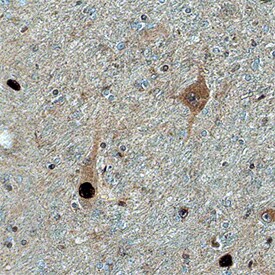
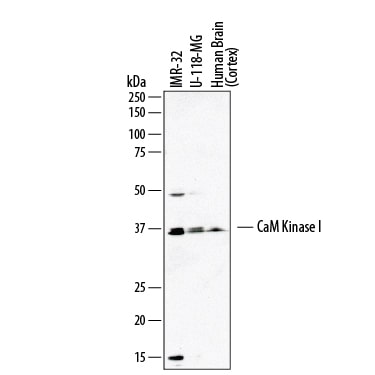
CaMKI (Calcium/Calmodulin-dependent kinase I) is a 37-43 kDa monomeric and cytosolic member of the CaMK subfamily, Ser/Thr protein kinase family, protein kinase superfamily of molecules. It is found in multiple cell types, including adrenal cortical cells, neurons and macrophages/osteoclast precursors. CaMKI is associated with the cellular Ca++ signaling pathway. Upon entry into the cell, calcium levels are sensed by calmodulin. Upon Ca++ binding, calmodulin (and CaMK kinase) interacts with a Ser/Thr protein kinase termed CaMKIa. CaMKIa is of particular interest in neurons and cells of the zona glomerulosa. In neurons, CaMKIa activation results in the recruitment of AMPA-Rs and the promotion of axon growth (vs.dendrite outgrowth which is promoted by CaMKIg). In the adrenal gland, CaMKIa regulates CYP11B2 transcription, and thus the ability to synthesize aldosterone. Human CaMKI, the isoform used for immunization, is 370 amino acids (aa) in length (SwissProt #:Q14012). It contains one protein kinase domain (aa 20-276) followed by a calmodulin-binding region (aa 296-317) and an NES (aa 315-321). Over aa 178-257, human and mouse CaMKI are identical in amino acid sequence. There are three additional CaMKI isoforms (b, g, d), all the product of distinct genes. Nevertheless, over the same aa sequence, these three isoforms (b, g, d) share 80%, 81% and 97% aa sequence identity with CaMKI(a), respectively.
 Powered by Bioz
