
Human CTRP9/C1qTNF9 Antibody (653533)
R&D Systems | Catalog # MAB6537

Scientific images may be resized, cropped, or adjusted for brightness or contrast for presentation purposes. These updates are limited to presentation and do not affect the underlying scientific interpretation of the data. Where available, additional source data may be provided upon request.
Key Product Details
Species Reactivity
Applications
Label
Antibody Source
Product Specifications
Immunogen
Asn16-Pro333
Accession # P0C862
Specificity
Clonality
Host
Isotype
Scientific Data Images for Human CTRP9/C1qTNF9 Antibody (653533)
Detection of CTRP9/C1qTNF9 by Western Blot
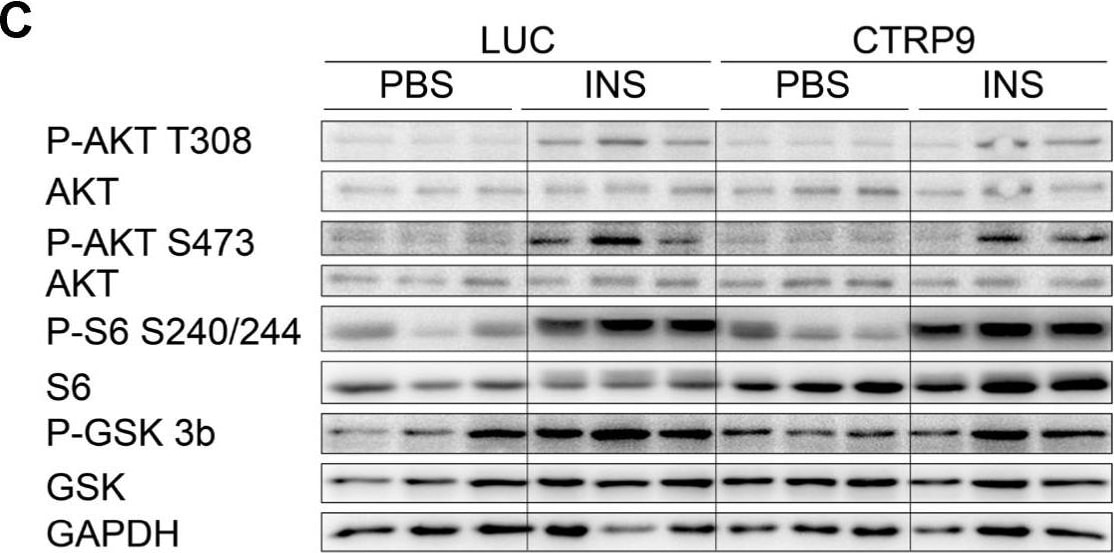
Overexpression of CTRP9 leads to increased glucose uptake in the heart during high-fat diet (HFD) administration. (A) Representative images of cardiac PET scans of the indicated HFD-fed mice treated either with AAV Luc (control) or AAV CTRP9 (leading to myocardial CTRP9 overexpression). 18F-fluoro-deoxyglucose was used as a tracer. (B) Dynamic glucose uptake measured through PET scans as described in (A). (C) Immunoblot of cardiac protein lysate of mice treated as shown. GAPDH was used as a loading control. INS: insulin. Data are shown as mean ± standard error of the mean (SEM). Image collected and cropped by CiteAb from the following open publication (https://pubmed.ncbi.nlm.nih.gov/36766785), licensed under a CC-BY license. Not internally tested by R&D Systems.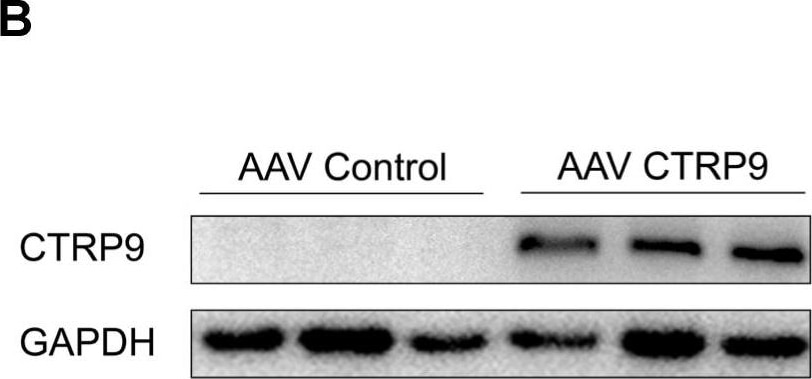
Detection of CTRP9/C1qTNF9 by Western Blot
Cardiac overexpression of CTRP9 leads to peripheral insulin resistance during administration of a high-fat diet (HFD). (A) Scheme showing the experimental timeline. (B) Immunoblotting for CTRP9 from cardiac protein lysate of mice treated either with AAV Luc (control, LUC) or AAV CTRP9 (CT9, leading to myocardial CTRP9 overexpression). (C) Body weight measured at 4, 8 and 12 weeks in the indicated mice after start of feeding. (D) Fasted serum glucose levels. (E) Glucose tolerance test in the indicated mice after 12 weeks of HFD. (F) Serum insulin levels. (G) HOMA-Index of insulin resistance. Data are shown as mean ± standard error of the mean (SEM). * p < 0.05, ** p < 0.01, *** p < 0.001, **** p < 0.0001. Image collected and cropped by CiteAb from the following open publication (https://pubmed.ncbi.nlm.nih.gov/36766785), licensed under a CC-BY license. Not internally tested by R&D Systems.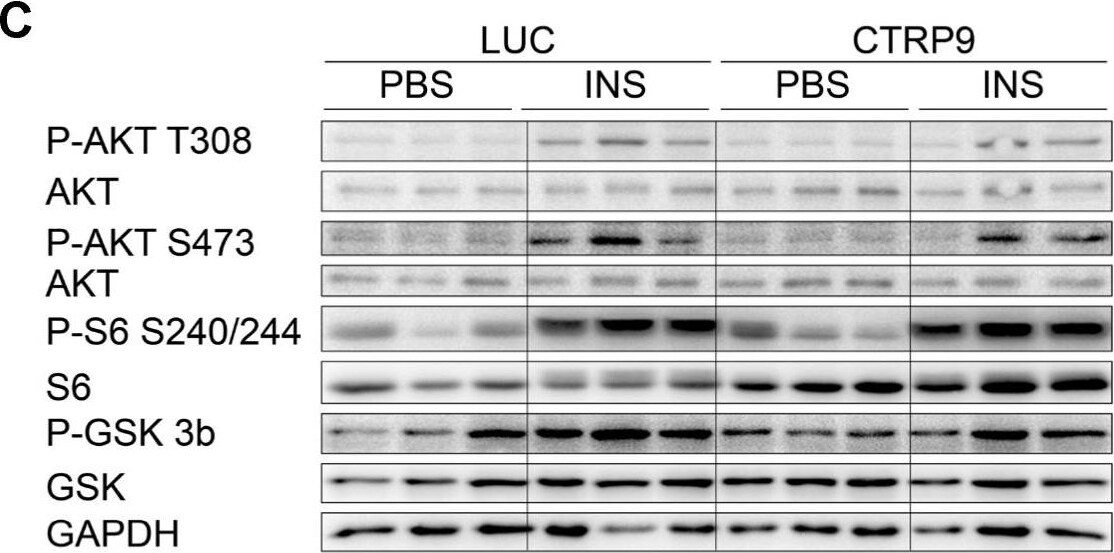
Detection of CTRP9/C1qTNF9 by Western Blot
Overexpression of CTRP9 leads to increased glucose uptake in the heart during high-fat diet (HFD) administration. (A) Representative images of cardiac PET scans of the indicated HFD-fed mice treated either with AAV Luc (control) or AAV CTRP9 (leading to myocardial CTRP9 overexpression). 18F-fluoro-deoxyglucose was used as a tracer. (B) Dynamic glucose uptake measured through PET scans as described in (A). (C) Immunoblot of cardiac protein lysate of mice treated as shown. GAPDH was used as a loading control. INS: insulin. Data are shown as mean ± standard error of the mean (SEM). Image collected and cropped by CiteAb from the following open publication (https://pubmed.ncbi.nlm.nih.gov/36766785), licensed under a CC-BY license. Not internally tested by R&D Systems.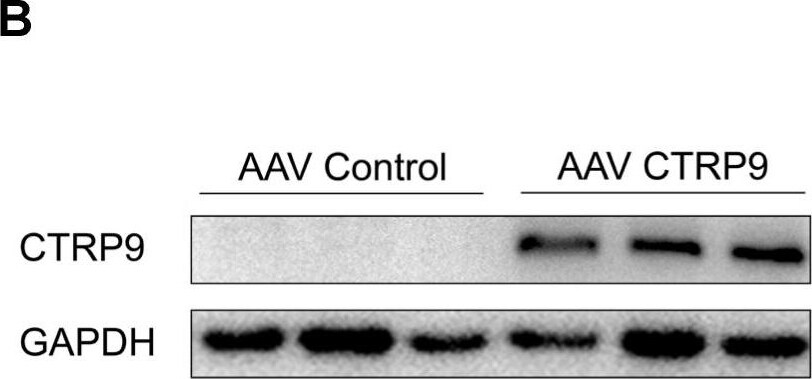
Detection of CTRP9/C1qTNF9 by Western Blot
Cardiac overexpression of CTRP9 leads to peripheral insulin resistance during administration of a high-fat diet (HFD). (A) Scheme showing the experimental timeline. (B) Immunoblotting for CTRP9 from cardiac protein lysate of mice treated either with AAV Luc (control, LUC) or AAV CTRP9 (CT9, leading to myocardial CTRP9 overexpression). (C) Body weight measured at 4, 8 and 12 weeks in the indicated mice after start of feeding. (D) Fasted serum glucose levels. (E) Glucose tolerance test in the indicated mice after 12 weeks of HFD. (F) Serum insulin levels. (G) HOMA-Index of insulin resistance. Data are shown as mean ± standard error of the mean (SEM). * p < 0.05, ** p < 0.01, *** p < 0.001, **** p < 0.0001. Image collected and cropped by CiteAb from the following open publication (https://pubmed.ncbi.nlm.nih.gov/36766785), licensed under a CC-BY license. Not internally tested by R&D Systems.Applications for Human CTRP9/C1qTNF9 Antibody (653533)
Western Blot
Sample: Recombinant human CTRP9/C1qTNF9
Formulation, Preparation, and Storage
Purification
Reconstitution
Sterile PBS to a final concentration of 0.5 mg/mL. For liquid material, refer to CoA for concentration.
Formulation
Shipping
Stability & Storage
- 12 months from date of receipt, -20 to -70 °C as supplied.
- 1 month, 2 to 8 °C under sterile conditions after reconstitution.
- 6 months, -20 to -70 °C under sterile conditions after reconstitution.
Calculators
Background: CTRP9/C1qTNF9
Long Name
Alternate Names
Gene Symbol
UniProt
Additional CTRP9/C1qTNF9 Products
Product Documents for Human CTRP9/C1qTNF9 Antibody (653533)
Certificate of Analysis
To download a Certificate of Analysis, please enter a lot or batch number in the search box below.
Note: Certificate of Analysis not available for kit components.
Product Specific Notices for Human CTRP9/C1qTNF9 Antibody (653533)
For research use only
Related Research Areas
Citations for Human CTRP9/C1qTNF9 Antibody (653533)
 Powered by Bioz
Customer Reviews for Human CTRP9/C1qTNF9 Antibody (653533)
There are currently no reviews for this product. Be the first to review Human CTRP9/C1qTNF9 Antibody (653533) and earn rewards!
Have you used Human CTRP9/C1qTNF9 Antibody (653533)?
Submit a review and receive an Amazon gift card!
$25/€18/£15/$25CAN/¥2500 for a review with an image
$10/€7/£6/$10CAN/¥1110 for a review without an image
Submit a review
Protocols
Find general support by application which include: protocols, troubleshooting, illustrated assays, videos and webinars.
- Cellular Response to Hypoxia Protocols
- R&D Systems Quality Control Western Blot Protocol
- Troubleshooting Guide: Western Blot Figures
- Western Blot Conditions
- Western Blot Protocol
- Western Blot Protocol for Cell Lysates
- Western Blot Troubleshooting
- Western Blot Troubleshooting Guide
- View all Protocols, Troubleshooting, Illustrated assays and Webinars