
Erythropoietin (EPO) a glycoprotein produced primarily by the kidney, is the principal factor that regulates erythropoiesis by stimulating the proliferation and differentiation of erythroid progenitor cells.
Best Seller
Human Erythropoietin/EPO Antibody (AE7A5)
R&D Systems | Catalog # MAB2871

Scientific images may be resized, cropped, or adjusted for brightness or contrast for presentation purposes. These updates are limited to presentation and do not affect the underlying scientific interpretation of the data. Where available, additional source data may be provided upon request.
Key Product Details
Species Reactivity
Validated:
Human
Cited:
Human, Mouse, Rat, Porcine, Avian - Chicken, Bovine, Camelid, Canine, Elephant, Equine, Feline, Hamster, Hamster - Cricetulus (Chinese Hamster), Insect - Drosophila, Plant - Nicotiana benthamiana, Primate - Pongo (Orangutan), Rhinoceros
Applications
Validated:
Western Blot, Immunoaffinity Purification
Cited:
Western Blot, ELISA Capture, Far Western Blot, Functional Assay
Label
Unconjugated
Antibody Source
Monoclonal Mouse IgG2A Clone # AE7A5
Loading...
Product Specifications
Immunogen
Erythropoietin/EPO synthetic peptide analog
Ala28-Thr53
Accession # P01588
Ala28-Thr53
Accession # P01588
Specificity
Recognizes an epitope within the first 26 amino acids at the NH
Clonality
Monoclonal
Host
Mouse
Isotype
IgG2A
Scientific Data Images for Human Erythropoietin/EPO Antibody (AE7A5)
Detection of Erythropoietin/EPO by Western Blot
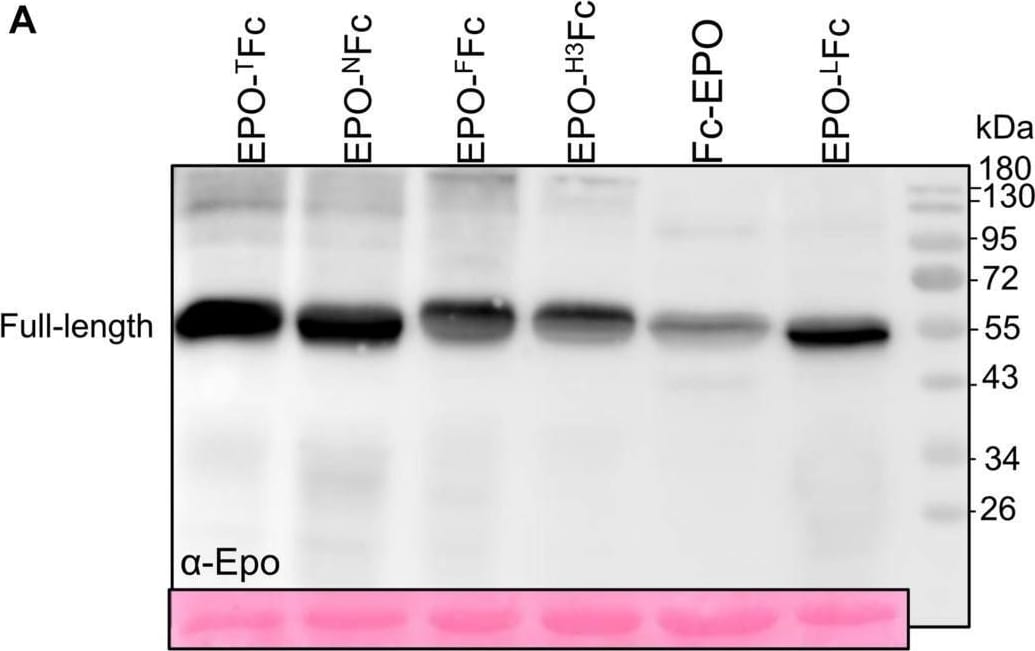
Analysis of the expression of EPO-IgG1 variants. Total soluble protein (TSP) extracts from N. benthamiana delta XTFT leaves expressing different EPO-Fc variants were analyzed by immunoblotting at 5 days post-infiltration (dpi) using (A) anti-EPO and (B) anti-hIgG antibodies. (C) EPO-Fc variants purified out of TSP with protein A were stained with Coomassie Brilliant Blue under reducing conditions (CBB). (D) Oligomerization of EPO-Fc variants was evaluated in 8% native PAGE of TSP non-reducing samples. Ponceau staining shows similar amounts of protein loaded. Protein size markers are shown in kilo Dalton (kDa). Image collected and cropped by CiteAb from the following open publication (https://pubmed.ncbi.nlm.nih.gov/34305971), licensed under a CC-BY license. Not internally tested by R&D Systems.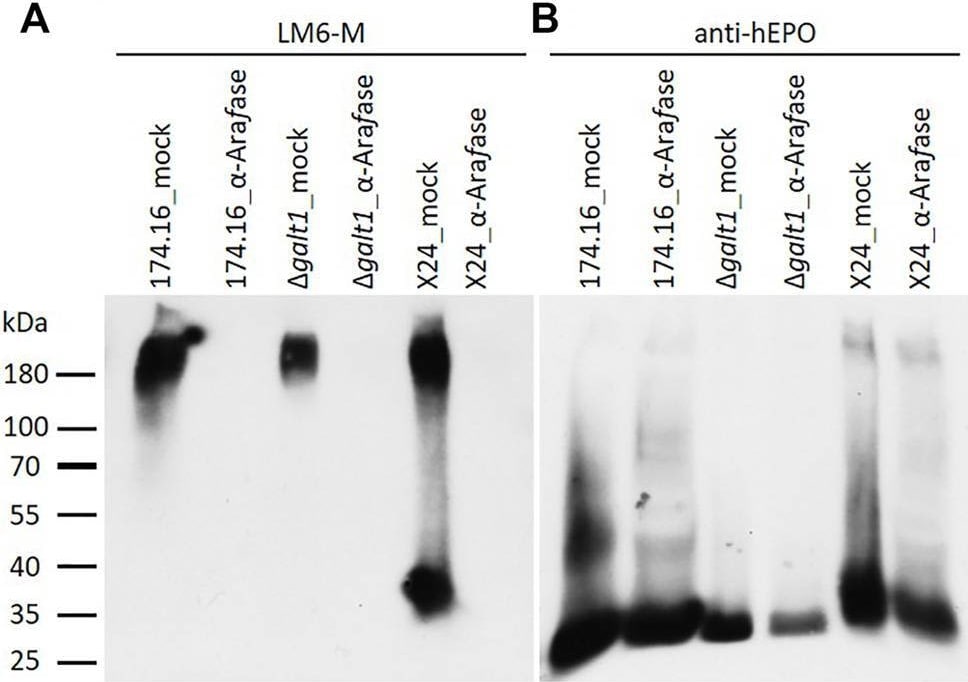
Detection of Erythropoietin/EPO by Western Blot
Western blots of mock-treated and alpha -L-arabinofuranosidase-digested samples from rhEPO-producing Physcomitrella lines. Ten microgram total protein of precipitated culture supernatants of the rhEPO-producing lines 174.16, delta galt1 and X24 were digested with one unit of alpha -L-arabinofuranosidase ( alpha -Arafase), while control samples were treated equivalently but without alpha -L-arabinofuranosidase (mock). After separation on SDS-PAGE and blotting, the PVDF-membrane was subsequently incubated with the anti-1,5-alpha -L-arabinan antibody (LM6-M, 1:10) (A) and an anti-hEPO monoclonal antibody (1:4,000) (B). Image collected and cropped by CiteAb from the following open publication (https://pubmed.ncbi.nlm.nih.gov/35252146), licensed under a CC-BY license. Not internally tested by R&D Systems.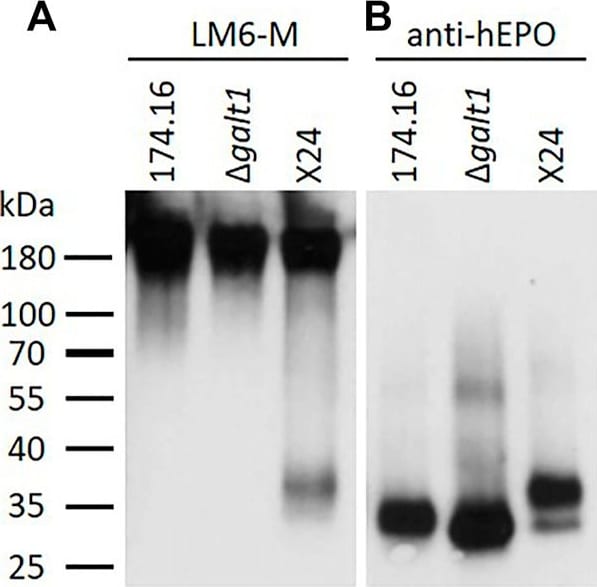
Detection of Erythropoietin/EPO by Western Blot
Western blots of precipitated culture supernatants of rhEPO-producing Physcomitrella lines. Five microgram total protein of the precipitated and blotted culture supernatants of the rhEPO-producing lines 174.16, delta galt1 and X24 were subsequently immunodetected with the anti-1,5-alpha -L-arabinan antibody (LM6-M, 1:10) (A) and the anti-hEPO monoclonal antibody (1:4,000) (B). Image collected and cropped by CiteAb from the following open publication (https://pubmed.ncbi.nlm.nih.gov/35252146), licensed under a CC-BY license. Not internally tested by R&D Systems.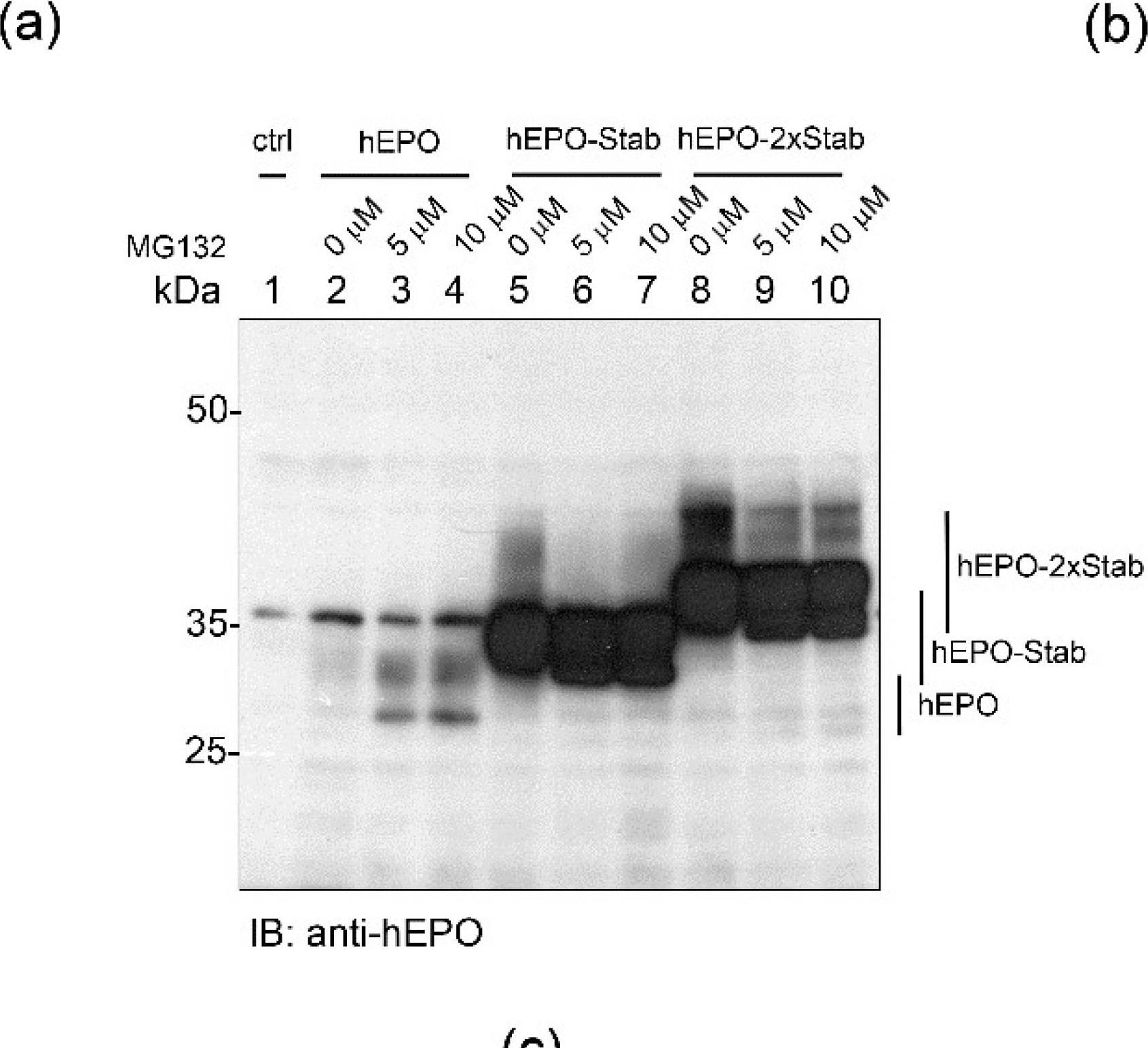
Detection of Erythropoietin/EPO by Western Blot
STABILON significantly boosts the intracellular and secreted levels of hEPO in mammalian cells. (a) Stably transfected CHO-K1 cells expressing hEPO (lane 2), hEPO-Stab (lane 3) or hEPO-2 × Stab (lane 4) proteins were induced by doxycycline treatment for 24 h. Lane 1 is the control nontransfected cell. Total cell extracts were fractionated on SDS-PAGE. Expression of hEPO derivatives (unmodified and glycosylated forms, Form I–III) was analyzed by immunoblotting using anti-hEPO monoclonal antibody. Coomassie-stained gel shows the protein loading (left panel). (b) 10 µL of cell culture medium of doxycycline-induced control (lane 1), hEPO (lane 2) or hEPO-Stab (lane 3) expressing stably transfected CHO-K1 cells were fractionated on SDS-PAGE. Secreted hEPO glycosylated species (Form III) were analyzed by immunoblotting. Coomassie-stained gel serves as loading control (left panel). Asterisk labels the extremely abundant serum albumin present in the medium. (c) Stable transfected CHO-K1 cells expressing hEPO, hEPO-Stab or hEPO-2 × Stab were induced with doxycycline treatment for 5 h, then continued for an additional 5 h in the presence of 0 μM (lanes 2, 5 and 8), 5 μM (lanes 3, 6 and 9) and 10 μM (lanes 4, 7 and 10) of MG132. Accumulation of hEPO derivatives was analyzed in total cell extracts by immunoblotting. Protein extracts of CHO-K1 cells served as control (lane 1). Image collected and cropped by CiteAb from the following open publication (https://pubmed.ncbi.nlm.nih.gov/35897744), licensed under a CC-BY license. Not internally tested by R&D Systems.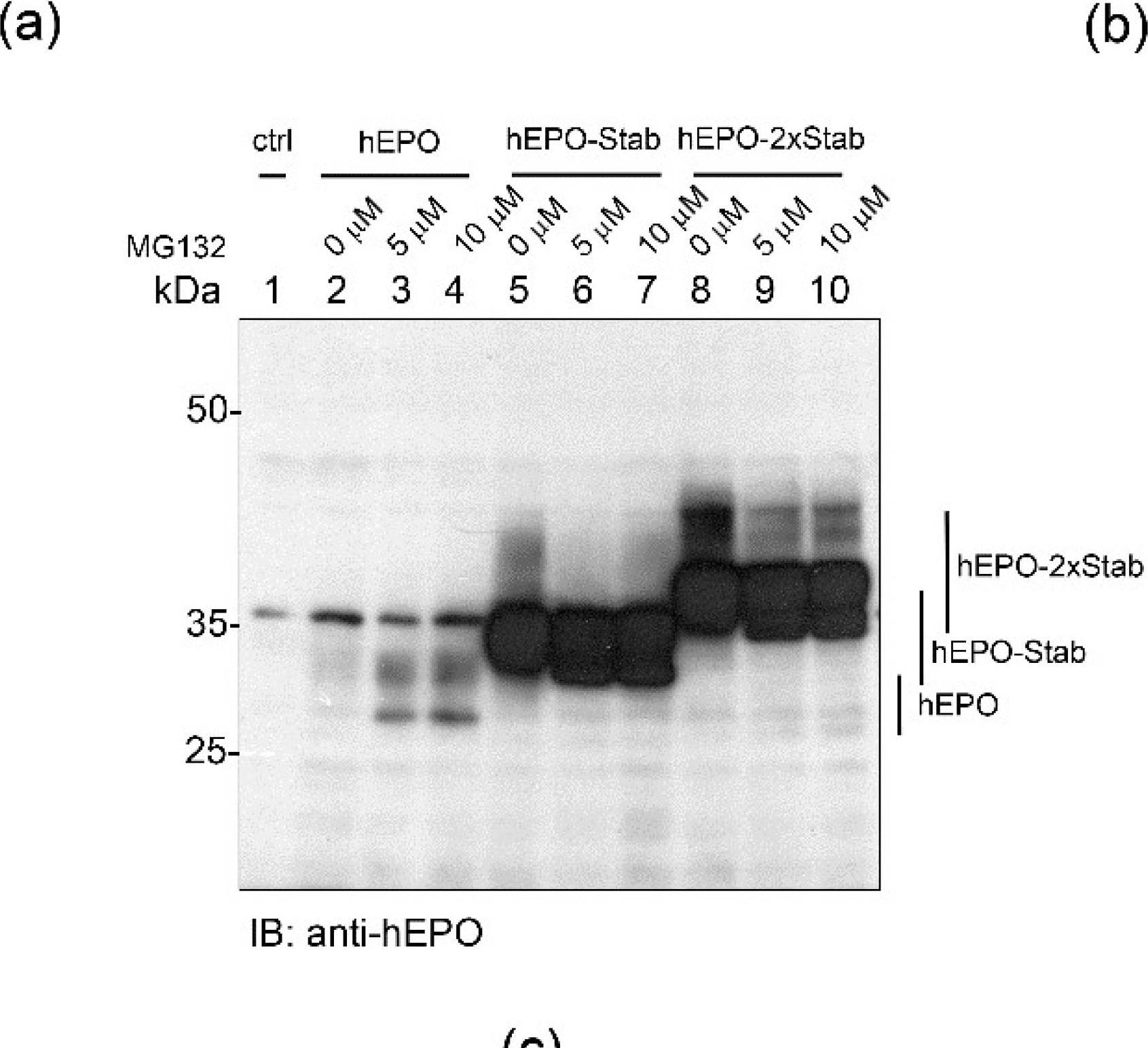
Detection of Erythropoietin/EPO by Western Blot
STABILON significantly boosts the intracellular and secreted levels of hEPO in mammalian cells. (a) Stably transfected CHO-K1 cells expressing hEPO (lane 2), hEPO-Stab (lane 3) or hEPO-2 × Stab (lane 4) proteins were induced by doxycycline treatment for 24 h. Lane 1 is the control nontransfected cell. Total cell extracts were fractionated on SDS-PAGE. Expression of hEPO derivatives (unmodified and glycosylated forms, Form I–III) was analyzed by immunoblotting using anti-hEPO monoclonal antibody. Coomassie-stained gel shows the protein loading (left panel). (b) 10 µL of cell culture medium of doxycycline-induced control (lane 1), hEPO (lane 2) or hEPO-Stab (lane 3) expressing stably transfected CHO-K1 cells were fractionated on SDS-PAGE. Secreted hEPO glycosylated species (Form III) were analyzed by immunoblotting. Coomassie-stained gel serves as loading control (left panel). Asterisk labels the extremely abundant serum albumin present in the medium. (c) Stable transfected CHO-K1 cells expressing hEPO, hEPO-Stab or hEPO-2 × Stab were induced with doxycycline treatment for 5 h, then continued for an additional 5 h in the presence of 0 μM (lanes 2, 5 and 8), 5 μM (lanes 3, 6 and 9) and 10 μM (lanes 4, 7 and 10) of MG132. Accumulation of hEPO derivatives was analyzed in total cell extracts by immunoblotting. Protein extracts of CHO-K1 cells served as control (lane 1). Image collected and cropped by CiteAb from the following open publication (https://pubmed.ncbi.nlm.nih.gov/35897744), licensed under a CC-BY license. Not internally tested by R&D Systems.
Detection of Erythropoietin/EPO by Western Blot
The effect of STABILON derivatives on the accumulation of hEPO in mammalian cells. (a) hEPO (lane 2), hEPO-StabDm1−15 (lane 3), hEPO-StabDm1−13 (lane 4), hEPO-StabDm1−10 (lane 5), hEPO-StabDm1−9 (lane 6), hEPO-StabDm1−8 (lane 7), hEPO-StabDm8−10 (lane 8), hEPO-StabDm8−11 (lane 9), hEPO-StabDm8−12 (lane 10), hEPO-StabDm1−7 (lane 11), hEPO-StabDm1−5 (lane 12), hEPO-StabDm1−3 (lane 13), hEPO-StabDm1−13-KR (lane 14), hEPO-StabDm1−13-KA (lane 15) and hEPO-StabDm1−13-DA (lane 16) transgenes in stably transfected CHO-K1 cells were induced by doxycycline-treatment for 24 h, respectively. The intracellular accumulation of hEPO derivatives was analyzed in total cell extracts by Western blotting using anti-hEPO monoclonal antibody. alpha Tubulin served as loading control. The lower diagram shows the amino acid positions and composition of the STABILON derivatives fused to hEPO. (b) hEPO (lane 2), hEPO-StabDm1-13 (lane 3) or hEPO-StabHs1–13 (lane 4) were expressed in stably transfected CHO-K1 cells by doxycycline-treatment for 24 h. Accumulation of hEPO derivatives was analyzed in total cell extracts by Western blotting using anti-hEPO monoclonal antibody. Protein extracts of CHO-K1 cells serve as control (lane 1). (c) Stably transfected CHO-K1 cells carrying the hEPO (lane 2), hEPO-StabDm1−13 (lane 3) and hEPO-StabHs1−13 (lane 4) genes were induced by doxycycline for 24 h. hEPO derivatives secreted into the tissue culture medium were analyzed by Western blotting with anti-hEPO monoclonal antibody. Tissue culture medium of CHO-K1 cells served as control (lane 1). Image collected and cropped by CiteAb from the following open publication (https://pubmed.ncbi.nlm.nih.gov/35897744), licensed under a CC-BY license. Not internally tested by R&D Systems.
Detection of Erythropoietin/EPO by Western Blot
The effect of STABILON derivatives on the accumulation of hEPO in mammalian cells. (a) hEPO (lane 2), hEPO-StabDm1−15 (lane 3), hEPO-StabDm1−13 (lane 4), hEPO-StabDm1−10 (lane 5), hEPO-StabDm1−9 (lane 6), hEPO-StabDm1−8 (lane 7), hEPO-StabDm8−10 (lane 8), hEPO-StabDm8−11 (lane 9), hEPO-StabDm8−12 (lane 10), hEPO-StabDm1−7 (lane 11), hEPO-StabDm1−5 (lane 12), hEPO-StabDm1−3 (lane 13), hEPO-StabDm1−13-KR (lane 14), hEPO-StabDm1−13-KA (lane 15) and hEPO-StabDm1−13-DA (lane 16) transgenes in stably transfected CHO-K1 cells were induced by doxycycline-treatment for 24 h, respectively. The intracellular accumulation of hEPO derivatives was analyzed in total cell extracts by Western blotting using anti-hEPO monoclonal antibody. alpha Tubulin served as loading control. The lower diagram shows the amino acid positions and composition of the STABILON derivatives fused to hEPO. (b) hEPO (lane 2), hEPO-StabDm1-13 (lane 3) or hEPO-StabHs1–13 (lane 4) were expressed in stably transfected CHO-K1 cells by doxycycline-treatment for 24 h. Accumulation of hEPO derivatives was analyzed in total cell extracts by Western blotting using anti-hEPO monoclonal antibody. Protein extracts of CHO-K1 cells serve as control (lane 1). (c) Stably transfected CHO-K1 cells carrying the hEPO (lane 2), hEPO-StabDm1−13 (lane 3) and hEPO-StabHs1−13 (lane 4) genes were induced by doxycycline for 24 h. hEPO derivatives secreted into the tissue culture medium were analyzed by Western blotting with anti-hEPO monoclonal antibody. Tissue culture medium of CHO-K1 cells served as control (lane 1). Image collected and cropped by CiteAb from the following open publication (https://pubmed.ncbi.nlm.nih.gov/35897744), licensed under a CC-BY license. Not internally tested by R&D Systems.Applications for Human Erythropoietin/EPO Antibody (AE7A5)
Application
Recommended Usage
Immunoaffinity Purification
This antibody can be used with optimal binding of human EPO at pH 7-9 (1-3).
Western Blot
1 µg/mL
Sample: Recombinant Human Erythropoietin/EPO (Ultrapure) (Catalog # 286-EP)
Sample: Recombinant Human Erythropoietin/EPO (Ultrapure) (Catalog # 286-EP)
Reviewed Applications
Read 1 review rated 5 using MAB2871 in the following applications:
Formulation, Preparation, and Storage
Purification
Protein A or G purified from hybridoma culture supernatant
Reconstitution
For liquid material, refer to CoA for concentration.
Formulation
Supplied as a 0.2 μm filtered solution in PBS. *Small pack size (SP) is supplied either lyophilized or as a 0.2 µm filtered solution in PBS.
Shipping
Lyophilized product is shipped at ambient temperature. Liquid small pack size (-SP) is shipped with polar packs. Upon receipt, store immediately at the temperature recommended below.
Stability & Storage
Use a manual defrost freezer and avoid repeated freeze-thaw cycles.
- 12 months from date of receipt, -20 to -70 °C, as supplied.
- 1 month, 2 to 8 °C under sterile conditions after opening.
- 6 months, -20 to -70 °C under sterile conditions after opening.
Calculators
Background: Erythropoietin/EPO
Alternate Names
ECYT5, EPO, MVCD2
Gene Symbol
EPO
UniProt
Additional Erythropoietin/EPO Products
Product Documents for Human Erythropoietin/EPO Antibody (AE7A5)
Certificate of Analysis
To download a Certificate of Analysis, please enter a lot or batch number in the search box below.
Note: Certificate of Analysis not available for kit components.
Product Specific Notices for Human Erythropoietin/EPO Antibody (AE7A5)
For research use only
Related Research Areas
Citations for Human Erythropoietin/EPO Antibody (AE7A5)
 Powered by Bioz
Customer Reviews for Human Erythropoietin/EPO Antibody (AE7A5) (1)
5 out of 5
1 Customer Rating
Have you used Human Erythropoietin/EPO Antibody (AE7A5)?
Submit a review and receive an Amazon gift card!
$25/€18/£15/$25CAN/¥2500 for a review with an image
$10/€7/£6/$10CAN/¥1110 for a review without an image
Submit a review
Showing
1
-
1 of
1 review
Showing All
Filter By:
-
Application: ImmunohistochemistrySample Tested: SerumSpecies: HumanVerified Customer | Posted 04/13/2018
There are no reviews that match your criteria.
Protocols
Find general support by application which include: protocols, troubleshooting, illustrated assays, videos and webinars.
- Cellular Response to Hypoxia Protocols
- R&D Systems Quality Control Western Blot Protocol
- Troubleshooting Guide: Western Blot Figures
- Western Blot Conditions
- Western Blot Protocol
- Western Blot Protocol for Cell Lysates
- Western Blot Troubleshooting
- Western Blot Troubleshooting Guide
- View all Protocols, Troubleshooting, Illustrated assays and Webinars
Loading...
Associated Pathways

