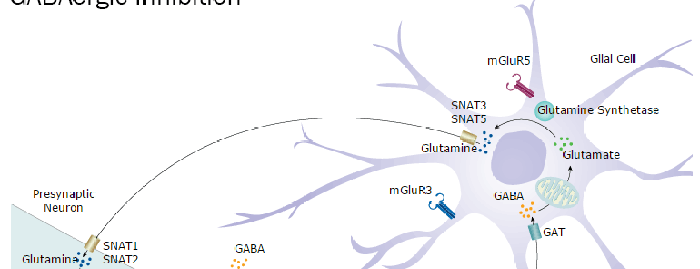
GABAA R beta 3 (GABA-A receptor subunit beta 3; also GABR3) is a 53-58 kDa member of the ligand-gated ion channel family of proteins. It is generally one of three beta-type subunits that contribute to a GABA-binding pentameric, postsynaptic chloride ion channel on neurons. Alternatively, it can apparently form a homopentameric channel that does not respond to GABA. Mature human GABAA R beta 3 is 448 amino acids (aa) in length. It is a 4-transmembrane glycoprotein that contains an extended N-terminal extracellular region (aa 26-245) and a long cytoplasmic loop between aa 328-450. There are potential splice variants. One shows an alternate start site at Met65, while others contain either a 48 aa substitution for aa 1-228, a nine aa substitution for aa 1-80, or a 26 aa substitution for aa 1-26. Over aa 26-245, human and mouse GABAA R beta 3 are absolutely identical in aa sequence.


Discontinued Product
AF5590 has been discontinued.
View all GABA-A R beta 3 products.
Key Product Details
Species Reactivity
Human
Applications
Immunohistochemistry, Western Blot, Simple Western
Label
Unconjugated
Antibody Source
Polyclonal Sheep IgG
Loading...
Product Specifications
Immunogen
E. coli-derived recombinant human GABAA R beta 3
Gln26-Tyr245
Accession # P28472
Gln26-Tyr245
Accession # P28472
Specificity
Detects human GABAA R beta 3 in direct ELISAs and Western blots. In direct ELISAs, less than 1% cross‑reactivity with recombinant rat GABAB R2 is observed.
Clonality
Polyclonal
Host
Sheep
Isotype
IgG
Scientific Data Images for Human GABA-A R beta 3 Antibody
Detection of Human GABAAR beta 3 by Western Blot.
Western blot shows lysates of human brain (cerebellum) tissue. PVDF membrane was probed with 1 µg/mL of Sheep Anti-Human GABAAR beta 3 Antigen Affinity-purified Polyclonal Antibody (Catalog # AF5590) followed by HRP-conjugated Anti-Sheep IgG Secondary Antibody (Catalog # HAF016). A specific band was detected for GABAAR beta 3 at approximately 54 kDa (as indicated). This experiment was conducted under reducing conditions and using Immunoblot Buffer Group 8.
GABAAR beta 3 in Human Brain.
GABAAR beta 3 was detected in immersion fixed paraffin-embedded sections of human brain using Sheep Anti-Human GABAAR beta 3 Antigen Affinity-purified Polyclonal Antibody (Catalog # AF5590) at 5 µg/mL overnight at 4 °C. Tissue was stained using the Anti-Sheep HRP-DAB Cell & Tissue Staining Kit (brown; Catalog # CTS019) and counterstained with hematoxylin (blue). Specific staining was localized to neurons. View our protocol for Chromogenic IHC Staining of Paraffin-embedded Tissue Sections.
Detection of Human GABAAR beta 3 by Simple WesternTM.
Simple Western lane view shows lysates of human brain cerebellum tissue, loaded at 0.2 mg/mL. A specific band was detected for GABAAR beta 3 at approximately 78 kDa (as indicated) using 10 µg/mL of Sheep Anti-Human GABAAR beta 3 Antigen Affinity-purified Polyclonal Antibody (Catalog # AF5590) followed by 1:50 dilution of HRP-conjugated Anti-Sheep IgG Secondary Antibody (Catalog # HAF016). This experiment was conducted under reducing conditions and using the 12-230 kDa separation system.Applications for Human GABA-A R beta 3 Antibody
Application
Recommended Usage
Immunohistochemistry
5-15 µg/mL
Sample: Immersion fixed paraffin-embedded sections of human brain
Sample: Immersion fixed paraffin-embedded sections of human brain
Simple Western
10 µg/mL
Sample: Human brain cerebellum tissue
Sample: Human brain cerebellum tissue
Western Blot
1 µg/mL
Sample: Human brain cerebellum tissue
Sample: Human brain cerebellum tissue
Formulation, Preparation, and Storage
Purification
Antigen Affinity-purified
Reconstitution
Reconstitute at 0.2 mg/mL in sterile PBS. For liquid material, refer to CoA for concentration.
Formulation
Lyophilized from a 0.2 μm filtered solution in PBS with Trehalose. *Small pack size (SP) is supplied either lyophilized or as a 0.2 µm filtered solution in PBS.
Shipping
Lyophilized product is shipped at ambient temperature. Liquid small pack size (-SP) is shipped with polar packs. Upon receipt, store immediately at the temperature recommended below.
Stability & Storage
Use a manual defrost freezer and avoid repeated freeze-thaw cycles.
- 12 months from date of receipt, -20 to -70 °C as supplied.
- 1 month, 2 to 8 °C under sterile conditions after reconstitution.
- 6 months, -20 to -70 °C under sterile conditions after reconstitution.
Calculators
Background: GABA-A R beta 3
Long Name
gamma-Aminobutyric Acid Type A Receptor, beta-3 Polypeptide
Alternate Names
GABAAR beta 3, GABAARb3, GABRB3
Gene Symbol
GABRB3
UniProt
Additional GABA-A R beta 3 Products
Product Documents for Human GABA-A R beta 3 Antibody
Certificate of Analysis
To download a Certificate of Analysis, please enter a lot or batch number in the search box below.
Note: Certificate of Analysis not available for kit components.
Product Specific Notices for Human GABA-A R beta 3 Antibody
For research use only
Related Research Areas
Customer Reviews for Human GABA-A R beta 3 Antibody
There are currently no reviews for this product. Be the first to review Human GABA-A R beta 3 Antibody and earn rewards!
Have you used Human GABA-A R beta 3 Antibody?
Submit a review and receive an Amazon gift card!
$25/€18/£15/$25CAN/¥2500 Yen for a review with an image
$10/€7/£6/$10CAN/¥1110 Yen for a review without an image
Submit a review
Protocols
Find general support by application which include: protocols, troubleshooting, illustrated assays, videos and webinars.
- Antigen Retrieval Protocol (PIER)
- Antigen Retrieval for Frozen Sections Protocol
- Appropriate Fixation of IHC/ICC Samples
- Cellular Response to Hypoxia Protocols
- Chromogenic IHC Staining of Formalin-Fixed Paraffin-Embedded (FFPE) Tissue Protocol
- Chromogenic Immunohistochemistry Staining of Frozen Tissue
- ClariTSA™ Fluorophore Kits
- Detection & Visualization of Antibody Binding
- Fluorescent IHC Staining of Frozen Tissue Protocol
- Graphic Protocol for Heat-induced Epitope Retrieval
- Graphic Protocol for the Preparation and Fluorescent IHC Staining of Frozen Tissue Sections
- Graphic Protocol for the Preparation and Fluorescent IHC Staining of Paraffin-embedded Tissue Sections
- Graphic Protocol for the Preparation of Gelatin-coated Slides for Histological Tissue Sections
- IHC Sample Preparation (Frozen sections vs Paraffin)
- Immunofluorescent IHC Staining of Formalin-Fixed Paraffin-Embedded (FFPE) Tissue Protocol
- Immunohistochemistry (IHC) and Immunocytochemistry (ICC) Protocols
- Immunohistochemistry Frozen Troubleshooting
- Immunohistochemistry Paraffin Troubleshooting
- Preparing Samples for IHC/ICC Experiments
- Preventing Non-Specific Staining (Non-Specific Binding)
- Primary Antibody Selection & Optimization
- Protocol for Heat-Induced Epitope Retrieval (HIER)
- Protocol for Making a 4% Formaldehyde Solution in PBS
- Protocol for VisUCyte™ HRP Polymer Detection Reagent
- Protocol for the Preparation & Fixation of Cells on Coverslips
- Protocol for the Preparation and Chromogenic IHC Staining of Frozen Tissue Sections
- Protocol for the Preparation and Chromogenic IHC Staining of Frozen Tissue Sections - Graphic
- Protocol for the Preparation and Chromogenic IHC Staining of Paraffin-embedded Tissue Sections
- Protocol for the Preparation and Chromogenic IHC Staining of Paraffin-embedded Tissue Sections - Graphic
- Protocol for the Preparation and Fluorescent IHC Staining of Frozen Tissue Sections
- Protocol for the Preparation and Fluorescent IHC Staining of Paraffin-embedded Tissue Sections
- Protocol for the Preparation of Gelatin-coated Slides for Histological Tissue Sections
- R&D Systems Quality Control Western Blot Protocol
- TUNEL and Active Caspase-3 Detection by IHC/ICC Protocol
- The Importance of IHC/ICC Controls
- Troubleshooting Guide: Immunohistochemistry
- Troubleshooting Guide: Western Blot Figures
- Western Blot Conditions
- Western Blot Protocol
- Western Blot Protocol for Cell Lysates
- Western Blot Troubleshooting
- Western Blot Troubleshooting Guide
- View all Protocols, Troubleshooting, Illustrated assays and Webinars
Loading...
Associated Pathways